

Smallcap stocks are back in focus after retail investors increased their holdings across hundreds of companies during the June 2026 quarter. Some of these stocks subsequently delivered sharp gains, with three more than doubling in less than three months.
According to an Economic Times analysis based on ACE Equity data, retail investors increased their stakes in nearly 766 BSE small-cap stocks during the June 2026 quarter compared with the previous quarter. Among companies where retail ownership increased, around 25 stocks subsequently gained more than 50% in less than three months. Ten stocks recorded gains of approximately 80% to 200%, while three delivered returns exceeding 100%.
The numbers are striking, but they also raise an important question: Should investors chase small-cap stocks after such a sharp rally, or should fundamentals, valuations and risk take priority?
Let us look at what happened and what investors should understand before making an investment decision.
Why Are Small-Cap Stocks in Focus in 2026?
Retail participation remains an important force in the Indian equity market. Small- and mid-cap mutual funds have also continued attracting investor money despite concerns around volatility and valuations.
In July 2026, small-cap mutual funds reportedly received ₹7,767.50 crore of inflows, while mid-cap funds attracted ₹6,192.31 crore. At the same time, market experts have cautioned that valuations across parts of the small- and mid-cap universe remain elevated.
This creates an interesting market environment.
Strong earnings growth, improving business prospects or structural sector opportunities can support smaller companies. But a rising share price by itself does not necessarily mean the underlying business has improved by the same magnitude.
For investors exploring small cap stocks in India, the distinction between price momentum and fundamental improvement becomes especially important.
10 Small-Cap Stocks Where Retail Stakes Increased
The analysis highlighted the following stocks that saw an increase in retail ownership during the June 2026 quarter and subsequently recorded strong price performance:
| Company | Retail Holding Mar 2026 | Retail Holding Jun 2026 | Price Move* |
|---|---|---|---|
| Kabra Extrusiontechnik | 19.05% | 19.19% | 198% |
| Indo Rama Synthetics (India) | 4.61% | 4.66% | 129% |
| PVP Ventures | 9.67% | 9.83% | 121% |
| Ind-Swift Laboratories | 13.07% | 13.75% | 97% |
| Shukra Pharmaceuticals | 6.61% | 6.88% | 94% |
| STL Networks | 29.30% | 30.12% | 93% |
| GMM Pfaudler | 21.14% | 22.60% | 87% |
| Spectrum Electrical Industries | 5.37% | 6.24% | 80% |
| Anlon Healthcare | 8.95% | 11.69% | 80% |
| Ratnaveer Precision Engineering | 23.42% | 25.22% | 80% |
1. Kabra Extrusiontechnik


Kabra Extrusiontechnik recorded the biggest price move among the stocks highlighted. Its share price increased from around ₹270 to ₹806 in less than three months, representing a gain of approximately 198%.
Retail shareholding, however, increased only marginally, from 19.05% in March 2026 to 19.19% in June 2026.
That difference is worth noticing. A relatively small change in retail ownership was followed by a very large stock-price movement, illustrating why investors should not use shareholding changes alone to explain a rally. Investors evaluating the stock should study revenue growth, profitability, operating margins, business developments, valuations and whether earnings can support the sharp rerating.
2. Indo Rama Synthetics

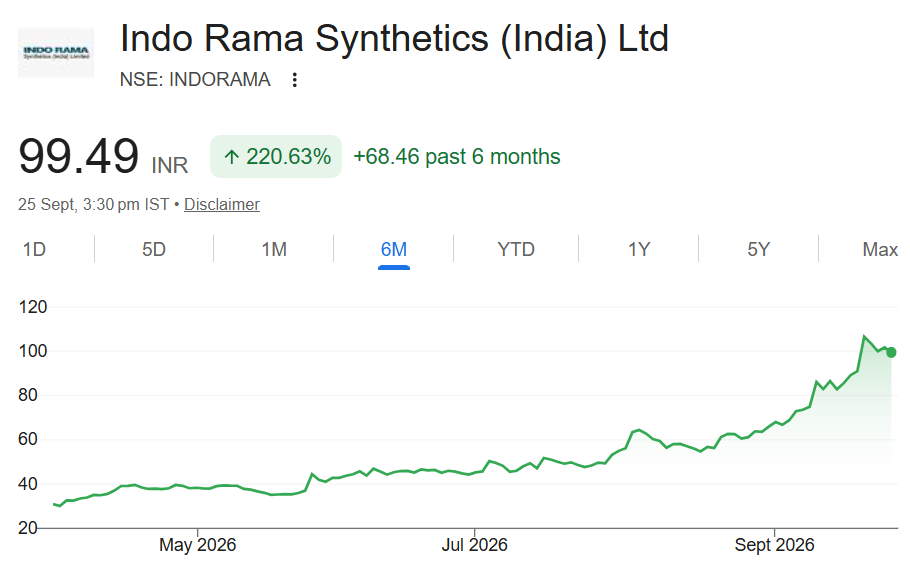
Indo Rama Synthetics rose from approximately ₹45 to ₹102, delivering a gain of around 129% during the period under consideration.
Retail ownership increased from 4.61% to 4.66%. There has also been improvement in profitability. For the June 2026 quarter, Indo Rama reported net profit of around ₹63.74 crore, while revenue stood at ₹936.64 crore. Revenue was lower year-on-year, highlighting why headline profit growth should be studied alongside sales, margins and sustainability of earnings.
The broader lesson for investors is simple: a multibagger return over a few months does not automatically turn a stock into a long-term investment opportunity.
3. PVP Ventures –

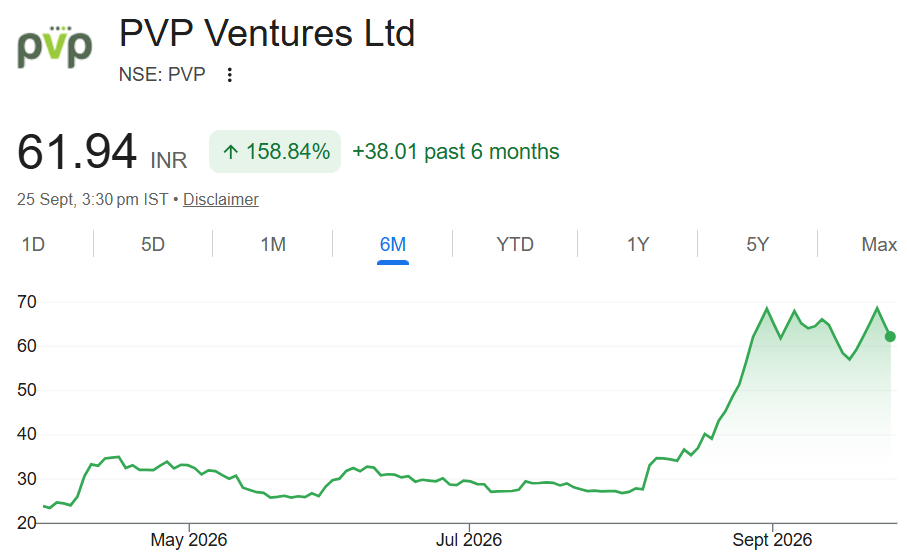
PVP Ventures was the third stock in the group to more than double, rising from around ₹30 to ₹65.
Retail shareholding increased from 9.67% to 9.83%. For Q1 FY27, the company reported revenue of approximately ₹45.64 crore and net profit of around ₹11.06 crore.
When analysing stocks that have already risen sharply, investors should determine whether earnings growth, cash flows and the underlying business outlook justify the new valuation rather than focusing exclusively on historical returns.
4. Ind-Swift Laboratories

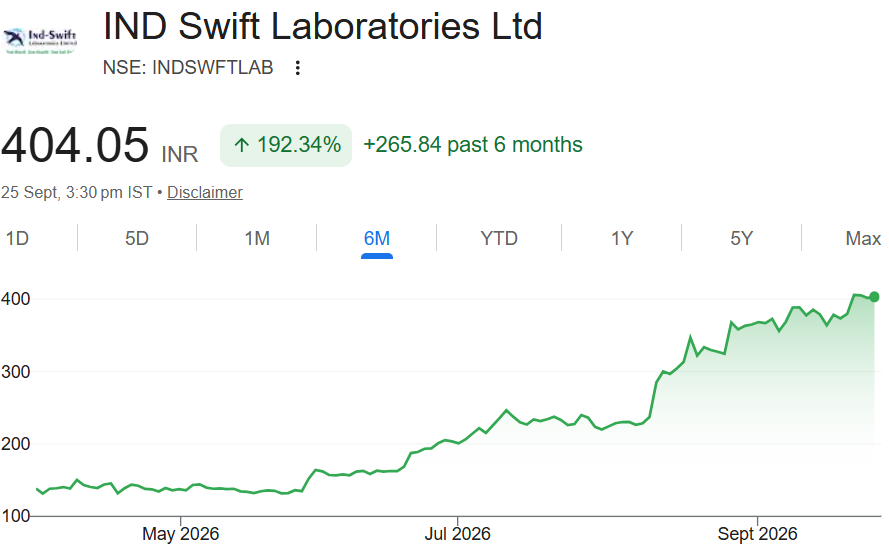
Ind-Swift Laboratories rose from approximately ₹203 to ₹401, representing a gain of about 97%.
Retail ownership increased more visibly, from 13.07% to 13.75%. The company also reported improving Q1 FY27 financials. Revenue from operations rose about 21% year-on-year to ₹186.08 crore, while net profit increased to approximately ₹24.44 crore.
Improving earnings can provide fundamental support to a stock, but investors still need to compare growth with valuation, debt, cash flows and future earnings visibility before making a decision.
5. Shukra Pharmaceuticals


Shukra Pharmaceuticals moved from around ₹29 to ₹56, translating into a gain of approximately 94%.
Retail shareholding increased from 6.61% to 6.88%. For smaller pharmaceutical companies, investors should look beyond price momentum and examine revenue concentration, regulatory compliance, manufacturing capacity, margins, balance-sheet strength and consistency of earnings.
These factors can become especially important after a sharp rerating.
6. STL Networks


STL Networks climbed from approximately ₹27 to ₹52, gaining around 93%.
Retail ownership increased from 29.30% to 30.12%. However, the company’s latest financial numbers illustrate why price performance and business performance should be evaluated separately. Q1 FY27 revenue stood at around ₹176.15 crore, down year-on-year, while the company reported a net loss of approximately ₹21.88 crore.
A stock can rally even while some financial metrics remain weak. That is precisely why investors should investigate what expectations are already reflected in its valuation.
7. GMM Pfaudler


GMM Pfaudler rose from around ₹789 to ₹1,478, delivering approximately 87% during the period.
Retail shareholding increased from 21.14% to 22.60%. Its Q1 FY27 results showed consolidated revenue of approximately ₹924.76 crore, up around 16% year-on-year. Net profit also improved significantly to around ₹22 crore.
GMM Pfaudler operates in engineered equipment and systems used across industries including chemicals and pharmaceuticals. Investors should monitor order visibility, margins, debt, execution and valuation when assessing whether recent momentum can translate into sustainable long-term performance.
8. Spectrum Electrical Industries

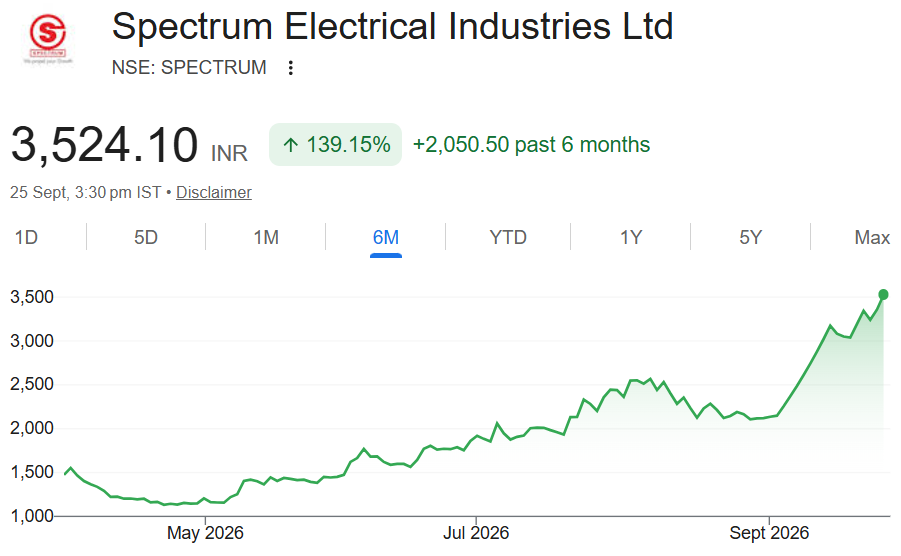
Spectrum Electrical Industries increased from around ₹1,855 to ₹3,345, delivering an approximately 80% gain.
Retail ownership rose from 5.37% to 6.24%. The company’s Q4 FY26 revenue stood at approximately ₹282.95 crore, up about 68% year-on-year, while net profit reached around ₹26.46 crore.
Strong earnings growth can attract investor attention, but after a significant stock-price increase, the key question becomes whether future earnings can continue growing fast enough to justify the valuation.
9. Anlon Healthcare


Anlon Healthcare moved from around ₹16 to ₹29, translating into approximately 80% returns.
Retail shareholding increased substantially from 8.95% to 11.69%. The company reported Q1 FY27 revenue of approximately ₹87.56 crore, while net profit stood at around ₹8.28 crore.
For relatively small companies, investors should pay particular attention to liquidity, promoter holdings, business concentration, cash flows and the consistency of quarterly performance.
10. Ratnaveer Precision Engineering

Ratnaveer Precision Engineering rose from approximately ₹180 to ₹324, delivering an approximately 80% gain.
Retail shareholding increased from 23.42% to 25.22%. For Q1 FY27, total income stood at approximately ₹318.43 crore, representing sequential growth over the March quarter. Investors researching the company should evaluate demand visibility, margins, capacity utilisation, working capital, debt and whether recent growth can be sustained.
What Does Rising Retail Shareholding Actually Tell Investors?
An increase in retail ownership can indicate growing investor interest, but it should not be treated as a buy signal. Retail shareholding is backward-looking information. By the time quarterly shareholding data becomes available, the market price may already have changed significantly.
It is also important to distinguish between:
- Retail participation – more individual investors owning the stock.
- Fundamental growth – improvement in revenue, profits, cash flows and return ratios.
- Valuation expansion – investors becoming willing to pay a higher multiple for the same earnings.
- Momentum – the stock continuing to rise because of market demand and sentiment.
That is why investors using stock market ai or traditional research should analyse multiple variables rather than interpreting increasing retail ownership as confirmation of future returns.
Should You Buy These Small-Cap Stocks After the Rally?
The better question is not whether these stocks have generated multibagger returns. That has already happened. The relevant question for a new investor is:
What return potential remains at today’s valuation relative to the risk being taken?
Before buying a small-cap stock after a sharp rally, investors can examine:
- Revenue and earnings growth: Is the business actually growing?
- Cash flow: Are reported profits converting into operating cash?
- Debt: Is growth being financed sustainably?
- Valuation: Has the share price risen much faster than earnings?
- Promoter holding: Are promoters increasing or reducing exposure?
- Institutional ownership: Are mutual funds, FIIs or other institutions participating?
- Liquidity: Can investors enter and exit without significant price impact?
- Corporate governance: Are disclosures, related-party transactions and capital allocation satisfactory?
- Competitive advantage: Does the company have something that can sustain growth?
- Risk-reward: How much downside exists if market expectations are not met?
This becomes especially important because parts of India’s small- and mid-cap market continue to trade at premium valuations.
Why Small-Cap Investing Needs More Than Looking for Multibaggers
Stories about stocks rising 100%, 200% or more naturally attract attention.
But past multibagger performance is one of the easiest ways for investors to fall into recency bias, assuming that what has performed exceptionally well recently will continue doing so. Small-cap companies can offer meaningful long-term growth opportunities because they often operate from smaller revenue bases and may have more room to scale.
The same characteristics can also create additional risks. Smaller businesses may have lower liquidity, narrower product portfolios, higher customer concentration, less predictable earnings and greater sensitivity to economic cycles.
SEBI-related investment disclosures consistently highlight market, volatility and liquidity risks associated with equity investments. Small-cap-oriented products can fall into very-high-risk categories. Therefore, identifying a fast-rising stock is only the beginning of the investment process.
How Can AI Help Analyse Small-Cap Stocks?
The Indian equity market contains thousands of listed companies. Manually tracking financial statements, valuations, technical indicators, market sentiment and risk factors across such a large universe can be difficult for an individual investor. This is where stocks ai systems can potentially support the research process.
An AI-based framework can process multiple financial and market variables simultaneously and continuously reassess companies as new information becomes available.
For investors researching ai-based stock trading india, however, technology should not be confused with guaranteed returns. AI is a research and decision-support mechanism; stock-market investments remain subject to market risk.
What Should Investors Take Away From This Small-Cap Rally?
Seeing a stock rise 80%, 100% or even 198% in a few months naturally gets attention. But once that rally has already happened, looking at the return number alone does not tell you whether the stock is still attractive at its current price.
The interesting part of this data is that retail investors had increased their holdings in these companies before the sharp price moves. However, that does not mean higher retail participation caused the rally or that following retail shareholding data can help investors find the next multibagger. In several cases, the increase in retail holding itself was quite small.
What matters now is what has changed inside the business. Are sales and profits improving? Is the company reducing debt? Are margins getting stronger? Does it have enough room to grow over the next few years? And importantly, after such a steep rise in the share price, does the current valuation still make sense?
These questions become even more important with small-cap stocks because prices can move much faster than the underlying business. A good company bought at an expensive valuation can still disappoint, while a stock that has already doubled can continue performing if earnings eventually justify the higher price.
For investors exploring ai-based stock trading india, the real advantage of technology is not predicting which stock will suddenly become the next multibagger stocks. It is being able to study a much larger universe of companies and filter opportunities using more than just price momentum.
Jarvis Invest, a SEBI Registered Investment Advisor, follows this broader approach by using AI-led analysis to evaluate stocks while also considering the investor’s risk profile and portfolio exposure. Rather than picking a stock simply because it is trending, the focus is on whether it deserves a place in the portfolio at its current price.


Conclusion
The biggest headline from this list is undoubtedly the returns. Kabra Extrusiontechnik gained nearly 198%, while Indo Rama Synthetics and PVP Ventures more than doubled. Several other stocks came close to delivering 100% returns in less than three months.
But there is another side to these numbers.
An investor discovering these stocks today is looking at them after much of that rally has already taken place. The decision now is very different from the decision someone made three months ago. That makes the next set of quarterly results, earnings growth, valuations and business developments far more useful than simply looking at how much these stocks have already risen.
Retail shareholding data can tell us where investor interest has increased. It cannot tell us which stock will become the next multibagger.
For investors trying to find opportunities from thousands of listed companies, stocks ai and fundamental research can help narrow that universe. But whether a stock deserves your money ultimately comes down to the business behind it, the price you are paying and the risk you are taking.