
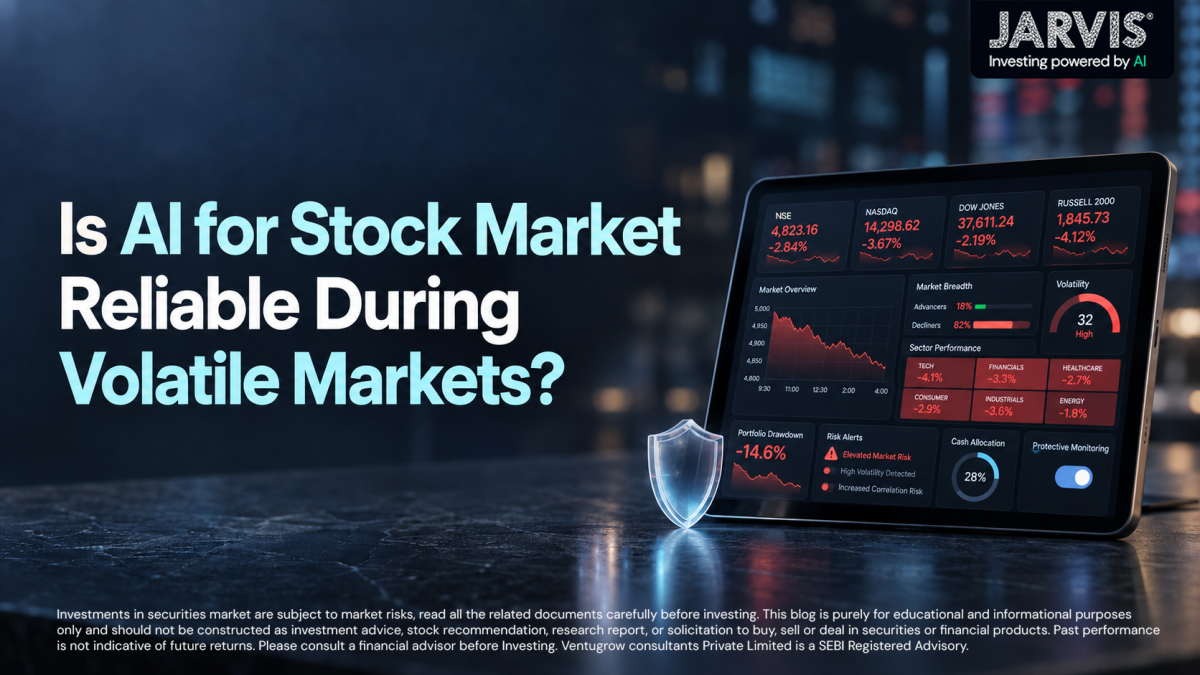
When the market is calm, almost every strategy looks intelligent. The real test begins when Nifty starts swinging, volatility spikes, stocks fall sharply and headlines change by the hour. That is when investors exploring AI for stock market investing start asking a more important question:
Can AI still be trusted when the stock market gets chaotic?
The short answer is – AI can be useful during volatile markets, but it is not a crystal ball. In fact, volatility is where AI for investment can become particularly valuable because the amount of information hitting the market increases dramatically. But the same environment can also expose weaknesses in an AI model.
Why Volatility Is a Different Game
Volatility means prices are moving faster and by larger amounts. The NSE’s India VIX measures the market’s expectation of near-term volatility based on NIFTY options trading prices and reflects expected fluctuations over the next 30 calendar days. During such periods, investors are not dealing with fundamentals alone.
A geopolitical headline can move an index. A currency move can affect IT stocks. Crude oil can influence inflation expectations. A central-bank decision can change valuations across sectors. Suddenly, yesterday’s market assumptions may not work today. This is precisely where stock market AI has an interesting role to play.
AI’s Biggest Advantage – It Doesn’t Panic
Humans see a 5% market fall and immediately start asking: “Should I sell?” An AI system does not experience fear or euphoria.
It can continue processing price movements, trading volumes, fundamentals, sentiment, news and other market signals according to its programmed framework. That makes AI stock analysis useful when markets become information-heavy. Instead of reacting to the loudest headline, an AI model can examine whether the underlying signals have actually changed.
AI Can Track Volatility Before It Becomes a Portfolio Problem
Volatility is not only about a stock falling. It can affect concentration, momentum, sector exposure, correlations and portfolio risk. This is where AI tools for stock analysis can go beyond simply identifying stocks.
A sophisticated system can continuously monitor changing market conditions and flag situations where the risk profile of a portfolio is changing. For an investor, this creates an important distinction: AI does not have to predict the crash to be useful. It can help recognise that the risk environment has changed.
Where Jarvis Fits In
This is central to the Jarvis approach to AI-Powered investing. Jarvis Invest combines multiple layers of market information rather than depending on one indicator. Its framework incorporates areas such as fundamentals, price and volume behaviour, market events, macroeconomic factors, news and sentiment.
Its portfolio-protection approach also focuses on monitoring changing risk conditions rather than treating stock selection as a one-time decision. That matters during volatile markets.
Because a stock that looked attractive three months ago may have a completely different risk profile today. For investors searching for an AI stock recommendation, AI for stock selection or an AI investing platform, the bigger question should therefore be:
How does the system behave after the recommendation is made?
But AI Has a Volatility Problem Too Here is the part that often gets ignored. AI is not automatically more reliable simply because markets become more volatile. Extreme events can produce patterns that a model has rarely encountered. Sudden policy changes, unexpected geopolitical events, liquidity shocks or unprecedented market behaviour can make historical relationships less useful.
SEBI has specifically highlighted that AI/ML can improve efficiency in securities markets while also creating or amplifying risks, which is why responsible use, governance and risk management matter. In other words: Garbage data in. Overconfident signal out. The quality of the data, model design, validation and monitoring matters just as much as the AI itself.
AI Stock Prediction Is Not the Same as Prediction
This is perhaps the biggest misconception surrounding AI stock prediction India. AI does not know that NIFTY will fall tomorrow. It can identify patterns, probabilities and changing signals based on available information.
That distinction becomes even more important during volatile markets. A model may identify rising downside risk without knowing exactly when the market will reverse. It may identify weakening momentum without knowing whether the next move will be a 3% decline or a 10% correction.


So, Is AI Reliable During Volatile Markets?
The answer depends on what you expect from it. If you expect an AI stock picker to predict every market crash, the answer is no.
If you expect AI to process thousands of signals, monitor changing market conditions, identify patterns, assess risk and make research more systematic, its usefulness can increase considerably during periods of volatility. SEBI’s framework also recognises AI/ML applications across areas including advisory, risk management, surveillance and pattern recognition, while emphasising responsible usage. And that is where platforms such as Jarvis position AI, not as a replacement for judgement, but as a way to bring more data and structured analysis into the investment process.
Final Thoughts
Volatile markets are where investors discover the difference between having more information and having better information. AI cannot eliminate uncertainty. It cannot predict every black-swan event. And it certainly cannot guarantee profits.
But a well-designed AI for stock market system can continuously analyse signals that are difficult for an individual investor to track manually. The real advantage of AI may therefore not be predicting the next market crash. It may be helping investors make fewer emotional decisions when the market is already doing enough of them.
If you’re looking for an AI app for stock market investing, it may be worth looking beyond stock recommendations alone. During volatile markets, the ability to monitor portfolio risk, changing market conditions and individual stock signals can be just as important as finding the stocks to invest in.
An AI-driven approach that keeps tracking the portfolio after you invest can help you stay aware of changing risks and make more informed investment decisions.