
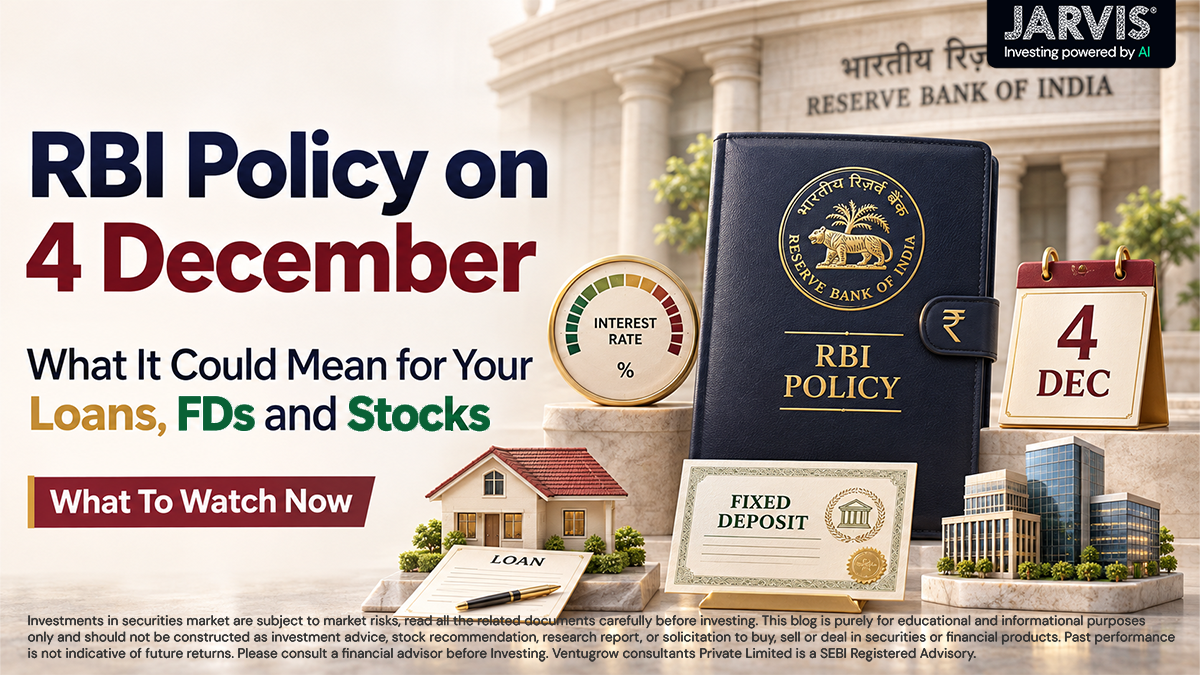
The RBI Policy decision on 4 December could affect your home loan EMI. At its previous meeting on 7 October, the RBI surprised borrowers by raising the repo rate by 25 basis points, from 5.25% to 5.50%. It was the first rate hike since February 2023, and all six members of the Monetary Policy Committee voted in favour.
Additionally, the RBI shifted into a ‘calibrated tightening’ mode meaning there may be further increases in rates. Many economists are predicting the rates will rise. Here is why, and how it may affect you:
What is the repo rate is the rate at which banks can borrow money from the RBI. Increasing the repo rate means that loans become more expensive, whereas decreasing it makes them cheaper.
What is the repo rate?
The repo rate is the interest rate at which banks borrow money from the RBI. If the repo rate goes up, loans get costlier for you. If it goes down, loans get cheaper.
Why may rates be increased?
In one word: inflation.
In October, retail inflation increased to 6.09% compared to 5.54% in September. The RBI prefers inflation to be around 4%, but is happy for it to reach 6%. However, this threshold has been exceeded. Food inflation saw an even greater increase, rising by 8.94%.
The main reason for this increase in inflation is higher oil prices due to the conflict in the Middle East, and poor monsoon conditions. Therefore, in a poll of 61 economists by Reuters this month, 56 believe that the repo rate will be increased by a further 0.25% to 5.75.
However, 2 economists believe the increase may be greater, by 0.50%. Most economists also believe that there will be one final increase in February, bringing the repo rate to 6%. This is quite a dramatic change. In 2025, there were 4 rate cuts, bringing the repo rate down to 5.25% from 6.50%. This cycle has ended.
What a hike means for your home loan?
If you have a mortgage with a bank, with a floating interest rate, it is very likely that your interest rate will change in 3 months’ time. If it was taken out after October 2019.
For example, if you took out a 20 year mortgage of Rs. 50lakh at an interest rate of 8.5%, you would pay monthly payments of approximately Rs. 43,391. If the interest rate increases by 0.25% to 8.75%, the new monthly payments would be approximately Rs. 44,186. This means you would pay an extra Rs. 800 per month compared to before.
Other loan providers may allow you to stretch out the period of loan repayments, meaning that you still pay the same amount per month. In these situations, your effective interest rate may still be increasing. You should check with your bank.
Car Loans, Personal Loans, loans from NBFCs & Housing Finance Companies with floating rates will also see rate increases in the future.
What about your FDs?
Although this is great news for savers, it may take some time to reflect in fixed rate savings products within banks. Typically, fixed rate savings within banks increase much more slowly than loan rates. Long term fixed rate savings may be a good idea to invest in. Or you may want to place money in multiple fixed rate accounts of varying lengths of time.
What does it mean for the stock market?
Although many investors may be panicking, the effect of rate rises on the stock market won’t be lasting. In May 2022, when the repo rate was increased, the Nifty dropped by 2.29% that day. However, in the 9 months following this increase in rates (6 rate rises, from 4.00% to 6.50%), the Nifty increased by approx 7% from the first rise to the last in February 2023. Similarly, the Bank Nifty increased by approx 17%. If you are considering AI based stock trading in India, you can consider how individual sectors have performed during these increases.
Similarly, during the rate rise in October, the stock market did not drop too much. The Nifty fell by 0.76%, and the Bank Nifty dropped by only 0.13%. This simply means that the direction of the stock market is rarely decided by just 1 decision made by the RBI.
Different sectors are affected differently. Initially, banks can benefit from rate increases. They can increase loan rates quickly, but increase fixed deposit rates slowly, giving them a larger margin. Real Estate and Auto Companies can generally expect slower sales, as people will be less keen to buy expensive loans.
NBFC’s will be affected negatively, as borrowing costs increase meaning profits decrease. Use the Jarvis Stock Market to see how much of your portfolio is in these sectors.
So, what should Investors do Now?
Not much. As the rate is expected to rise by 0.25%, the market is aware of this, and the shock to the market occurs if the rate is held, or increased more significantly (by 0.50%). If you are looking for the best AI tool for stock trading in India, begin by seeing if it can determine the risk in your current investments.
If you have any floating rate loans, check with your bank to see when the rate will change. Plan to pay a little bit more each month. If investing in the long term, do not panic due to increasing rates.
However, you should ensure that your portfolio is not weighted too highly in sectors that will be negatively affected by rate increases, such as real estate, and NBFCs. Using an AI stock advisor can help you see if any sectors are overrepresented in your portfolio.


The bottom line
Most likely, on 4th December, the RBI will increase the repo rate to 5.75%, meaning that EMIs may be slightly higher. This means FD rates will slowly improve. However, considering previous trends, there is no reason to panic in the stock market as a whole.
However, depending on the sector, certain stocks are affected more. If you have a portfolio weighted in real estate, autos or NBFCs, it may be a good idea to have a look at it. This is where Jarvis Invest can help.
Within Jarvis Invest App, you can complete a Portfolio Health Check to see how much money you have in each sector.