
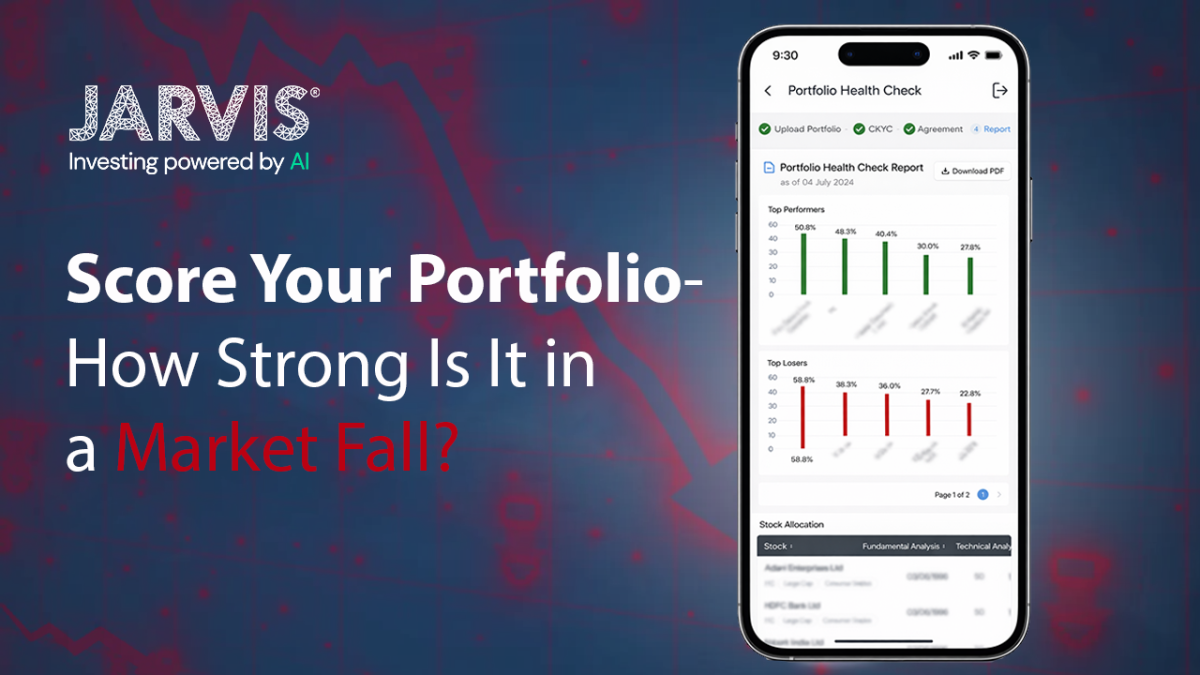

Everything looks good in a rising market. Prices go up, returns look good, and your confidence is in the seventh sky. The real test comes when markets fall – 10 – 20 – 30 percent fall. That is when fear replaces logic, losses appear faster than gains ever did, and weak portfolios get exposed. In this article, we have fully explained a point-by-point framework to help investors genuinely assess how strong your portfolio is when markets fall.
Drawdown Tolerance: Can You Actually Handle Losses?
Drawdown is the temporary fall in your portfolio value from its peak. Most investors think they can tolerate a 20% fall. Very few actually can.
When your portfolio falls:
- Daily losses look larger than daily gains ever felt.
- Confidence drops faster than prices
- Decision-making becomes emotional, not logical
If a 15% fall makes you check your portfolio every hour, your portfolio risk is already too high for you, even if the assets are “good.”
A strong stock portfolio is aligned not just with market risk, but with your personal emotional capacity. If the structure forces you into panic, it is, by definition, weak.
Asset Allocation: The Core Strength Test
Asset allocation is the single biggest factor in how your portfolio behaves in a market downturn. Portfolios fail not because stocks fall, but because everything falls together.
A weak allocation usually means too much equity exposure, no balance between growth and stability & no predefined structure. On the other hand, a strong allocation means equity for growth, debt for stability, and cash for flexibility.
When markets fall, debt and cash do not exist to give returns. They exist to prevent bad decisions. They slow down losses, give mental comfort, and allow portfolio rebalancing. If your portfolio only works when markets rise, it is not a portfolio. It is a bet.
Market Capitalization Exposure: Where the Pain Hits First
Not all stocks fall equally. Historical data suggest that:
- Large-cap stocks usually fall less and recover earlier
- Mid-cap stocks fall more and recover slower
- Small-cap stocks fall the hardest and test patience the most
In bull markets, small and mid-caps make portfolios look smart. In bear markets, they expose overconfidence. A strong portfolio knows why each market cap exposure exists:
- Large caps for stability
- Mid-caps for measured growth
- Small caps only for long-term capital that can tolerate deep volatility
If your portfolio is dominated by whatever performed best recently, it is structurally weak.
Role of Debt: The Shock Absorber
Debt assets are often ignored because they feel unexciting. In market falls, they become critical. Debt does three important things:
- Reduces overall volatility
- Protects capital during sharp corrections
- Gives you money to rebalance into equity at lower levels
Without debt, every fall forces you into a corner: either tolerate extreme volatility or sell equity at the wrong time. Strong portfolios use debt intentionally, not accidentally. Debt is not about returns. It is about control.
Liquidity: Can You Survive Without Selling?
Liquidity decides whether you are an investor or a forced seller. During market falls:
- Job risk increases
- Emergency expenses feel heavier
- Fear of running out of cash increases
If you do not have enough liquid money:
- You sell investments to raise cash
- You sell when prices are low
- You lock in permanent losses
A strong portfolio always separates:
- Emergency money
- Short term investment needs
- Long term investments
Markets recover. Portfolios recover. Only if you are not forced to exit.
Sector and Theme Concentration: One Story Risk
Concentration feels comfortable when the story is working. The problem appears when the story breaks.
If your portfolio depends heavily on one sector, theme, or macro-narrative, then a single negative event can damage the entire portfolio at once.
Strong portfolios spread risk across:
- Different business cycles
- Different economic drivers
- Different types of companies
It does not eliminate losses. It prevents irreversible damage.
Leverage and Fixed Obligations: The Silent Killer
Leverage turns normal market volatility into a personal crisis. This includes:
- Investing with borrowed money
- High EMIs are dependent on market income
- Margin trading or leveraged products
When markets fall, leverage creates pressure from both sides: Asset values fall & obligations stay fixed.
Even a good portfolio can fail under bad cash flow pressure. Strong portfolios are built to survive bad markets without financial stress.
Rebalancing Discipline: Turning Pain Into Advantage
Portfolio Rebalancing is what separates long-term investors from emotional traders. Without rebalancing:
- Equity weight rises in bull markets
- Risk silently increases
- Falls hurt more than expected
With rebalancing:
- You automatically sell what has held up
- You buy what has fallen
- Risk stays controlled
Rebalancing forces you to do the hardest thing in investing, calmly and systematically. Portfolios that rebalance regularly fall less and recover faster.
Time Horizon Alignment: Are You Using the Right Assets?
Many investors panic not because markets fall, but because they need money at the wrong time.
Problems arise when:
- Short-term goals are invested in equity
- Long-term money is used casually
- Goals are not clearly defined
Strong portfolios assign every rupee a job:
- Short-term needs stay safe
- Long-term goals get equity exposure
- No confusion during volatility
Time does not eliminate risk. Misalignment magnifies it.
Final Portfolio Strength Assessment
When you score your portfolio honestly on these points, the result is usually eye-opening.
- A high score means you can stay invested
- A medium score means fine-tuning is needed
- A low score means your most significant risk is not the market, but your structure
Before You Go
Market falls are not accidents. They are part of the system. Strong portfolios are not built to avoid falls. They are built to survive them without panic, without forced selling, and without permanent damage. If your portfolio allows you to stay calm when prices are falling, you are already ahead of most investors. Returns will follow.
Know your portfolio score using our Portfolio Health Check – https://jarvisinvest.com/jarvis-health-check