

Tata Power’s September-quarter profit rose nearly 49% year on year. Yet its EBITDA margin fell to about 18.7% from 21.24%. That combination tells you more about the long-term investment case than the profit headline alone. The business grew, but it earned less at the operating level on every ₹100 of revenue. So what does that mean for the Tata Power share price, and how much of the company’s future growth is already priced in?
Is Tata Power a good long-term investment at ₹360? Tata Power has a credible multi-year growth case across electricity distribution, renewables and energy storage. At ₹360, the valuation still depends on whether new capacity earns attractive returns, operating margins recover and cash generation keeps pace with project spending. The share price closed flat on the NSE on 11 November 2026, before the results were announced. The next trading session will offer the first post-results price signal.
Tata Power Q2 FY27 results – What changed?
| Consolidated metric | Q2 FY27 | Q2 FY26 | Year-on-year change |
|---|---|---|---|
| Revenue from operations | ₹19,636 crore | ₹15,545 crore | +26.3% |
| EBITDA | About ₹3,668 crore | ₹3,302 crore | +11.1% |
| EBITDA margin | About 18.7% | 21.24% | Down about 2.6 percentage points |
| Net profit | ₹1,366 crore | ₹919 crore | +48.6% |
Tata Power generated roughly ₹4,091 crore more revenue than it did a year earlier. EBITDA increased by about ₹366 crore. The gap is worth investigating because it shows how much more slowly operating earnings grew than sales. To judge how repeatable the quarter was, look at which businesses contributed to growth and how finance costs, depreciation, associate profits and taxes affected the final profit figure.
This is where stock market ai can help investors sift through results. Comparing the same revenue, margin and cash-flow measures across quarters can surface trends that a single earnings headline misses.
Shirawata pumped storage project – Why it matters to shareholders
Tata Power lists Shirawata in Maharashtra as a proposed 1,800 MW pumped hydro storage project. In simple terms, a pumped storage plant uses electricity to move water uphill when power is plentiful. When demand rises, the water flows back down through turbines to generate electricity. That flexibility can help meet evening demand after solar output falls.
For shareholders, the commercial questions are straightforward. How much capital will Tata Power commit? How will it finance construction? Who will pay for the storage capacity, and under what contract terms? A long build puts cash outflows well ahead of operating revenue. Delays, cost overruns or expensive financing can reduce the return on the project even if the grid needs the capacity.
What supports Tata Power’s long-term growth case?
1. Solar projects are reaching commissioning
On 5 November, Tata Power Renewable Energy said it had commissioned a 300 MW solar project in Koppal, Karnataka, for the Solar Energy Corporation of India. The subsidiary also reported 419 MW of utility-scale project commissioning and 131.2 MWh of battery storage project delivery during Q2 FY27. These figures give investors milestones they can track alongside new project announcements.
2. Distribution gives the business another source of earnings
Tata Power spans generation, transmission, distribution and renewables. Its distribution business serves ongoing electricity demand, with returns also shaped by tariff decisions, collections and operating efficiency. Alongside renewables and storage, distribution gives investors a way to assess whether growth is coming from several businesses or relying on one segment.
3. Cash flow will show what the expansion costs
Tata Power said it deployed more than ₹5,000 crore in capital expenditure in Q1 FY27. For a business spending at that scale, watch operating cash flow, capex and net debt together. If cash from operations grows alongside investment, the company has more room to fund expansion internally. If borrowing rises faster than operating earnings, interest costs can absorb more of the benefit. Investors using ai for stock market research can track these measures consistently across filings.
Tata Power share price at ₹360 – What does the valuation assume?
Tata Power ended 11 November about 23% below its 52-week high of ₹464.90 and about 8% above its 52-week low of ₹333.20. At ₹360, dividing by the ₹12.09 trailing adjusted EPS displayed by The Economic Times gives an indicative multiple of about 30× earnings. This is a snapshot using the quoted earnings base, which may update as the September-quarter results feed through.
Here’s a way to read that valuation. At the same ₹360 share price, annual EPS of ₹14.40 would imply 25× earnings. That requires about 19% growth from ₹12.09. It’s an illustration of what earnings growth would do to the multiple at a fixed share price. The market can also assign a lower or higher multiple as it reassesses margins, leverage and project execution.
From a chart perspective, ₹333.20 is the observed 52-week low, and ₹370.20 is the 11 November session high. The next weekly close and trading volume can help show whether demand has improved following the earnings release. A single session high carries limited weight in a multi-year investment case. If your starting point is a search for ai-based stock trading india, check whether the tool shows the date, timeframe and source behind a price signal.
Technical analysis update – Tata Power weekly chart


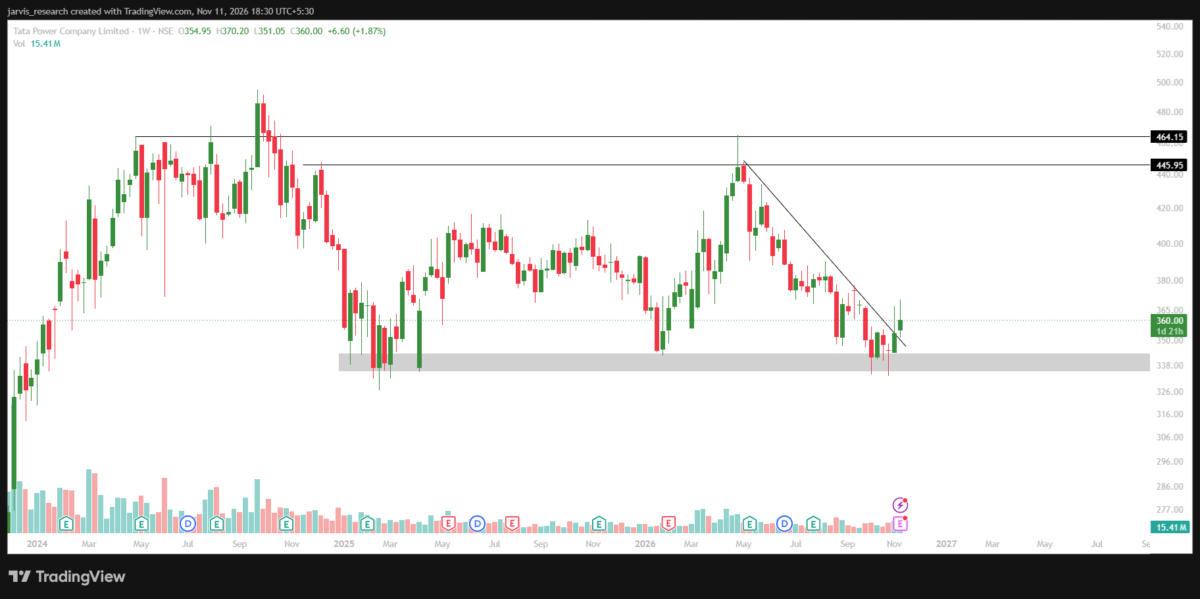
Tata Power is showing signs of a potential bullish reversal after a strong recovery from the ₹334 – 340 demand zone, indicating renewed buying interest at lower levels. The recent price action suggests a possible breakout from the prevailing descending trendline, signalling an improvement in the short-term market structure.
Sustained movement above ₹368 – 375 could strengthen the bullish outlook, opening the possibility of an upside move towards ₹380 – 390, followed by ₹400 – 410. The broader outlook remains constructive as long as the stock sustains above the ₹334 – 340 support zone, with further confirmation required through strong price action and buying volumes.
If your starting point is a search for ai-based stock trading india, check whether the tool shows the date, timeframe and source behind a price signal.
What could weaken the investment case?
| Risk | What to watch |
|---|---|
| Margin pressure | Whether EBITDA growth starts catching up with revenue growth and which segments drive the change |
| High capital expenditure | Whether operating cash flow covers more of the investment programme and how net debt and interest costs move |
| Storage execution | Financing, construction milestones, contracted revenues and commissioning |
| Singapore arbitration | Further company disclosures on the Kleros appeal, enforcement and any financial impact |
Tata Power disclosed developments in its dispute with Kleros in November. The company has appealed a Singapore court ruling, and shares it holds in two Singapore subsidiaries were attached as part of enforcement proceedings. That adds a separate risk to track alongside operating performance.
Conclusion
The long-term case rests on whether Tata Power can turn a growing pipeline of power projects into cash flows that justify the share price. The next few quarters should make that easier to judge. Look for stronger operating margins, steadier cash conversion and progress on large projects without a disproportionate rise in debt. For investors exploring ai trading in india, those are the questions a research tool should help you follow after the earnings story moves off the front page.
The portfolio question is personal. If you already own utilities, renewable-energy companies or infrastructure stocks, adding another power name may deepen an exposure you already have. Jarvis Portfolio uses your investment horizon, risk profile and investment amount to build personalised equity recommendations and monitor portfolio risk. Advisory services are provided by Ventugrow Consultants Pvt. Ltd., a SEBI Registered Investment Advisor (INA000013235). You can review the current plan fees and what’s included online, then complete your risk profile and KYC when you’re ready to subscribe.