
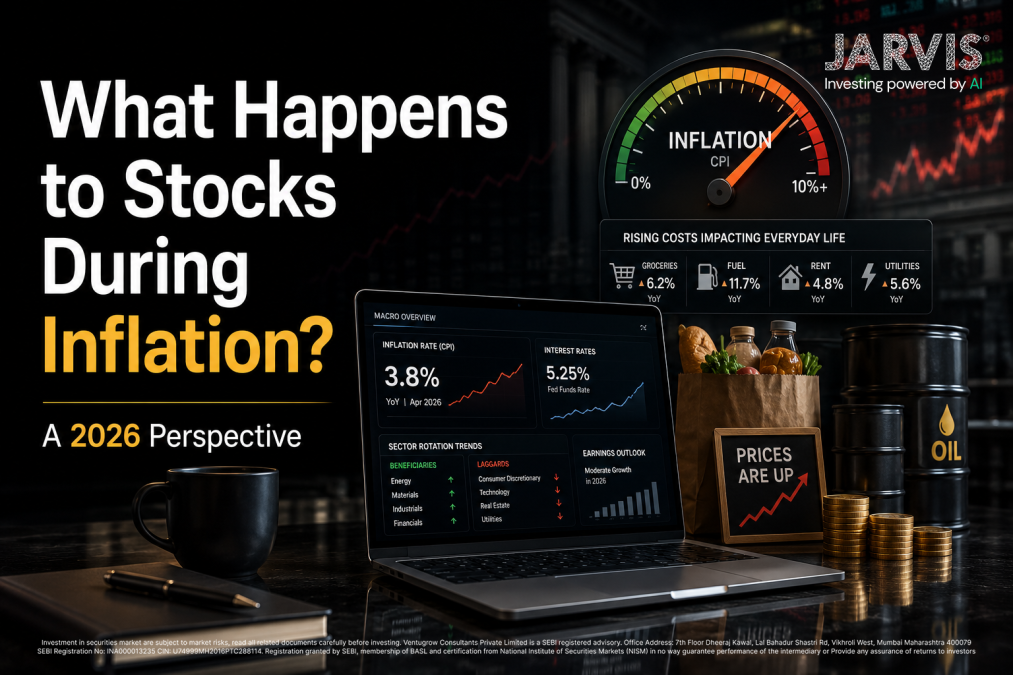

Inflation doesn’t feel like an economic concept when you’re living through it. It feels like your salary is staying the same while everything around you gets quietly more expensive. Your grocery run costs more. Fuel prices are increasing day by day, school fees are rising, and your stocks investment are experiencing the same pressure, whether you’re watching them or not.
For those of us investing in India right now, this is real. And the question is that investors usually ask, “What happens to our stocks when inflation rises?” Read this blog to know more.
Why Does Inflation Even Touch Stocks?
Inflation doesn’t impact stocks directly. It forces them from multiple sides at once, like pressure building from every direction simultaneously.
If your business is strong enough to raise prices without losing customers, you survive. But if you can’t, your margins get reduced. And when margins decrease, stock prices follow.
Then the RBI or the Fed comes in. They raise interest rates to bring things down. Suddenly, borrowing gets costlier. Future earnings are the ones that stock prices are basically investing in; they become worth less in today’s money.
The whole system becomes more rigid. And investors start demanding higher returns just to compensate for the purchasing power they’re losing. That pushes valuations down further.
Where does India stand right now?
- CPI inflation is sitting around 3.4% as of March 2026.
- US inflation hit 3.3%, driven heavily by energy prices from Middle East tensions.
- The RBI is projecting average inflation near 4.6% this year.
- But India’s GDP growth of around 6.9% provides genuineness.
What Does History Actually Say?
When inflation stays relatively low, roughly 2% to 4%:
- Companies adjust prices alongside rising costs.
- Revenues hold up reasonably well.
- Stocks tend to post decent gains in nominal terms.
- Real returns stay positive for patient investors.
The 1970s showed us what long-term high inflation actually does to equity returns.
Here’s Where It Gets Really Interesting
Inflation doesn’t hit every stock the same way. Some sectors actually do well. Knowing the difference between a portfolio that survives inflation and one that gets slowly drained by it.
Benefits are:
- Energy and commodities — Their revenues are literally tied to the prices driving inflation. When oil goes up, energy company earnings often go up with it. Right now, with geopolitical tensions keeping crude elevated, this sector has been a real cushion for diversified portfolios.
Sectors Benefiting During Inflation – Energy Sector Stocks
| Stock Name | SYM | Why It Benefits | Key Exposure |
|---|---|---|---|
| Reliance Industries | RIL | Integrated (upstream, refining, petrochemicals); higher hydrocarbon margins + diversified cash flows. Market cap: ₹19,55,722 Cr (as of 07 May 2026). | Oil refining, petrochemicals, gas. |
| Oil & Natural Gas Corp | ONGC | Direct upstream; crude price realizations boost earnings. | Exploration & production (E&P). |
| Oil India | OIL | Similar to ONGC; state-backed production upside. | E&P, natural gas. |
| Bharat Petroleum Corp | BPCL | Refining/marketing; crack spreads + retail volumes. | Downstream refining. |
| Indian Oil Corp | IOC | Large refiner; government policy pass-through. | Refining, marketing. |
| Hindustan Petroleum | HPCL | Refining margins + fuel retail. | Downstream. |
| GAIL India | GAIL | Gas transmission; natural gas demand in inflation. | Midstream gas. |
Sectors Benefiting During Inflation – Commodities Sector Stocks
| Stock Name | Sub-Sector | Why It Benefits | Key Exposure |
|---|---|---|---|
| Coal India | Coal/Mining | Dominant supplier; higher thermal coal prices/dispatch. | Coal production. |
| NMDC | Mining | Iron ore realizations; steel input demand. | Iron ore. |
| Tata Steel | Steel/Metals | Pricing power; global supply cuts aid exports. | Steel production. |
| JSW Steel | Steel/Metals | Private leader; capacity expansion + pricing. | Integrated steel. |
| Vedanta | Diversified Metals | Multi-asset (aluminium, zinc, copper, oil). | Base metals, mining. |
| Hindalco Industries | Metals | Aluminium/copper; base metal rallies. | Non-ferrous metals. |
| Hindustan Zinc | Metals | Zinc/lead; commodity cycle upside. | Zinc mining. |
| UltraTech Cement | Cement | Infra spend + price pass-through. | Cement (building materials). |
- Sectors Benefiting During Inflation – Commodities Sector Stocks
Sectors Benefiting During Inflation – Consumer Staples Sector Stocks
| Stock Name | Ticker | Why It Benefits | Key Products/Exposure |
|---|---|---|---|
| Hindustan Unilever | HUL | Premium brands + vast distribution; superior pricing power. | Soaps, foods, personal care. |
| ITC | ITC | Diversified (foods + cigarettes cash cow); rural strength. | Foods, staples, tobacco. |
| Nestlé India | NESTLEIND | Brand loyalty in essentials; high-margin foods. | Maggi, dairy, beverages. |
| Britannia Industries | BRITANNIA | Packaged foods; inelastic biscuit/dairy demand. | Biscuits, bread. |
| Marico | MARICO | Edible oils + personal care; sourcing efficiencies. | Hair oils, oils. |
| Dabur India | DABUR | Ayurvedic staples; rural reach. | Health, personal care. |
| Tata Consumer Products | TATACONSUM | Teas, foods, salts; premiumisation. | Beverages, staples. |
| Godrej Consumer Products | GODREJCP | Household/personal care; wide portfolio. | Soaps, hair care. |
| Reliance Consumer Products (via RIL) | RCPL (RIL sub.) | Retail scale + acquisitions; affordable mass staples. | Beverages, health foods (e.g., Manna, Nexba). |
- Healthcare — Demand here doesn’t care about inflation cycles. People don’t postpone necessary medical care because the CPI is going up. That built-in resilience makes healthcare a quietly powerful holding during uncertain times.
Sectors Benefiting During Inflation – HealthCare Sector Stocks
| Stock Name | Category | Why It Benefits | Key Exposure |
|---|---|---|---|
| Sun Pharmaceutical | Pharma | Scale + exports; chronic therapies pricing. | Generics, specialty drugs. |
| Dr. Reddy’s Laboratories | Pharma | US exports + domestic; rupee tailwind. | Generics, biosimilars. |
| Cipla | Pharma | Respiratory/chronic focus; diversified. | Formulations, APIs. |
| Divi’s Laboratories | Pharma | CRAMS/API; high margins, global demand. | Custom manufacturing. |
| Lupin | Pharma | US/India mix; specialty growth. | Generics, inhalers. |
| Apollo Hospitals | Hospitals | Tariff hikes, insurance; bed expansions. | Multi-specialty chains. |
| Max Healthcare | Hospitals | High ARPOB; premium services. | Urban hospitals. |
| Fortis Healthcare | Hospitals | Occupancy + acquisitions. | Network expansion. |
| Narayana Hrudayalaya | Hospitals | Affordable care; volume-led. | Cardiac/multi-specialty. |
Sectors that face real pressure:
High-growth tech stocks — Their valuations are built on future earnings. When interest rates rise, those future earnings get discounted more heavily. It means they’re worth less in today’s money. The math is brutal for stocks trading at high multiples when inflation spikes.
For Indian investors, especially:
- Sectors with strong domestic demand stabilizers, such as infrastructure, energy, and consumption, have shown they can absorb global shocks better
- Export-heavy sectors carry more exposure to currency swings and global slowdown risk.
What Makes 2026 Specifically Tricky
Go through these features.
- It’s being driven by supply.
The Iran conflict has rattled oil markets, which affect everything from fuel costs and logistics to manufacturing inputs and food prices. Supply-driven inflation isn’t really fixed by raising interest rates.
- Rate expectations keep moving.
The Cleveland Fed’s inflation tracking tool recently showed April US inflation trending toward 3.58% on a trailing 12-month basis. It gives the Fed almost zero reason to cut rates anytime soon and potentially a reason to increase again. Every time rate expectations shift, markets move. Sometimes sharply and without much warning.
- India has genuine advantages, but they’re limited.
India’s growth story remains intact, as it reached 6.9% GDP growth, which is real and meaningful. The domestic consumption base is large and resilient. But foreign institutional investors watch global rate differentials closely.
- Earnings have been a stabilizer.
Many Indian companies have reported reasonable earnings this cycle. Infrastructure investment, adoption of technology, and domestic consumption have offered support. But companies without genuine pricing power are quietly seeing their margins compress.
So What Do You Actually Do With This Information?
Check out these key points that will help you out.
Build a portfolio that doesn’t depend on everything going right.
- Mix defensive holdings with inflation-sensitive exposure.
- Don’t put all your conviction behind one sector or theme.
- Balance businesses with near-term earnings against selective long-term growth predictions.
- Diversification isn’t a lack of certainty; it’s wisdom about uncertainty.
Stop treating cash as a safe option.
- Every month, inflation runs above your savings rate, and cash loses real value.
- Sitting out feels safe. It isn’t. It’s just a slower way to fall behind.
- Regular, disciplined investing beats trying to time the perfect entry.
Pay attention to the signals that actually matter:
- Monthly CPI and WPI releases.
- RBI policy decisions and forward guidance.
- Crude oil price movements.
- Quarterly earnings, specifically margin commentary, not just headline numbers.
- Fed communications and any shift in US rate expectations.
Wrapping This Up
Inflation in 2026 is manageable if you’re thoughtful about it. Stocks aren’t automatically surpassed by inflation.
The investors who navigate this well won’t be the ones who made the perfect broader investment decision. They’ll be the ones who owned quality businesses, stayed diversified, and didn’t panic every time a CPI print came in hot.
If you’re an Indian investor looking for well-organized, intelligent support to build exactly that kind of portfolio, the Jarvis Portfolio from Jarvis Invest is built for this. It is an SEBI Registered and AI-powered advisor that is specifically designed for long term stocks for those who are investing in the Indian markets. It builds personalized portfolios, manages risk on an ongoing basis, and suggests timely adjustments as conditions evolve.
Just visit jarvisinvest.com and take the next step.
Frequently Asked Questions
1. Why do growth stocks fall when inflation rises?
Growth stocks depend heavily on future earnings. Rising inflation and interest rates reduce the present value of those future profits, which can pressure stock valuations.
2. Does inflation push stock prices up or down?
YES! But it totally depends on the situation. Mild inflation (2–4%) often lets stocks rise. High or persistent inflation is tougher. Valuations compress, borrowing costs rise, and consumer spending weakens.
3. What types of stocks perform well during inflation?
Energy, infrastructure, healthcare, and consumer-focused stocks often perform better during inflation because these sectors usually maintain stable demand and pricing power.
4. Which stocks tend to survive inflation best?
These are the following stocks listed below:
- Energy and product manufacturers.
- Consumer basic needs remain stable because demand doesn’t disappear.
- Value stocks, those that have strong current earnings, perform better than high-growth company names.
- Energy, infrastructure, and consumption have shown particular durability.
5. Why do growth stocks get hit hardest during inflation?
Growth stocks are priced on earnings expected years into the future. When inflation rises, interest rates follow, and higher rates reduce what those future earnings are worth today.
6. Should I stay invested or move to cash during inflation?
Yes! You just need to keep yourself invested, but be aware of what you own.
- Cash loses real purchasing value every single month. Inflation runs above your savings rate.
- Investors who stayed diversified through past inflationary cycles consistently outperformed those who moved to the downside.
7. How does the RBI rate policy affect Indian stocks when inflation rises?
- Rate hikes raise borrowing costs for companies and consumers almost immediately.
- Real estate, NBFCs, and capital-intensive businesses feel it fastest.
- But a credible anti-inflation stance stabilizes the rupee and supports foreign investor confidence over time.