
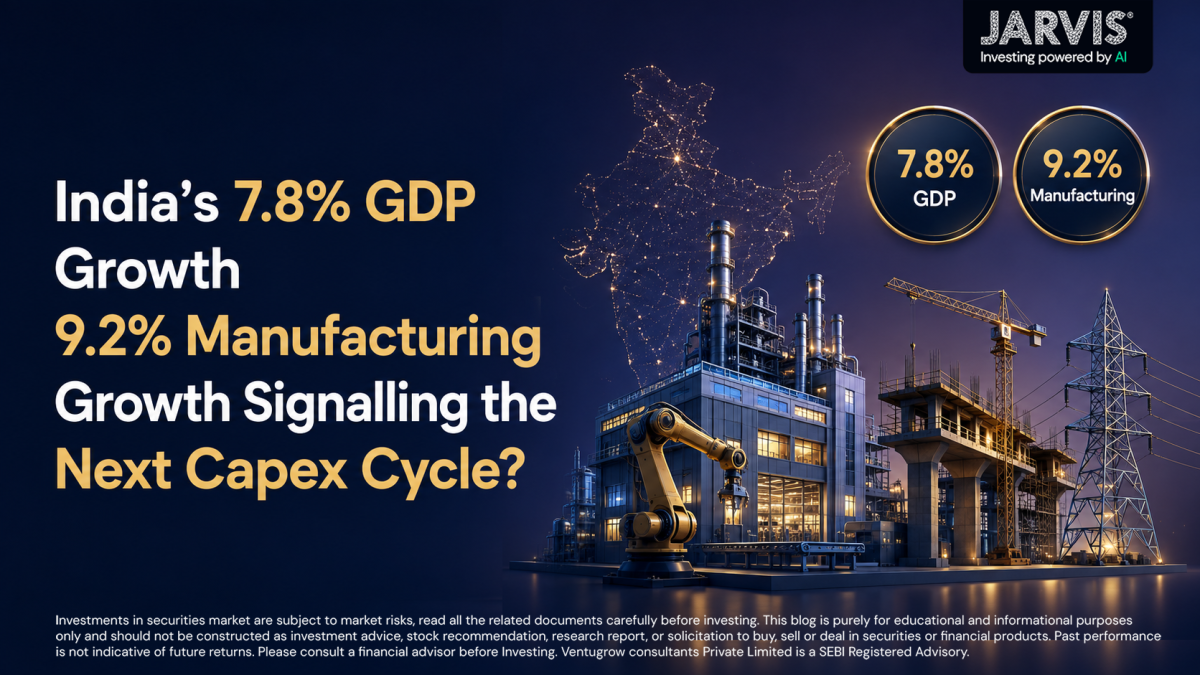
India’s real GDP grew 7.8% year-on-year in Q1 FY27, ahead of the 7.1% consensus expectation cited in a Reuters poll. Gross value added, or GVA, expanded 8.2%.
Those are encouraging numbers. Yet GDP alone does not tell investors where the next earnings opportunities may emerge. For that, two figures deserve closer attention: manufacturing grew 9.2%, while gross fixed capital formation, an indicator of investment in productive assets rose 11.9%.
Construction grew 7.7%, while financial, real estate and professional services expanded 12.1%. Together, these numbers suggest that growth is not being driven only by household spending. Investment and industrial activity are becoming important parts of the story.
The economic chain could look something like this: demand rises → factories use more capacity → companies invest → infrastructure expands → employment improves → consumption receives another boost.
That loop matters because one new factory rarely benefits only one company. It can create orders for machinery, automation, electrical equipment, cement, logistics, power providers and banks. GDP growth may grab the headline; this multiplier effect is where the stock-market story begins.
For investors exploring ai-based stock trading india, this multiplier effect can help identify companies that may benefit from the wider manufacturing and capex cycle.
Is India entering a new manufacturing and capex cycle?
The latest data makes the possibility difficult to ignore, but it is still too early to declare a full capex supercycle. One strong quarter is a signal, not a guarantee.
Government infrastructure spending has supported investment activity for several years. The stronger confirmation would be a sustained increase in private-sector capex: companies committing their own money to new plants, machinery and production capacity.
Investors can watch five indicators for confirmation:
- Private capex announcements: Are companies approving new factories and capacity expansion?
- Capacity utilisation: Are existing plants operating close enough to capacity to justify fresh investment?
- Capital-goods orders: Are engineering and equipment businesses reporting sustained order growth?
- Corporate credit: Are banks seeing stronger borrowing demand from businesses?
- Earnings delivery: Are orders turning into revenue, margins and profit growth?
This final point is essential. A rising economy can create opportunities, but shareholder returns ultimately depend on company earnings and the price paid for those earnings.
The industrial data adds a useful reality check
India’s industrial production grew 6.7% in July, moderating from a revised 8.8% in June. Manufacturing expanded 7.3%, while capital-goods output grew a much stronger 16.1%.
The mix is encouraging but balanced. Overall industrial momentum cooled, yet investment-related production remained strong. That supports the manufacturing thesis without giving investors permission to extrapolate one exceptional quarter forever. Markets adore a good story; valuations occasionally adore it a little too much.
Which sectors could benefit from the next capex cycle?
If manufacturing and private investment continue to expand, the opportunity may spread across an entire ecosystem. Jarvis Invest has also compared Indian sectors positioned for growth in 2026 for investors researching the broader theme.
1. Capital Goods Sector and engineering
Capital-goods companies are among the most direct beneficiaries. New factories, power projects, transport networks and industrial facilities all require equipment, engineering and execution.
Stocks to Watch Now in Capital Goods and Engineering
| Company | Why to Watch This Stock |
|---|---|
| Larsen & Toubro (L&T) | Strong order book and capex visibility: L&T maintained its FY27 outlook after Q1 profit growth, supported by strong project execution and order inflows. Its large infrastructure pipeline keeps it closely linked to India’s ongoing public and private capex cycle. |
| Siemens India | Industrial and infrastructure opportunity remains strong: Siemens reported Q1 FY27 revenue of ₹4,714 crore, although profit declined over 18%. The stock remains worth tracking for its exposure to industrial automation, electrification, mobility and India’s infrastructure investment cycle—but earnings execution is an important watchpoint. |
| ABB India | Record orders provide strong revenue visibility: ABB India reported its highest-ever Q2 orders of ₹4,363 crore, up 50% YoY, while its order backlog reached ₹11,898 crore. Demand from data centres, renewables, metals, mining and infrastructure strengthens its medium-term growth visibility. |
| Cummins India | Strong earnings base with infrastructure and power-demand exposure: Cummins reported record FY2025-26 revenue of about ₹11,950 crore and remains positioned around power generation, industrial engines and infrastructure demand. Data-centre and backup-power requirements add another structural theme to watch. |
2. Industrial automation
India does not simply need more factories; it needs more productive factories. Global manufacturers evaluating India will look for scale, consistent quality, energy efficiency, automation and reliable supply chains.
This creates a longer-term opportunity for automation and electrification companies such as Siemens India and ABB India. The narrative is shifting from “Make in India” to “Make efficiently in India and compete globally.”
A stock market ai research framework can support this analysis by tracking order growth, earnings momentum and valuation together. Investors can also review Jarvis Invest’s study of high-growth stocks with earnings momentum for additional context.
3. Auto Sector Stocks and Auto Components
Automobiles sit at the intersection of manufacturing and consumption. Strong economic activity can support vehicle demand, while a wider manufacturing cycle can benefit component suppliers, logistics providers and industrial businesses.
Stocks to Watch Now in Auto Sector Stocks and Auto Components
| Company | Why to Watch This Stock |
|---|---|
| Mahindra & Mahindra | SUV momentum remains exceptionally strong: August 2026 SUV sales reached 59,257 units, up 50% YoY, while total vehicle sales increased 42% YoY. Strong response to models such as the updated Scorpio-N and BE 6 SPORTEQ could provide momentum heading into the festive season. |
| Maruti Suzuki | Domestic passenger vehicle demand accelerated: August 2026 total sales reached 2,19,220 units, up about 21% YoY, with domestic passenger vehicle sales rising strongly. The festive season, utility-vehicle demand and Maruti’s scale make volumes worth tracking, although exports declined YoY in August. |
| Tata Motors | Sharp recovery in passenger vehicles and EVs: Tata Motors Passenger Vehicles’ August sales increased 56% YoY to 67,753 units, while EV volumes reportedly jumped 94% YoY. The acceleration in EV and domestic PV demand is a strong trigger to watch, though recent margin pressure and vehicle price increases remain key risks. |
The opportunity extends beyond vehicle manufacturers. This analysis of EV stocks across vehicles, batteries and components explains how the wider auto ecosystem could participate in India’s next growth phase
4. Electronics and semiconductor Stocks
Electronics manufacturing may be one of the biggest structural opportunities in the cycle. India is building capabilities across smartphones, electronic components, semiconductors, consumer devices and industrial electronics.
The theme combines domestic consumption with global supply-chain diversification. That makes Dixon Technologies an important stock to track, but also a company where entry valuation deserves close attention.
An ai app for share market research process can help screen fast-changing financial and valuation signals across this segment. For deeper sector research, explore Jarvis Invest’s analysis of semiconductor and electronics manufacturing stocks.
5. Infrastructure and cement stocks
Factories require roads, railways, ports, warehouses, electricity and water. That makes infrastructure a natural ecosystem beneficiary when manufacturing investment accelerates.
Stocks to Watch Now in Infrastructure and Cement Stocks
| Company | Why to Watch This Stock |
|---|---|
| Larsen & Toubro (L&T) | Order momentum remains a major trigger: L&T announced multiple major contracts in August 2026, including a major Battery Energy Storage System order in the Middle East, an ultra-mega gas compression project, and a mega order to build India’s largest NVIDIA B300 AI Factory. This expanding order pipeline across infrastructure, energy and AI infrastructure makes execution and order-book growth key factors to watch. |
| UltraTech Cement | 200+ MTPA capacity creates a powerful scale advantage: UltraTech crossed 200 MTPA of domestic grey cement capacity in 2026 and is targeting more than 240 MTPA through its next expansion phase. Its scale, infrastructure-linked cement demand and increasing green-power usage make it a key stock to track as India’s construction and capex cycle develops. |
The cement thesis is straightforward: more construction and industrial capacity can lift cement demand. Yet cement remains a cyclical business where volumes, pricing discipline, fuel costs and regional capacity matter.
6. Power and transmission
Power may be the less obvious manufacturing trade. Every new plant and data-heavy industrial process requires reliable electricity, creating demand across generation, transmission, distribution, renewables and electrical equipment.
Stocks to Watch Now in Power and Transmission sector
| Company | Why to Watch This Stock |
|---|---|
| NTPC | ₹16.86 lakh crore expansion plan is the big trigger: NTPC plans to nearly triple its generation capacity to 244 GW by 2037, spanning conventional power, renewables, nuclear and storage. This massive capex pipeline gives the company long-term exposure to India’s rising electricity demand and energy transition. |
| Power Grid Corporation of India | Renewable transmission build-out is accelerating: POWERGRID recently acquired two SPVs for renewable-energy transmission projects, while projects worth over ₹4,370 crore were dedicated and the ₹5,550+ crore Kurnool-IV REZ Phase-I project moved forward. Q1 FY27 total income stood at ₹11,697 crore, reinforcing its role in India’s grid expansion. |
| ABB India | Record orders provide strong growth visibility: ABB India’s Q2 CY2026 orders jumped 50% YoY, its order backlog increased 22%, and revenue grew 21%. Demand across electrification, automation, data centres and infrastructure makes the expanding order book a particularly strong trigger to watch. |
| Siemens India | Orders and backlog continue to strengthen: In Q1 FY27, Siemens reported 16.5% growth in new orders to ₹6,328 crore, while its order backlog increased 9.6% to ₹46,670 crore and revenue grew 14.8%. Recent railway electrification and metro orders add further visibility to its infrastructure and mobility opportunity. |
Stocks for Investor’s Watchlist
| COMPANY | THEME | WHAT TO TRACK NOW |
|---|---|---|
| L&T | Infrastructure and capex | Order inflows, execution and valuation |
| Siemens India | Automation and electrification | Orders, margins and industrial demand |
| ABB India | Industrial automation | Revenue growth, margins and valuation |
| M&M | Auto and consumption | Volumes, market share and margins |
| ICICI Bank | Corporate credit | Loan growth, deposits and asset quality |
| UltraTech Cement | Infrastructure | Volumes, realisations and input costs |
| Dixon Technologies | Electronics manufacturing | Growth delivery and valuation |
| NTPC | Power generation | Capacity additions and execution |
| Power Grid | Transmission | Project pipeline and regulated returns |


How should investors approach the opportunity?
Investors do not need to chase every stock connected to GDP growth. A more disciplined approach is to follow the path from economic activity to company earnings.
Only after that chain is visible should valuation enter the decision. Even an excellent company can deliver weak returns when purchased at a price that assumes years of flawless execution.
Research methods associated with ai-based stock trading india can help organise financial, technical and risk signals across multiple companies. AI should strengthen investor research, suitability assessment or diversification.
Conclusion
India’s strong GDP, manufacturing and investment growth could create long-term opportunities across capital goods, infrastructure, automation, power, automobiles, electronics and banking. However, investors should focus on companies with sustainable earnings, strong fundamentals, reasonable valuations and risks that match their financial goals.
Looking to create a well-researched long term portfolio? Jarvis Invest, a SEBI Registered Investment Advisor, uses AI-powered research and continuous risk monitoring to help investors build and manage a personalised portfolio aligned with their investment horizon and risk profile.