

Trent share price is drawing attention after the company reported stronger earnings for the September quarter. The retailer behind Westside and Zudio delivered growth in revenue and profit, giving investors fresh reasons to watch the stock.
The bigger question is what comes next. Can Trent maintain this improvement as it expands its store network, or will rising costs and high growth expectations make the next few quarters more challenging? For investors, the answer lies in understanding how the business is performing beyond the headline numbers.
Why Is Trent Share Price in Focus?
Trent shares rose as much as 6.92% to ₹3,060 on the NSE in early trading on 30 October 2026, following its Q2 FY27 results. This was an intraday observation, rather than the closing price. Better profitability and improving sales at existing fashion stores supported the positive reaction.
A results-day rally shows that investors welcomed the announcement. Whether the gains last will depend on how the business performs against expectations over the coming quarters.
Trent Q2 Results – What Do the Numbers Show?
Trent reported consolidated revenue of ₹5,873 crore for the quarter ended 30 September 2026, up 22% year on year. Consolidated profit after tax increased 25% to ₹468 crore. Operating EBITDA, a measure of earnings before interest, tax, depreciation and amortisation, rose 37% to ₹785 crore. Its faster growth compared with revenue suggests that operating performance improved during the quarter.
| Consolidated financial metric | Q2 FY27 | Year-on-year growth |
|---|---|---|
| Revenue from operations | ₹5,873 crore | 22% |
| Operating EBITDA | ₹785 crore | 37% |
| Profit after tax | ₹468 crore | 25% |
What Worked for Trent During the Quarter?
1. Existing Stores Showed Better Sales Growth
For a growing retailer, opening new stores is only part of the story. Investors also need to know whether customers are spending more at locations that have already been operating for some time.
Trent’s fashion like-for-like sales growth improved to the mid-single-digit range, compared with low single digits in Q1 FY27, according to brokerage commentary following the results.
Like-for-like growth compares sales at a similar set of existing stores. It helps answer a practical question: is the business attracting more demand, or is total revenue rising mainly because there are more shops?
An improvement in existing-store sales is encouraging because it can help the company make better use of its established retail network.
2. Profitability Improved Alongside Revenue
Trent’s operating EBITA margin increased to 11.6%, compared with 10.5% in the corresponding quarter a year earlier.
When sales rise, some expenses can be spread across a larger revenue base. This is called operating leverage. It can support profit growth, provided costs remain under control.
However, one quarter of better margins does not settle the longer-term outlook. Investors should watch whether profitability holds up as the company manages sourcing costs, employee expenses and its expanding footprint.
3. Zudio and Westside Continued to Expand
At the end of September 2026, Trent’s portfolio included 311 Westside stores, 999 Zudio stores and 32 stores across other lifestyle concepts. The company opened its 1,000th Zudio store during the quarter, but the quarter-end count reflected the consolidation of two outlets.
A larger network gives Trent more opportunities to reach customers. The quality of that expansion matters just as much as the number of openings.
New stores need time to build a customer base. Over time, investors should look for evidence that additional locations are generating enough sales and profit to justify the capital invested.
Why Did Standalone Profit Grow More Slowly?
Trent’s standalone profit after tax rose 9% to ₹490 crore, while standalone operating EBITDA increased 37%.
The comparison needs context. The previous year’s quarter included ₹96 crore in pre-tax gains from asset sales, with no material corresponding gain in the current quarter. That higher base affected the year-on-year profit growth rate. What Risks Should Trent Investors Watch?This is why it helps to read beyond a single profit figure. Revenue, operating earnings, other income and cash flow each explain a different part of the business.
For investors exploring stock market ai, this is also a useful way to assess research tools. A helpful tool should make the numbers easier to understand and compare, including the factors behind unusually strong or weak growth.
What Risks Should Trent Investors Watch?
Retailers have to balance affordability with profitability. Higher sourcing and operating costs can put pressure on that balance. If a company absorbs rising costs, its margins may weaken. If it increases prices, some customers may reduce spending.
Brokerage coverage following Trent’s results identifies input-cost inflation and the sustainability of margins as important areas to monitor. The next few quarters will help investors judge whether the recent improvement can withstand these pressures.
1. More Stores Need to Deliver Productive Growth
A growing store count can look impressive, but investors should also examine sales generated from the space added.
Closely located stores may serve overlapping customer groups. Some sales at a new location could therefore come from an existing nearby outlet. Brokerage commentary has highlighted this potential risk as Trent’s network becomes denser.
2. Valuation Still Matters
Strong results do not automatically make a stock attractive at every price.
Investors buy shares based partly on what they expect a company to earn in the future. If the share price already assumes rapid growth, even a healthy business can struggle to meet those expectations. Brokerage views on Trent remain divided following the results, reflecting different assessments of growth, margins and valuation.
For anyone researching ai-based stock trading india, the same principle applies: consider how the research assesses price, earnings expectations and downside risk before acting on a stock that has already rallied.
Can Trent Share Price Continue Rising?

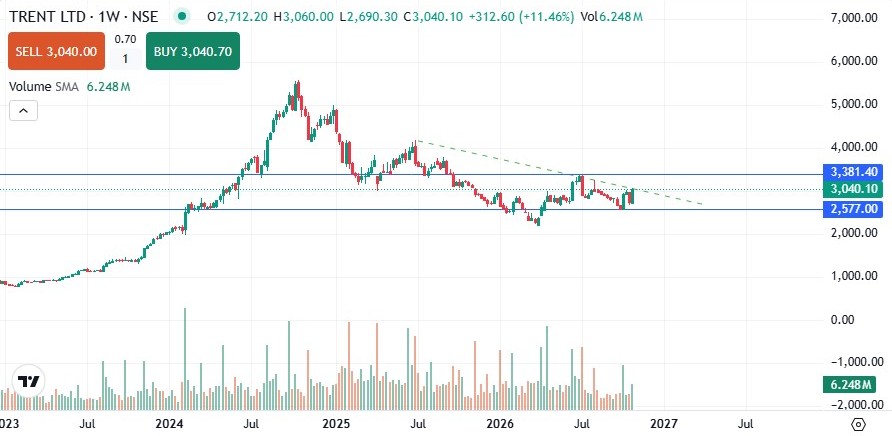
As per my view, Trent is showing signs of a potential reversal, but Rs.3,381 is the key breakout level. A retest or short-term downside remains possible, with Rs.3,137
(Fibonacci 0.5 level) acting as important support. A strong weekly close above Rs.3,381 with good volume would turn the setup bullish; until then, it remains in
consolidation between Rs.2,577 and Rs.3,381.
Trent’s results offer encouraging signs, but the direction of its share price will depend on future performance and the expectations already reflected in its valuation.
These are the main factors worth following:
| What to watch | Why it matters |
|---|---|
| Existing-store sales | Shows whether demand is improving across established locations |
| Operating margins | Helps assess whether growth is translating into better profitability |
| Store productivity | Indicates how effectively the company is using its expanding footprint |
| Inventory and cash flow | Helps test whether reported earnings are supported by healthy operations |
| Valuation | Shows how much future growth investors may already be paying for |
From a technical perspective, an earnings-day rise alone is insufficient to confirm a lasting uptrend. Subsequent price behaviour, trading volumes and the broader market trend would need to be assessed before drawing that conclusion.
How Should Investors Approach Stocks After Strong Results?
Start by asking what has changed. Has customer demand improved? Are margins becoming more sustainable? Is growth supported by cash generation? And does the current share price leave room for earnings to fall short of expectations?
Then consider your own portfolio. Adding another consumer stock may increase concentration if you already have substantial exposure to the sector. A SEBI Registered Investment Advisor can help assess investments in relation to your goals and risk profile.
If you are comparing the best ai app for trading in india, look closely at the research approach, fees, risk disclosures and whether the service fits your investment horizon. Choosing a platform starts with understanding what you need from it.


Conclusion
Trent’s Q2 performance gives investors reasons to watch the business closely. Improving demand at existing stores and stronger operating performance are encouraging, while expansion creates opportunities for further growth.
The next test is consistency. Investors will want to see whether Trent can maintain profitability, improve store productivity and deliver earnings that support market expectations. Before making a decision based on Trent share price, consider how the investment fits your broader financial goals.
With Jarvis Invest, explore an AI-led approach to stock market investing and review the available solutions, subscription features, fees and risks. Take time to understand the service and choose a plan suited to your investment needs.