
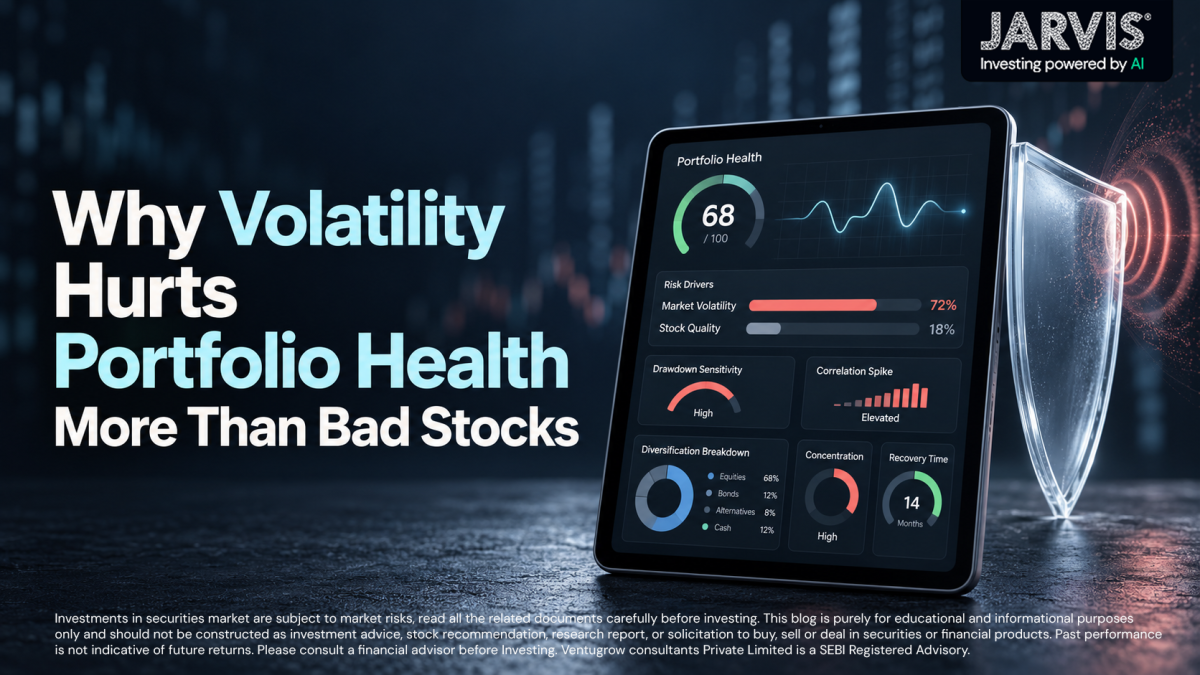
When markets are volatile, do you often blame poor stock choices? In reality, volatility damages stock portfolio health more than a few bad picks. Bad stocks hurt single holdings. Volatility tests the whole stock portfolio and investor discipline. Here’s how and why it does more harm than bad stocks.
Understanding Volatility
Imagine you travel to work every day along a road connecting your home to your office.
On some days, traffic moves smoothly. You reach on time, and the journey feels predictable. On other days, there are sudden jams, short clear stretches, unexpected diversions, and stop-and-go movement. Even if you still reach your office eventually, the journey feels stressful and uncertain.
That stop-and-go movement is volatility.
In the investing world, volatility refers to the speed and intensity with which prices move up and down. From a portfolio health perspective, volatility is not just about price movement. It is about how those movements interact with your portfolio structure and your behaviour.
A healthy stock portfolio is designed to absorb volatility without forcing emotional decisions. An unhealthy portfolio magnifies volatility and turns normal market fluctuations into stress.
Why Bad Stocks Are Easier to Fix Than Poor Portfolio Health
A bad stock usually shows clear warning signs over time. Weak earnings, high debt, or poor management eventually become visible. Once identified, a bad stock can be removed without disturbing the rest of the portfolio.
Poor portfolio health is harder to diagnose. Concentration risk, hidden correlations, and misaligned asset allocation often remain unnoticed until volatility exposes them. By the time this happens, damage is already widespread.
How Volatility Exposes Weak Portfolio Structure
Let us understand this with an example. An investor has 8 different stocks in his/her portfolio, but 6 of them belong to the same sector. When volatility hits that sector, all 6 stocks fall together, and the portfolio drops sharply. Even though the investor owned many stocks, the risk was actually concentrated in a single stock. Volatility exposed that the portfolio only looked diversified, but was weak in structure.
Volatility acts like a stress test. When markets fall, overexposed sectors fall together, concentrated positions drop sharply, and liquidity disappears where it is needed most.
A stock portfolio that looked balanced during rising markets may suddenly feel fragile. This does not happen because the stocks turned bad overnight, but because the portfolio was never built to handle stress. Healthy portfolios bend under volatility. Unhealthy ones crack.
Volatility Damages Portfolio Health Through Behaviour
Portfolio health is not only about numbers. It is also about how comfortable an investor feels staying invested. High volatility increases anxiety and leads to frequent checking, impulsive decisions, and unnecessary buying and selling. Investors start reacting to price movements instead of reviewing structure and risk.
Over time, this behaviour weakens portfolio health by increasing transaction costs, reducing exposure to recoveries, and breaking long-term discipline.
Why Volatility Hurts Long-Term Portfolio Outcomes
Long-term portfolio health depends on consistency. Volatility interrupts this by encouraging investors to reduce exposure at the worst possible time. Even if the underlying businesses remain strong, exiting during volatile periods converts temporary declines into permanent losses. Re-entering later often happens at higher prices, further damaging outcomes.
Bad stocks reduce returns gradually. Volatility-driven behaviour damages the entire portfolio at once.
Why Portfolio Health Matters More Than Individual Stock Quality
Strong stocks inside a fragile portfolio still lead to poor outcomes. Weak stocks inside a well-structured portfolio often cause limited damage.
Portfolio health Check determines how risks interact, how losses are absorbed, and how recoveries are captured. It decides whether volatility becomes a short-term inconvenience or a long-term problem. This is why experienced investors focus more on portfolio construction than on finding perfect stocks.
Managing Portfolio Health Is the Best Defence Against Volatility
Volatility cannot be avoided, but its impact on portfolio health can be reduced. Diversification across sectors, sensible position sizing, and alignment with personal goals all act as shock absorbers.
A healthy portfolio helps investors stay invested during uncertainty rather than reacting emotionally. This alone improves long-term results more than frequent stock changes.
How Investors Should Think About Volatility and Portfolio Health
For new investors, volatility often feels like something is going wrong. In reality, volatility is normal. What matters is whether your portfolio can handle it. Instead of asking which stock is causing losses, it is more useful to ask whether the portfolio is overexposed, misaligned, or poorly diversified.
This shift in thinking is critical for long-term success.
Before You Go
A portfolio rarely fails because of one bad stock. It fails because risks quietly accumulate – overexposure to a sector, weak diversification, delayed exits, or holding declining companies for too long. Over time, these small mistakes compound and weaken portfolio health.
Successful investors understand that portfolio management is not a one-time decision – it is a continuous process of monitoring, rebalancing, and managing risk.
Before searching for the next multibagger, the smarter step is to evaluate the strength of what you already hold with Jarvis Invest.
Use the Jarvis Portfolio Health Check to analyse your current portfolio. It helps identify risk concentration, weak stocks, sector imbalance, and structural gaps that could affect long-term performance. Once you understand the health of your portfolio, the next step is disciplined action.
If you already hold stocks and want AI-driven monitoring with timely sell signals and risk alerts, Jarvis Protect helps you actively manage your portfolio by identifying when a stock should be exited to protect your capital.
Markets will always fluctuate. But investors who regularly evaluate portfolio health and act on data-driven insights are far more likely to protect capital and build long-term wealth.


Start by checking your portfolio with the Jarvis Portfolio Health Check, and if your portfolio requires adjustments, Jarvis Protect can help you safeguard and optimise it with AI-driven sell signals.