
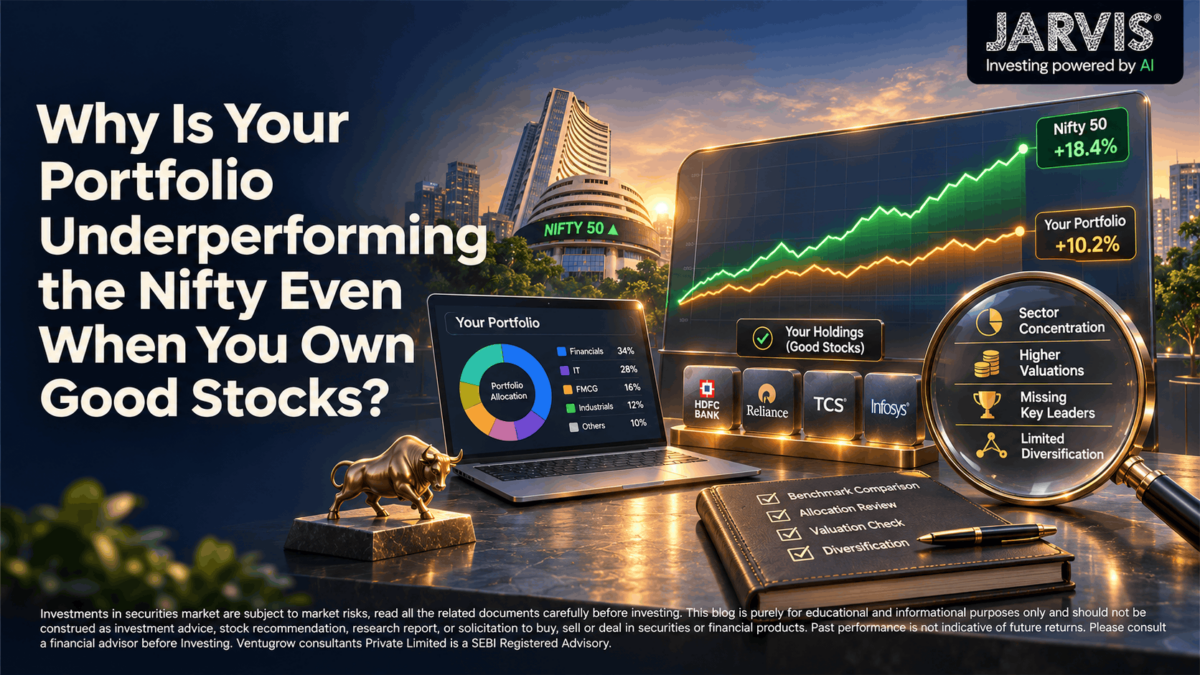

You might have some good brands and a good balance sheet and have long-term growth prospects in some of your businesses but still be lagging behind the Nifty 50. This is because the quality of a company’s business is not synonymous with the return on the investment in its stocks.
Even when the share price is already in line with expectations, those results can still not meet the investors’ expectations. The valuation and the context should be studied in AI stock analysis, not company funds only.
The issue could also be in the portfolio’s structure. Relative performance can be impacted by a couple of large positions, some underperforming sectors, and holdings that are cobbled together or just not matching the index. To prevent selling a mediocre stock, investors should ensure that they have a systematic approach for reviewing their stocks, with the help of a comparable AI for stock market review.
Five Reasons Your Portfolio May Be Underperforming Nifty
1: Buying good companies at expensive valuations
However, a solid company can turn out to be a bad investment if you buy it at too high a price. Earnings could improve, but the stock could not appreciate. If years of anticipated growth have already been factored into the price. Even if the business is performing well, returns can be undermined during periods of falling expectations and falling valuation. When valuing a stock market AI research, one should look at earnings growth, cash flow, and the business’s future as well as debt.
2: Too much exposure to underperforming sectors
A portfolio can have good companies and still underperform if a significant portion of the funds are invested in poor areas of the market. If the portfolio is heavily weighted in a sector with slower growth in demand or margin pressure, for instance, then strong individual businesses are not going to compensate for weak returns. When using AI stock analysis, it’s important to take into account the weights of the stocks in a portfolio and how they perform relative to the benchmark, rather than examining each stock individually.
3: Holding too many similar stocks
A portfolio of 20 or 30 stocks wouldn’t necessarily be considered diversified. Multiple holdings might rely on the same economic conditions, customer demand, interest rates, or commodity prices. When that common driver fails, multiple stocks can experience a decline. A disciplined AI for the stock market should analyze joint exposures in the sectors and businesses, not just the number of holdings.
4: Missing the market’s leading stocks
The Nifty 50 Index is free-float market cap weighted, which implies that the larger the companies, the higher the weight of the index components compared to smaller-sized companies. A portfolio that excludes or underweights some of the index’s largest contributors can underperform even if its stocks do well. Comparisons between portfolio weights and the index are a benefit of stock market AI research, but such an approach is not necessarily an appropriate strategy for every investor.
5: Comparing returns over different periods
When the dates don’t align, performance comparisons can be misleading. It is not an appropriate way to compare a portfolio’s return from the time of purchase with a different index return over a different period. Investors also need to consider dividends, transaction costs, cash, and whether to compare the price return or total return. The ability to compare the portfolio and benchmark consistent large caps makes AI stock analysis more meaningful.
How to Identify What Is Dragging Down Your Portfolio
Begin by examining the contribution of each holding to gains/losses. The percentage impact of a stock that has dropped precipitously can be small when the position is small and can be significant when the position is large; the converse also holds. While AI stock analysis can assist in organizing this review, it is important for investors to be aware of the reasons for the performance of each stock.
Then, compare the exposure to your sectors and market caps with the benchmark. Re-check company earnings growth, margin, debt, valuations, and, if any, a change of the investment thesis. Find positions and holdings that are too large in comparison to the risk.
A stock that is declining is not a poor investment, and a stock that is rising is not a good investment either. While stock market AI tools can assist in this process, it is important to remember that trading decisions should be made based on evidence, not just price movements.
Nifty Comparison – Are You Measuring Performance Fairly?
The Nifty 50 index may be a good index for a large cap portfolio. But if you have a portfolio of mid-cap or small-cap stocks, the Nifty 50 is not a good comparison. Pick the benchmark that is consistent with your portfolio’s investment universe and objective. The comparison should be made easier by AI stock analysis, not a reason for investors to join a stampede to whichever index has just had the most successful performance.
Be sure to use the same return period and dates. The Nifty 50 Total Returns Index (TRI) is different from the regular price index and is calculated with the reinvested dividends. Also take into account risk: a portfolio that makes a bit less but has less volatility will work just as well for that person as a portfolio that makes a lot more but has a lot more volatility. The returns in stock market research should be considered with the objective of investments and the risk level.
How to Improve Portfolio Decisions Without Chasing the Nifty
Trading in response to all market activity is a bad strategy; checking holdings regularly is better. Re evaluate the original investment thesis based on the earnings, valuations, and business fundamentals. Do not buy when stock prices are low only because of the idea that you need to add to a stock, and consider if there are any hidden sector concentrations. While these checks can be structured with the use of stock market AI research, there are other factors that need to be taken into account when it comes to changing your portfolio, including your financial goals, time horizon, and loss tolerance.
The intention is not to win the Nifty monthly or quarterly. Relative performance will fluctuate due to market conditions, and too many switches can add up and cause reactive decisions. Be consistent with the review process and only rebalance when it is found that there is a good reason to do so. While Jarvis AI tools can assist in structuring portfolio insights, they do not necessarily ensure that a shift in strategy will lead to better returns in the future.
How Jarvis Portfolio Health Check Can Help
Jarvis Portfolio Health Check also provides an AI-powered portfolio review for investors who wish to review their current portfolio. It can give an idea of risky stocks, underperforming stocks, concentration in sectors, diversification, and how a particular stock is doing as compared to the Nifty, Jarvis said. These can provide investors with a place to start further research on where their investments might require more in-depth attention.
Next, take a look at the cause of any identified problem. The reasons a stock may be underperforming vary from simple market weakness to a high valuation or weak business fundamentals, and the analysis should be different.
Jarvis Invest India readers should not consider the health check as a buy or sell signal; it should be used as a research tool. There is no investment tool that promises higher returns or can foretell all market movements.
Final Thoughts
Business quality is not the only reason for investment returns, and a portfolio may have fundamentally good companies yet underperform the Nifty. Sector exposure, position size, and entry valuations are also important. By carefully examining the factors, investors can conduct an AI stock analysis rather than simply jumping on the bandwagon of short-term performance.
But rather, how much better is your portfolio than the index, and are you taking the right amount of risk for your goals? Jarvis Portfolio Health Check can be a starting point, and the final investment decision should be based on your circumstances, research, and long-term plan. The objective is to make better decisions, not guaranteed outperformance.