Jarvis
  • CATEGORIES
    • Equity Markets
    • Investing Basics
    • AI for investing
    • Trending Stock Market News: Quick Reads
    • Portfolio Management
    • Stock Market News Updates
    • Global Stock Market
    • Stock Advisory
  • I AM A
    • Beginner
    • Intermediate
  • Home
  • Products
    • Jarvis Portfolio
    • Jarvis Protect
    • Jarvis OneStock
    • Jarvis Prime – For HNIs & UHNIs
    • Jarvis Sentiment Tracker – AI Tool for F&O
    • Jarvis US Multi-Asset Portfolio
    • Jarvis Atlas
  • FAQs
  • About Us
  • Contact Us
  • Become a Partner
No Result
View All Result
Jarvis
No Result
View All Result
Home Investing Basics

A 30% Fall Needs a 43% Recovery – Can Your Stock Portfolio Handle It?

by Sumit Chanda
November 14, 2026
in Investing Basics
Reading Time: 9 mins read
A A
0
A 30 fall needs a 43 recovery   can your stock portfolio handle it

A 30% Fall Needs a 43% Recovery - Can Your Stock Portfolio Handle It

Share on FacebookShare on Twitter

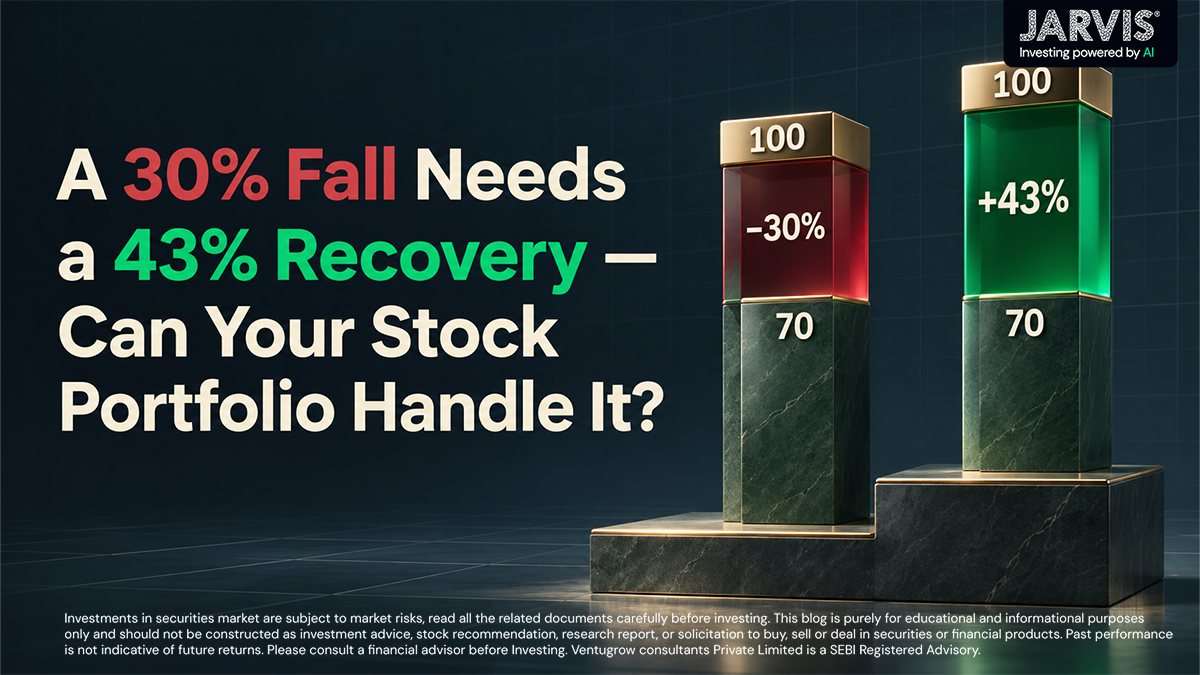
A ₹10 lakh stock portfolio falls by 30% during a market correction. Its value drops to ₹7 lakh. Now, the investor needs a 30% gain to recover, right? Not quite. A 30% return on ₹7 lakh adds just ₹2.1 lakh, leaving the portfolio at ₹9.1 lakh. To return to ₹10 lakh, the portfolio must gain approximately 42.9%.

This is one of the most important mathematical realities of investing: losses and gains are not symmetrical. The deeper a portfolio falls, the harder it becomes to recover. Understanding this relationship can help investors evaluate risk, manage volatility and build portfolios that can withstand difficult market conditions.

Why Does a 30% Loss Require a 43% Recovery?

The reason is simple: investment returns are calculated on the portfolio’s current value, not its original value. Suppose an investor starts with ₹10 lakh and experiences a 30% decline. The portfolio falls to ₹7 lakh. A subsequent 30% gain takes it to ₹9.1 lakh, not back to the original investment.

To recover the missing ₹3 lakh, the investor needs a return of ₹3 lakh on the remaining ₹7 lakh. That translates to approximately 42.9%. The recovery requirement becomes increasingly demanding as losses deepen.

PORTFOLIO DECLINEVALUE LEFT FROM ₹10 LAKHSGAIN REQUIRED TO RECOVER
10%₹9 lakh11.1%
20%₹8 lakh25%
30%₹7 lakh42.9%
40%₹6 lakh66.7%
50%₹5 lakh100%

The pattern is clear: a 50% loss requires a 100% gain just to return to the starting value. This is why limiting severe losses can be an important part of long term portfolio management.

Why Stock Portfolio Drawdowns Matter More Than Investors Expect

Investors often focus on annual returns, benchmark performance and their biggest winning stocks. However, the depth of a portfolio’s decline can be equally important. A drawdown measures the fall in portfolio value from a previous peak to a subsequent low.

For example, if a portfolio rises from ₹10 lakh to ₹12 lakh before falling to ₹8.4 lakh, it has experienced a 30% drawdown from its peak.

Drawdowns can affect both financial outcomes and investor behaviour. A substantial decline may create pressure to sell investments at unfavourable prices, particularly when the investor needs money for an upcoming expense. The risk becomes more significant when portfolios are concentrated in a few stocks, highly exposed to one sector or invested in businesses with deteriorating fundamentals.

What Can Cause a Stock Portfolio to Fall 30%?

A sharp portfolio decline does not always require a single dramatic event. Several risks can combine to produce substantial losses. Market-wide corrections caused by economic uncertainty, rising interest rates or geopolitical tensions can push down share prices across multiple sectors. Individual companies may also fall because of disappointing earnings, excessive debt, governance concerns or declining competitive advantages.

Concentration risk can magnify the damage. If a large portion of a portfolio is invested in one company or sector, a negative development affecting that exposure can significantly reduce total wealth. Valuation risk matters, too.

Even a financially strong company can experience a substantial share-price correction if investors previously paid too much for its expected growth. A diversified portfolio can reduce some company-specific risks, although diversification cannot eliminate market-wide losses.

How Can Investors Make Their Portfolios More Resilient?

The first step is to understand how much risk the portfolio actually carries. Investors should review individual stock weights, sector exposure, debt-related risks and the extent to which holdings move together during market stress.

Diversification across suitable asset classes, sectors and companies can help reduce dependence on a single investment outcome. The right allocation depends on an investor’s financial goals, investment horizon, liquidity needs and ability to tolerate losses.

Investors should also maintain an appropriate emergency fund. Money needed for near-term expenses should not depend entirely on recovering stock-market prices. Regular rebalancing can help prevent a successful stock from becoming an excessively large position.

However, investors should consider taxes, transaction costs and the underlying business outlook before making changes. Importantly, risk management does not mean avoiding every decline. Equity investments naturally experience volatility. The objective is to avoid taking risks that could permanently damage financial goals or force investors to sell at the wrong time.

Why Recovery Time Matters

Even after a portfolio begins recovering, returning to its previous value can take time. The required recovery depends on the size of the original loss and the returns achieved afterwards.

For example, if a ₹10 lakh portfolio falls to ₹7 lakh, a hypothetical annual return of 10% would take approximately 3.8 years to restore it to ₹10 lakh, assuming steady annual compounding and no additional contributions, withdrawals, fees or taxes.

Actual markets do not deliver steady returns, so recovery may be faster or considerably slower. Some investments may never recover their previous highs. This is why investors should distinguish between temporary market declines and permanent impairment caused by weakening business fundamentals.

How Data-Driven Stock Portfolio Analysis Can Help

Investors can assess portfolio resilience by examining historical drawdowns, concentration, volatility and the potential impact of adverse market scenarios. Stress testing can help illustrate how different holdings might respond to a sharp decline, although past behaviour cannot guarantee future outcomes.

Data-driven investment research platforms such as Jarvis Invest can complement portfolio reviews by helping investors evaluate financial trends and portfolio risks. However, no analytical tool can eliminate market risk or guarantee recovery.

Final Thoughts

A 30% portfolio decline requires a 42.9% gain to recover because the recovery starts from a smaller capital base. As losses deepen, the required return rises disproportionately.

For investors, the lesson is not to fear every market correction but to understand the risks they are taking before a correction occurs. Building wealth is not only about capturing market gains. It is also about managing losses well enough to stay invested and pursue long-term financial goals with Jarvis Portfolio from SEBI Registered Investment Experts.

Disclaimer: The information, data, charts and company references presented in this article are compiled from publicly available sources believed to be reliable. While reasonable efforts have been made to ensure accuracy, Jarvis Invest does not guarantee the completeness, accuracy or timeliness of the information. This content is intended solely for educational and informational purposes and should not be construed as investment, financial or trading advice. Investments in securities are subject to market risks. Please conduct your own research or consult a SEBI Registered Investment Advisor before making any investment decision. Jarvis Invest is a SEBI Registered Investment Adviser (Registration No. INA000013235). Past performance is not indicative of future results.
Tags: AI based stock trading IndiaAIbasedstockmarketdiversified investment portfoliodiversified portfoliojarvis ailong term portfolio managementSEBI Registered Investment Advisorshare market advisorstock market aistock market portfoliostock portfoliowhat is portfolio in stock market
Sumit Chanda

Sumit Chanda

Sumit has 18 years of experience in BFSI industry, into devising strategy for various functions, Investments and Managing Asset Portfolios. Specializes in Strategy & implementation in sales & operations, Team management, IT implementation, Affiliations.

Leave a Reply Cancel reply

Your email address will not be published. Required fields are marked *

Get access to AI-picked stock ideas, market insights and research updates daily tailored to your investing style.

Popular Posts

  • A 30 fall needs a 43 recovery   can your stock portfolio handle it
    A 30% Fall Needs a 43% Recovery – Can Your Stock Portfolio Handle It?November 14, 2026
  • Promotional banner for stock market news top 8 stock market news you need to know with a bull statue stock charts and a collage of industries like construction manufacturing and aviation
    Stock Market News Updates – 13th November, 2026November 13, 2026
  • Graphic for friday stock market outlook 10 cues that could move stocks today with icons for global markets oil bonds currencies inflation and more
    Friday Stock Market Outlook – 10 Cues That Could Move Stocks TodayNovember 13, 2026
  • Midterm elections and us stocks   what history says what just happened and what to do about it now
    Midterm Elections and US Stocks – What History Says, What Just Happened, and What to Do About It NowNovember 12, 2026
  • Jewellery stocks beat nifty as festive gold demand picks up
    Jewellery Stocks Beat Nifty as Festive Gold Demand Picks UpNovember 12, 2026

Recent Posts

  • A 30% Fall Needs a 43% Recovery – Can Your Stock Portfolio Handle It? November 14, 2026
  • Stock Market News Updates – 13th November, 2026 November 13, 2026
  • Friday Stock Market Outlook – 10 Cues That Could Move Stocks Today November 13, 2026
  • Midterm Elections and US Stocks – What History Says, What Just Happened, and What to Do About It Now November 12, 2026
  • Jewellery Stocks Beat Nifty as Festive Gold Demand Picks Up November 12, 2026

Browse by Category

Jarvis Invest

India's AI-powered, SEBI-registered investment advisory — research, portfolios and global market intelligence for every investor.

Company

  • About Us
  • FAQs
  • Contact Us
  • Become a Partner

Products

  • Jarvis Portfolio
  • Jarvis Protect
  • Jarvis OneStock
  • Jarvis Prime
  • Sentiment Tracker (F&O)
  • US Multi-Asset Portfolio

Explore Topics

  • Equity Markets
  • Investing Basics
  • AI for investing
  • Trending Stock Market News: Quick Reads
  • Financial Planning
  • Portfolio Management
  • Stock Market News Updates
  • Global Stock Market

Get in touch

Customer support customersupport@jarvisinvest.com

Jarvis Invest — SEBI Registered Investment Adviser (Reg. No. INA000013235) & SEBI Registered Research Analyst (Reg. No. INH000018762). Investments in the securities market are subject to market risks. Read all the related documents carefully before investing. Registration granted by SEBI and certification from NISM in no way guarantee performance of the intermediary or provide any assurance of returns to investors.

© 2026 Jarvis Invest. All rights reserved.

  • Privacy Policy
  • Terms & Conditions
  • Disclaimer
Categories
Equity MarketsGet latest insights on the Indian equity market including stock trends, market analysis, sector…Investing BasicsLearn stock market basics including investing fundamentals, equity concepts, and beginner-friendly guides to start…AI for investingStay ahead with AI-powered stock insights, trend analysis, and intelligent investing strategies for ai…Trending Stock Market News: Quick ReadsDiscover the latest trends in the stock market with insightful blogs from Jarvis Invest…Portfolio ManagementExpert insights on portfolio management, asset allocation, risk management, and strategies to optimise best…Stock Market News UpdatesGet daily stock market news updates, key market movements, and insights that matter to…Global Stock MarketGet latest global stock market news, trends, and AI-driven stock insights on US, Europe…Stock AdvisoryLearn how AI-powered stock advisory and expert market research can help you build wealth.
I Am A
BeginnerBeginner-friendly stock market guides covering investing basics, common mistakes, and simple strategies to build…IntermediateIntermediate-level stock market insights covering investment strategies, portfolio analysis, and market concepts for informed…
Products
Jarvis PortfolioModel portfolio matched to your risk profile for long-term wealth creation.Jarvis ProtectContinuous portfolio monitoring for your existing portfolio with timely sell alerts to help manage downside risk.Jarvis OneStockHigh-conviction stock recommendations designed for short-term investing.Jarvis Prime - For HNIs & UHNIsPremium portfolio management services for investors with ₹25 lakh+ investment corpus.Jarvis Sentiment Tracker - AI Tool for F&OReal-time market sentiment analysis and trading signals for options traders.Jarvis US Multi-Asset PortfolioDiversified US portfolio investing across stocks and ETFs with automated portfolio management.Jarvis AtlasInvestment opportunities across Indian equities, global markets, and commodities in 10+ global markets.
No Result
View All Result
  • CATEGORIES
    • Equity Markets
    • Investing Basics
    • AI for investing
    • Trending Stock Market News: Quick Reads
    • Portfolio Management
    • Stock Market News Updates
    • Global Stock Market
    • Stock Advisory
  • I AM A
    • Beginner
    • Intermediate
  • Home
  • Products
    • Jarvis Portfolio
    • Jarvis Protect
    • Jarvis OneStock
    • Jarvis Prime – For HNIs & UHNIs
    • Jarvis Sentiment Tracker – AI Tool for F&O
    • Jarvis US Multi-Asset Portfolio
    • Jarvis Atlas
  • FAQs
  • About Us
  • Contact Us
  • Become a Partner

© 2023 Jarvis Invest

Go to mobile version