
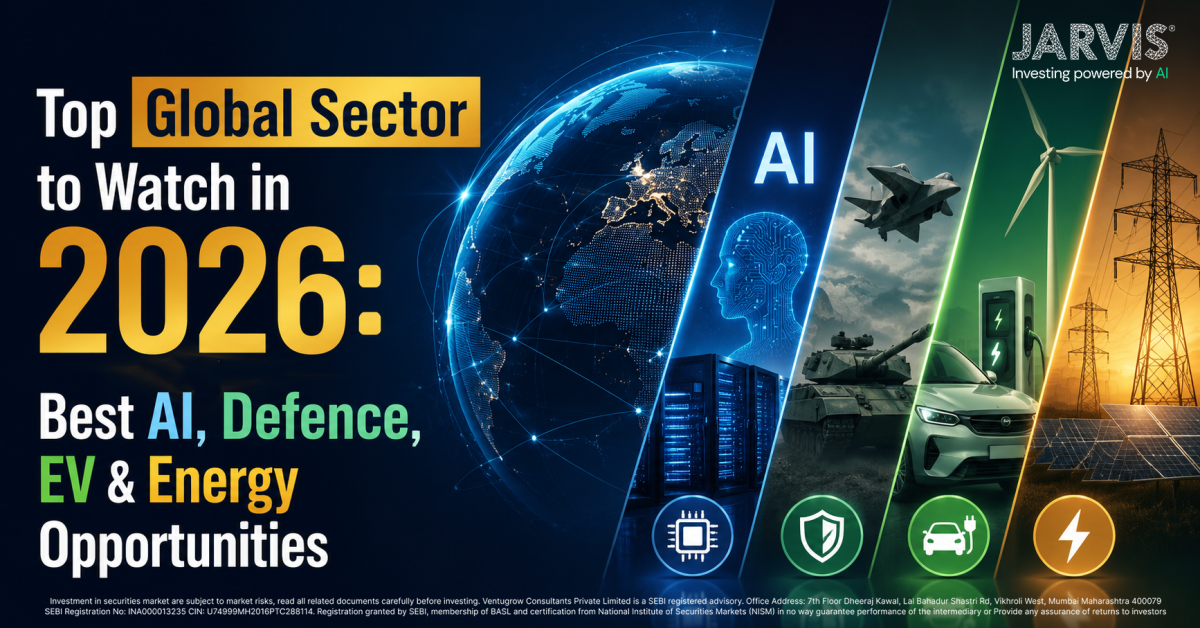

Let’s be honest. Most investors are either too early or too late. They hear about a big trend after it has already run, or they jump in before it is actually ready. Both mistakes cost money. If you’re trying to identify the top global sectors in 2026: where is serious, institutional money moving right now, and why?
The answer keeps pointing to the same four sectors.
AI-Powered Intelligence
Defence
Battery-Powered Vehicles
Clean Energy
But here is the thing: most people do not realize that these four are not separate investments.
We’ve prepared a guide for you to understand all these sectors.
1. Artificial Intelligence
Billions of dollars are being spent on chips, data centres, power systems, and software right now, not in some future year. Morgan Stanley Research estimates that nearly $3 trillion in AI infrastructure investment will move through the global economy by 2028. More than 80% of that has not been spent yet. Just for 2026, AI spending is estimated at $725 billion. That figure has nearly doubled compared to what people were expecting just a year ago.
The competition between the US and China over chips, computing power, and data control has made AI a matter of national importance.
What Companies Are Actually Doing With AI Right Now?
Nowadays, companies are deploying AI across real operations, such as
- Customer service,
- Logistics,
- Fraud detection,
- Medical diagnosis,
- And financial planning.
About 21% of S&P 500 companies now say they are directly benefiting from AI. The ones that have made the switch are seeing their profit margins grow at roughly twice the global average.
The companies that are slow to adopt are starting to fall behind.
- Costs are higher.
- Speed is lower.
- The gap between AI users and non-adopters is growing quietly but slowly.
Key numbers that you should keep in mind:
- AI is investing $725 billion in 2026. So, it is nearly double what was predicted a year ago.
- The estimated overall AI investment by 2028 is around $3 trillion, with 80%+ still remaining unused.
- AI users are growing profits at 2x the pace of non-users.
- The US-China competition means governments are treating AI like a security issue, not just a business one
2. Defence
Defence spending used to go up during wars and then drop when things calmed down.
In 2026, countries are spending big because they think the world has turned permanently riskier. It’s a long-term view, rather than any conflicts. Global military spending hit $2.63 trillion last year, and it’s still climbing. Europe jumped up by over 12%. For the first time ever, all 32 NATO countries hit the 2% of GDP target. Now they’re aiming for 5% by 2035. The US budget just crossed a trillion dollars, with extra cash piled on top.
This is great for defence companies because they have long-term contracts and steady orders.
What Do These Commitments Mean for the Next Ten Years?
The FY2026 defence budget was the first in American history to go over $1 trillion. Congress separately granted approval for an extra $156 billion in 2025 to speed up military upgrades.
Let’s first discuss the best and most growing sectors for your preference:
- Precision attack utilizing weapons and guided missiles.
- Drones and autonomous vehicles.
- AI-powered military intelligence and command systems.
- Cybersecurity and electronic military operations.
- Modernizing ships and air forces across Europe and Asia.
3. Electric Vehicles
People have joked about EVs being “the future” for so long that it became a meme. But in 2026, the future has arrived.
The government is pushing hard with schemes like PM E-DRIVE, building charging points, and planning to switch hundreds of thousands of buses to electric.
Let’s elaborate on them in detail:
- The PM E-DRIVE Scheme puts Rs. 10,900 crore (about $1.3 billion) directly into growing EV infrastructure across the country.
- A plan to replace 800,000 diesel buses with electric buses over seven years.
- Continued government incentives through the FAME India program for two-wheelers, auto-rickshaws, and public transport.
But smart money knows the car itself is just the best part. The bigger opportunities are in batteries, charging stations, mining the necessary minerals, recycling old batteries, and software to manage large EV vehicles.
4. Clean Energy
In most countries today, building a new solar or wind farm is cheaper than building a new coal or gas plant. The cost of solar energy has dropped by more than 90% over the last fifteen years.
And in 2026, three things are making clean energy investment even more urgent:
- AI data centres need a lot of power. Traditional energy sources cannot scale fast enough.
- Governments want energy independence. After years of supply disruptions, no country wants to be dependent on imported fuel.
- EVs are changing electricity demand patterns. Millions of cars charging overnight is reshaping when and how much electricity grids need to deliver.
Energy debt financing also grew. $1.2 trillion in clean energy bonds and project loans were issued in 2025, up 17% from 2024. Serious money is being locked in for the long term.
How US Policy Uncertainty Actually Created a Buying Opportunity
Policy in the United States around clean energy has been inconsistent. But the global numbers did not flinch. Investment still grew 8% in 2025 because Europe, China, India, and Southeast Asia kept spending.
Some professional investors recognized the US policy noise as a chance to buy quality clean energy assets at lower prices.
Conclusion
The data in this article is clear. The money is already moving. The harder question is personal. Are you positioned to benefit from what is already happening, or are you going to catch up later, at higher prices?
Investing in a world this complex takes more than reading the news. One that tracks thousands of signals at the same time, like economic data, sector flows, company results, currency shifts, policy changes, and turns all of that into clear, actionable portfolio decisions.
That is exactly what Jarvis Invest was built for. Jarvis is India’s AI-powered SEBI-registered investment platform. It reads market signals and tracks macro trends. Whether you want to participate in the global themes or simply want a portfolio that stays updated as the world changes, Jarvis does the hard analytical work for you.
You just need a platform that does it right. The question is whether your money moves with it.