
The Indian stock market never really stops talking. Prices move every second, earnings announcements arrive, global markets react overnight, and thousands of stocks compete for an investor’s attention. For an individual investor, keeping up with all of it can quickly become overwhelming. This is where AI for stock market investing is becoming increasingly relevant. But with so many platforms calling themselves AI-powered, an important question remains: what actually makes an AI stock market app useful?
AI Investing Is More Than a Buy or Sell Signal
A useful AI stock analysis app should do much more than simply tell an investor to buy or sell a stock. Stock selection is only one part of investing. A meaningful AI system can bring together fundamentals, valuation, price and volume behaviour, sentiment, news, macroeconomic factors and portfolio risk.
This matters because a fundamentally strong company can still be overpriced. A stock showing strong momentum can suddenly reverse. A sector performing well today can face pressure after a change in interest rates or commodity prices. AI-based stock analysis attempts to connect these different signals instead of viewing each one in isolation. The objective is not to eliminate research. It is to make research faster, broader and more systematic.
What Makes a Good AI Stock Market App?
When investors search for the best AI app for stock market, they often focus on the number of recommendations a platform generates. A more useful starting point is to examine how those recommendations are created.
A strong AI tool for stock analysis India should be capable of analysing company fundamentals such as revenue growth, profitability, margins, debt, cash flows and valuation. It can then combine this information with technical indicators, price movements, volume and market sentiment.
Scale also matters. An AI system can screen a large universe of stocks much faster than a human investor manually checking financial statements and charts. This makes AI for stock selection particularly useful for narrowing thousands of possibilities into a more manageable research universe.
The Bigger Opportunity Is Risk Management
Finding a stock is only the beginning. What happens after you buy it can matter just as much. This is where AI-based portfolio management India becomes interesting. AI can continuously monitor factors such as volatility, momentum, sector exposure and concentration. If market conditions or the underlying signals change, the system can identify that change rather than treating the original investment decision as permanent.
The Jarvis research framework similarly describes AI as combining fundamentals, technical indicators, sentiment, macroeconomic signals and risk monitoring rather than relying on a single signal.
For investors, this creates a different way of thinking about an AI investment tool: not simply as a stock picker, but as a system that can support the investment journey after the initial decision.
How Jarvis Approaches AI-Based Investing
This is where Jarvis AI fits into the broader AI investing landscape. Jarvis’s framework brings together multiple layers of market information, including fundamentals, price and volume behaviour, corporate actions, macroeconomic indicators, news, sentiment and market events.
The idea is to convert large volumes of market information into structured investment intelligence. For someone searching for the best AI tool for stock market, the important question therefore goes beyond how much data an AI platform can process. The more meaningful question is: how effectively can that information be converted into useful, risk-aware insights?
Why the Jarvis App Goes Beyond Stock Picking
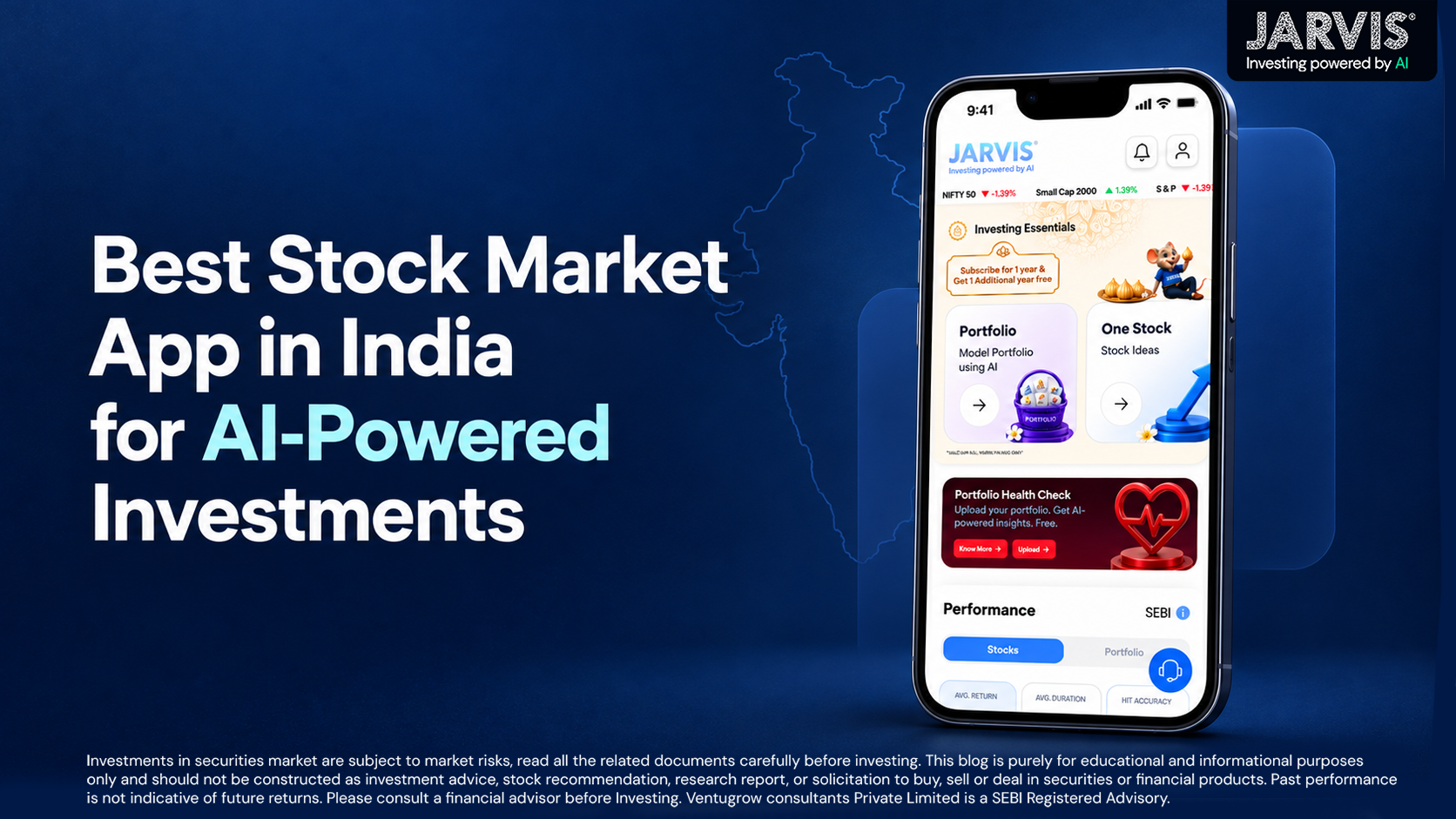
The Jarvis Invest app represents a broader approach to AI-powered investing rather than simply functioning as a stock recommendation engine. The focus extends from identifying opportunities to monitoring portfolios and changing market conditions.
That distinction becomes important when looking at an AI based investment app. Markets do not remain static, so an investment system that continuously evaluates new information can be more useful than one that treats a recommendation as a final answer.
For investors exploring AI apps for stock market, the value lies in how technology can reduce the amount of manual work involved in monitoring a constantly changing market.
Is AI Actually Predicting the Market?
This is where investors need to be careful. Searches such as AI stock prediction India, best AI for stock trading can create the impression that AI knows what a stock will do next. It does not. AI models identify patterns, relationships and probabilities based on available information. Unexpected events, incomplete data and changing market conditions can still produce incorrect signals. The uploaded Jarvis-focused research also makes this distinction clear: AI generates signals and investment ideas, not certainty.
So the real value of AI for investing in stocks is not necessarily perfect prediction. It is the ability to process information at a scale and speed that would be difficult for an individual investor to replicate manually.
Human Investors Still Matter
The future of AI investing does not necessarily have to be AI versus humans. AI can process large datasets, screen stocks, identify patterns and continuously monitor market signals. Humans can provide context, question assumptions and decide how much risk they are willing to accept.
That makes the combination particularly interesting. For someone evaluating an AI stock trading app India, AI investing platform or AI app for Indian stock market, the focus should be on the quality of analysis, transparency of signals, risk management and the overall investment process not simply the number of stocks the platform recommends.

Conclusion
The most useful AI stock market app is not necessarily the one promising the most dramatic prediction. It is the one that can turn data into context, signals into research and research into a structured investment process. For Indian investors, that may be the real shift AI brings to the stock market.
Because when thousands of stocks, millions of data points and endless market headlines compete for your attention, the biggest advantage may not be knowing more. It may be knowing what actually matters.


