Jarvis
  • CATEGORIES
    • Equity Markets
    • Investing Basics
    • AI for investing
    • Trending Stock Market News: Quick Reads
    • Portfolio Management
    • Stock Market News Updates
    • Global Stock Market
    • Stock Advisory
  • I AM A
    • Beginner
    • Intermediate
  • Home
  • Products
    • Jarvis Portfolio
    • Jarvis Protect
    • Jarvis OneStock
    • Jarvis Prime – For HNIs & UHNIs
    • Jarvis Sentiment Tracker – AI Tool for F&O
    • Jarvis US Multi-Asset Portfolio
    • Jarvis Atlas
  • FAQs
  • About Us
  • Contact Us
  • Become a Partner
No Result
View All Result
Jarvis
  • CATEGORIES
    • Equity Markets
    • Investing Basics
    • AI for investing
    • Trending Stock Market News: Quick Reads
    • Portfolio Management
    • Stock Market News Updates
    • Global Stock Market
    • Stock Advisory
  • I AM A
    • Beginner
    • Intermediate
  • Home
  • Products
    • Jarvis Portfolio
    • Jarvis Protect
    • Jarvis OneStock
    • Jarvis Prime – For HNIs & UHNIs
    • Jarvis Sentiment Tracker – AI Tool for F&O
    • Jarvis US Multi-Asset Portfolio
    • Jarvis Atlas
  • FAQs
  • About Us
  • Contact Us
  • Become a Partner
No Result
View All Result
Jarvis
No Result
View All Result
Home Global Markets

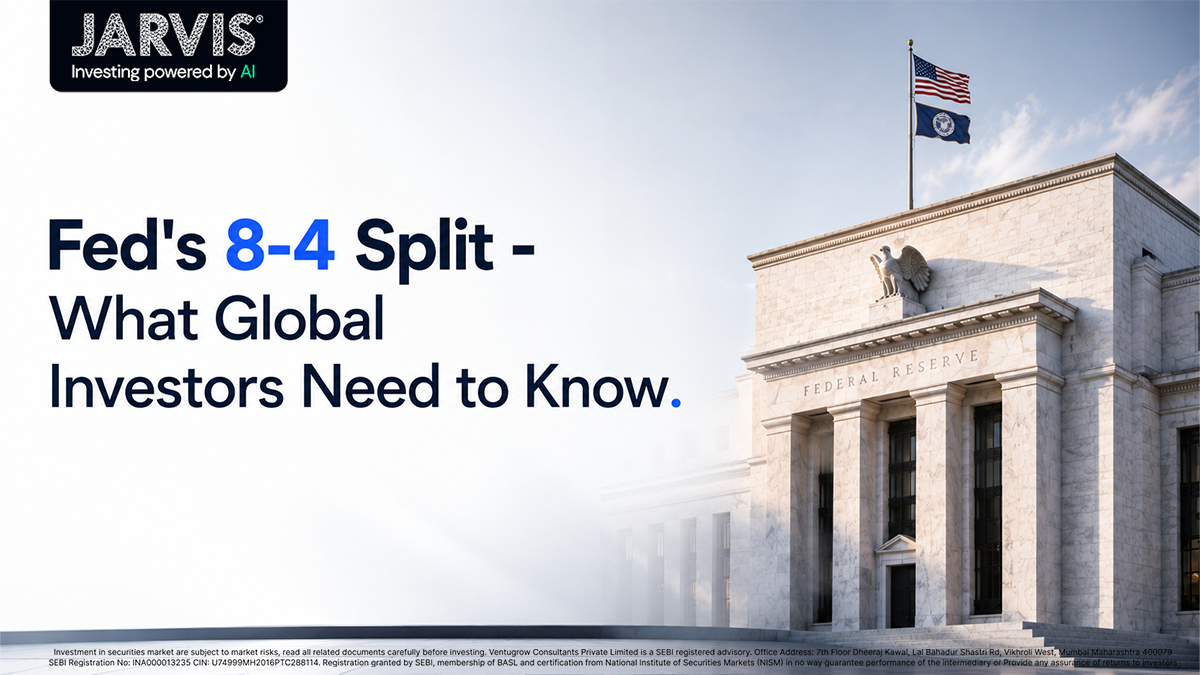
Fed’s 8-4 Split – What Global Investors Need to Know

by Sumit Chanda
August 13, 2026
in Global Markets
Reading Time: 11 mins read
A A
0
Feds 8 4 split   what global investors need to know

Fed's 8-4 Split - What Global Investors Need to Know

Share on FacebookShare on Twitter

How the Fed’s Historic 8-4 Split Could Impact US Stocks

The interest rate doesn’t move markets; it’s what the central bank’s decision signals about future rates that moves markets. The 8 – 4 decision by the Federal Reserve, the most split since 1992, indicates a shift in the Fed’s inflation and monetary policy perspectives, with potential implications for US stocks. These signals are as crucial to global investors around the world as are corporate earnings.

Everyone is talking about the Historic 8-4 Vote – What it means.

The Federal Reserve divined the interest rate it will keep in place for the next meeting at its latest gathering, when it chose to hold its benchmark rate steady at 3.50%–3.75%. The voting pattern, however, was what caught investors’ interest in the decision, and not the decision itself.

It was the most split Federal Open Market Committee (FOMC) vote since October 1992, with an 8 – 4 vote. This is uncommon, as the committee generally tries to give a unified message to the financial markets.

However, rather than coming from one place, there was a divergence in views on the economy’s management, and uncertainty about inflation and rate moves is growing.

Why did Fed Officials disagree?

While everyone agreed that inflation is still an issue, they disagreed over the Fed’s next message.

Three policymakers voted to maintain the status quo on rates, but opposed any mention of future reductions, noting that inflation threats are still high. One policymaker, however, preferred to cut the rate by 25 basis points sooner, as he felt the economy warranted a policy easing.

The disagreement is due to two conflicting concerns:

  • The inflation rate is still above the Fed’s long-term target.
  • In the longer run, rising borrowing rates may begin to drag down economic growth.

The meeting was not a blueprint of future policymaking but a reminder that future policymaking will rely greatly on future economic data. Still, the Fed’s top worry is inflation.

The take-home from the meeting was that inflation hasn’t been tamed.

Specifically, the Fed noted that global energy prices have been among the factors driving up inflation, and that continued geopolitical uncertainty remains a concern for the economic outlook. Higher oil prices can also lead to higher transportation, production and, ultimately, consumer costs for everyday goods and services.

Although inflation has subsided from its high levels, the door is open for policymakers to be cautious about declaring victory too early.

Why Global Investors Should Pay Attention to the Fed’s Words

Interest rates are not always the most important factor, as markets are more inclined to pay heed to the accompanying text.

The words in statements like “easing bias,” “inflation remains elevated,” and “data-dependent” can have a large impact on expectations for future interest rates. Such expectations have an impact on the value of stocks, interest rates on bonds, exchange rates of currencies, and interest rates for borrowing, globally.

That is why pro investors always study the tone of the Fed’s statement and minutes of the meeting.

What does this imply for U.S. stocks?

When the Fed is uncertain, so is the stock market. Investors start to question their outlook for corporate profits, interest rates, economic growth and US Stock recommendations when policymakers disagree on interest rate policy. This is also where stock market AI can help investors analyse changing market signals and understand how shifts in monetary policy may influence investment opportunities.

The technology sector, among others, which is oriented toward growth, may benefit from lower rates, while higher rates can negatively affect company valuations. Financial institutions, consumer businesses, and areas with interest sensitivity could also have more volatility until the policy clarity comes through.

Instead of worrying about the short-term ups and downs of the economy, investors should be aware of whether upcoming economic data will validate the Fed’s inflation fears or lead to slower growth.

What This Could Mean for the US Dollar and the Rupee?

A decision by the Fed does not only impact the US economy, but also the world’s currencies.

When investors think that interest rates in the United States are likely to stay higher for longer, the US dollar tends to appreciate as investors rush to dollar-denominated assets. Many countries may find the escalating import costs to be a result of the stronger dollar, which may also put pressure on emerging market currencies, such as the Indian rupee.

The currency fluctuations can make a positive or negative difference for the overall returns of Indian investors whose currency is exposed to US assets after converting in rupees. This is in addition to stock performance and makes fluctuations in exchange rates an important component of global portfolio management.

Global Investors Should Pay Attention to Interest Rates as Well as Other Factors

This is one piece in a big puzzle that the Fed is trying to solve. Monetary policy is influenced by inflation, oil prices, employment data, bond yields, and geopolitical developments.

The recent Fed statement, for instance, mentioned rising prices for energy supplies in the world as one of the risks to inflation. The inflation outlook could become less favourable if oil prices stay high, which would mean there might be less scope for rate cuts soon. However, any slowdown in economic growth or a slowdown in inflation could alter the Fed’s thinking in its future deliberations.

It’s important to grasp the relationships between these macroeconomic indicators for successful long-term investing, not to just react to a headline.

Looking Beyond Headlines with AI-Powered Insights

When major central bank announcements are made, thousands of news articles, opinions from experts, and market responses come out in hours. Investors can find it overwhelming to be overwhelmed by all this information.

Rather than monitoring individual indicators, investors are now turning to AI tools that synthesize several macroeconomic indicators and aggregate them into a single report. By tracking inflation, interest-rate forecasts, bond prices, currency fluctuations, and geopolitical news in combination, market conditions become clearer.

Jarvis Atlas is created with this in mind. It provides a macro view of the world alongside company-level analysis in both the US Stocks and Indian markets to guide investors to make decisions before market trends take shape, on events such as Federal Reserve meetings.

The following are important points for investors to keep in mind:

The 8-4 split of the Fed reminds the markets that the markets don’t move just because of the Fed’s interest rates policy, but because of uncertainty in the Fed itself. Although inflation is an issue, future policy will likely be influenced by incoming economic data, not a set plan.

This is a reminder for investors not to trust what they read on the news. When making investment decisions, it is important to consider the state of inflation, employment, bond yields, currency levels, and corporate profits across the board in all of these metrics rather than simply in one.

Final Thoughts

Today’s economic conditions are so unpredictable that the Fed’s decision to vote split in more than 30 years is evidence. Although no one can guess what the path of interest rates will take, investing with a macro mindset, rather than a short-term view, can prepare investors for changing market conditions. The research process can be complemented with AI-driven market analysis to facilitate informed investment decisions rather than complex policy decisions.

For investors looking beyond domestic markets, consulting a SEBI Registered Investment Advisor can help them evaluate opportunities with a more structured approach. Jarvis Atlas provides AI-powered global stock recommendations and market insights, helping investors navigate opportunities across global markets while making more informed investment decisions.

Disclaimer: The information, data, charts and company references presented in this article are compiled from publicly available sources believed to be reliable. While reasonable efforts have been made to ensure accuracy, Jarvis Invest does not guarantee the completeness, accuracy or timeliness of the information. This content is intended solely for educational and informational purposes and should not be construed as investment, financial or trading advice. Investments in securities are subject to market risks. Please conduct your own research or consult a SEBI Registered Investment Advisor before making any investment decision. Jarvis Invest is a SEBI Registered Investment Adviser (Registration No. INA000013235). Past performance is not indicative of future results.
Tags: ai for indian stock marketai-based stock trading indiabest ai tool for indian stock marketglobal investorshow to invest in us stocks from indiainvest in us stocks from indiajarvis aiSEBI Registered Investment Advisorstock market aistocks for buyus stockUS stock investment from Indiaus stock marketUS Stocksusa stocks
Sumit Chanda

Sumit Chanda

Sumit has 18 years of experience in BFSI industry, into devising strategy for various functions, Investments and Managing Asset Portfolios. Specializes in Strategy & implementation in sales & operations, Team management, IT implementation, Affiliations.

Leave a Reply Cancel reply

Your email address will not be published. Required fields are marked *

Get access to AI-picked stock ideas, market insights and research updates daily tailored to your investing style.

Popular Posts

  • Engineers india share price
    Engineers India Share Price: Is EIL Prepared for Stronger Growth?August 13, 2026
  • Feds 8 4 split   what global investors need to know
    Fed’s 8-4 Split – What Global Investors Need to KnowAugust 13, 2026
  • Global Market Weekly Reports – 12th July, 2026August 13, 2026
  • Global Market Weekly Report- 28th June, 2026August 13, 2026
  • Axiscades technologies share price
    AXISCADES Technologies Share Price- A Smart Buy Now?August 13, 2026

Recent Posts

  • Engineers India Share Price: Is EIL Prepared for Stronger Growth? August 13, 2026
  • Fed’s 8-4 Split – What Global Investors Need to Know August 13, 2026
  • Global Market Weekly Reports – 12th July, 2026 August 13, 2026
  • Global Market Weekly Report- 28th June, 2026 August 13, 2026
  • AXISCADES Technologies Share Price- A Smart Buy Now? August 13, 2026

Browse by Category

Jarvis Invest

India's AI-powered, SEBI-registered investment advisory — research, portfolios and global market intelligence for every investor.

Company

  • About Us
  • FAQs
  • Contact Us
  • Become a Partner

Products

  • Jarvis Portfolio
  • Jarvis Protect
  • Jarvis OneStock
  • Jarvis Prime
  • Sentiment Tracker (F&O)
  • US Multi-Asset Portfolio

Explore Topics

  • Equity Markets
  • Investing Basics
  • AI for investing
  • Trending Stock Market News: Quick Reads
  • Financial Planning
  • Portfolio Management
  • Stock Market News Updates
  • Global Stock Market

Get in touch

Customer support customersupport@jarvisinvest.com

Jarvis Invest — SEBI Registered Investment Adviser (Reg. No. INA000013235) & SEBI Registered Research Analyst (Reg. No. INH000018762). Investments in the securities market are subject to market risks. Read all the related documents carefully before investing. Registration granted by SEBI and certification from NISM in no way guarantee performance of the intermediary or provide any assurance of returns to investors.

© 2026 Jarvis Invest. All rights reserved.

  • Privacy Policy
  • Terms & Conditions
  • Disclaimer
Categories
Equity MarketsGet latest insights on the Indian equity market including stock trends, market analysis, sector…Investing BasicsLearn stock market basics including investing fundamentals, equity concepts, and beginner-friendly guides to start…AI for investingStay ahead with AI-powered stock insights, trend analysis, and intelligent investing strategies for ai…Trending Stock Market News: Quick ReadsDiscover the latest trends in the stock market with insightful blogs from Jarvis Invest…Portfolio ManagementExpert insights on portfolio management, asset allocation, risk management, and strategies to optimise best…Stock Market News UpdatesGet daily stock market news updates, key market movements, and insights that matter to…Global Stock MarketGet latest global stock market news, trends, and AI-driven stock insights on US, Europe…Stock AdvisoryLearn how AI-powered stock advisory and expert market research can help you build wealth.
I Am A
BeginnerBeginner-friendly stock market guides covering investing basics, common mistakes, and simple strategies to build…IntermediateIntermediate-level stock market insights covering investment strategies, portfolio analysis, and market concepts for informed…
Products
Jarvis PortfolioModel portfolio matched to your risk profile for long-term wealth creation.Jarvis ProtectContinuous portfolio monitoring for your existing portfolio with timely sell alerts to help manage downside risk.Jarvis OneStockHigh-conviction stock recommendations designed for short-term investing.Jarvis Prime - For HNIs & UHNIsPremium portfolio management services for investors with ₹25 lakh+ investment corpus.Jarvis Sentiment Tracker - AI Tool for F&OReal-time market sentiment analysis and trading signals for options traders.Jarvis US Multi-Asset PortfolioDiversified US portfolio investing across stocks and ETFs with automated portfolio management.Jarvis AtlasInvestment opportunities across Indian equities, global markets, and commodities in 10+ global markets.
No Result
View All Result
  • CATEGORIES
    • Equity Markets
    • Investing Basics
    • AI for investing
    • Trending Stock Market News: Quick Reads
    • Portfolio Management
    • Stock Market News Updates
    • Global Stock Market
    • Stock Advisory
  • I AM A
    • Beginner
    • Intermediate
  • Home
  • Products
    • Jarvis Portfolio
    • Jarvis Protect
    • Jarvis OneStock
    • Jarvis Prime – For HNIs & UHNIs
    • Jarvis Sentiment Tracker – AI Tool for F&O
    • Jarvis US Multi-Asset Portfolio
    • Jarvis Atlas
  • FAQs
  • About Us
  • Contact Us
  • Become a Partner

© 2023 Jarvis Invest

Go to mobile version