Jarvis
  • CATEGORIES
    • Equity Markets
    • Investing Basics
    • AI for investing
    • Trending Stock Market News: Quick Reads
    • Portfolio Management
    • Stock Market News Updates
    • Global Stock Market
    • Stock Advisory
  • I AM A
    • Beginner
    • Intermediate
  • Home
  • Products
    • Jarvis Portfolio
    • Jarvis Protect
    • Jarvis OneStock
    • Jarvis Prime – For HNIs & UHNIs
    • Jarvis Sentiment Tracker – AI Tool for F&O
    • Jarvis US Multi-Asset Portfolio
    • Jarvis Atlas
  • FAQs
  • About Us
  • Contact Us
  • Become a Partner
No Result
View All Result
Jarvis
  • CATEGORIES
    • Equity Markets
    • Investing Basics
    • AI for investing
    • Trending Stock Market News: Quick Reads
    • Portfolio Management
    • Stock Market News Updates
    • Global Stock Market
    • Stock Advisory
  • I AM A
    • Beginner
    • Intermediate
  • Home
  • Products
    • Jarvis Portfolio
    • Jarvis Protect
    • Jarvis OneStock
    • Jarvis Prime – For HNIs & UHNIs
    • Jarvis Sentiment Tracker – AI Tool for F&O
    • Jarvis US Multi-Asset Portfolio
    • Jarvis Atlas
  • FAQs
  • About Us
  • Contact Us
  • Become a Partner
No Result
View All Result
Jarvis
No Result
View All Result
Home Global Markets

Global Portfolio Rebalancing – When Should Investors Exit or Add?

by Sumit Chanda
October 1, 2026
in Global Markets
Reading Time: 10 mins read
A A
0
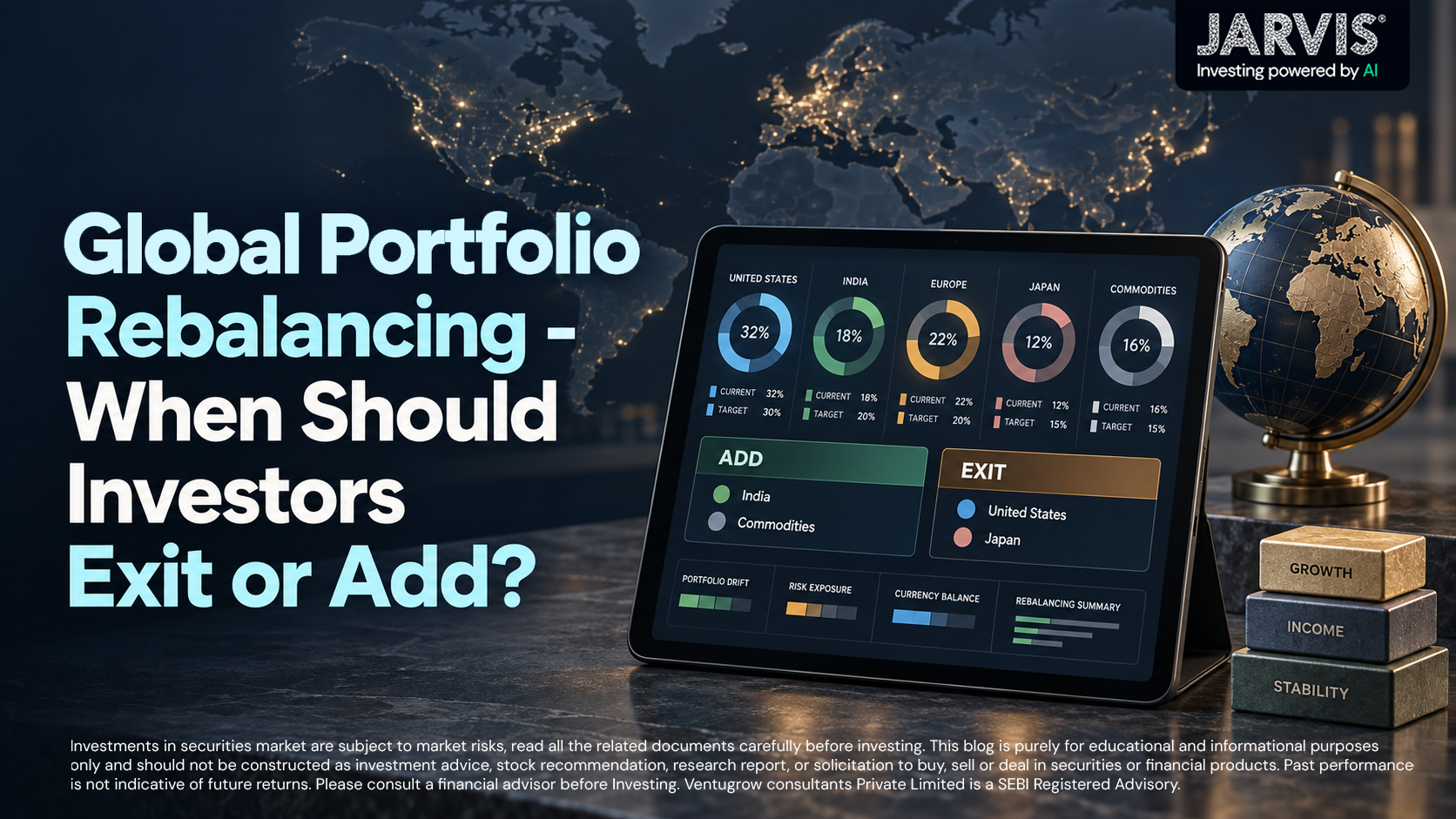
Global portfolio rebalancing   when should investors exit or add

Global Portfolio Rebalancing - When Should Investors Exit or Add?

Share on FacebookShare on Twitter

A global portfolio can change its risk profile without the investor making a single trade. A strong rally in US equities can push an investor’s international allocation from 30% to 40%. 

A correction in emerging markets can cut another allocation by 20%. Currency movements can further change returns for an Indian investor. That is why global portfolio rebalancing is less about predicting markets and more about knowing when your portfolio has moved too far away from its intended structure.

Rebalancing Is About Risk, Not Timing the Market

Suppose an investor has ₹1 crore, with ₹30 lakh allocated to global equities. If global markets rally 25% while the rest of the portfolio remains unchanged, that ₹30 lakh becomes ₹37.5 lakh. The global allocation has now increased materially without the investor consciously taking additional exposure. This is portfolio drift.

Vanguard describes portfolio rebalancing as restoring a portfolio when its asset allocation moves away from the investor’s intended mix. Its research also notes that many investors use a threshold of around 5 – 10 percentage points to trigger a review. 

The important point – rebalancing does not necessarily mean selling everything that has performed well. It means bringing risk back toward the level the investor originally intended.

When Should Investors Add?

A falling market is not automatically a buying opportunity. Before adding to global equities, investors should examine three things: valuation, fundamentals and portfolio allocation. Imagine a global equity allocation falls from ₹30 lakh to ₹24 lakh after a 20% decline.

If the original investment thesis remains intact, valuations have become more reasonable and the allocation is now materially below its target, adding capital may be worth evaluating.

But if the decline reflects deteriorating earnings, structural problems or excessive leverage, simply buying because prices are lower can increase portfolio risk.

This distinction is particularly important when using AI for investment or AI based portfolio management India. Technology can process large amounts of fundamental, market, macroeconomic and sentiment data, but the objective should be better decision-making, not blindly buying every correction.

When Should Investors Reduce or Exit?

The harder question is often knowing when to sell. A profitable position should not automatically be exited simply because it has generated a strong return.

Consider an investor who buys ₹10 lakh of global equities and the position grows to ₹16 lakh. A 60% gain sounds attractive, but if that position now represents 45% of the entire portfolio instead of the intended 30%, the investor’s risk profile has changed.

Reducing part of the position can therefore be a risk-management decision, rather than a prediction that markets will fall. Investors should consider reducing exposure when:

  • An allocation becomes significantly overweight. 
  • The original investment thesis has weakened. 
  • Valuations become difficult to justify against expected earnings. 
  • Geographic or sector concentration becomes excessive. 
  • Currency exposure becomes disproportionate. 
  • A more attractive risk-adjusted opportunity emerges elsewhere. 

Don’t Sell Every Time Markets Get Volatile

Global markets can react sharply to interest-rate decisions, geopolitical developments, inflation data and changes in liquidity. That does not mean every correction requires an exit.

For example, a 10% fall in an international equity allocation caused by temporary market sentiment is very different from a 10% fall accompanied by a structural deterioration in earnings. Investors need to separate price volatility from fundamental change.

This is particularly relevant for long term portfolios. International diversification can reduce dependence on a single domestic market because different markets do not always move together. However, international investing also introduces currency and geopolitical risks.

A 5% Rule Can Create Discipline

One practical approach is threshold-based rebalancing. Suppose an investor targets 30% global equities and sets a 5-percentage-point tolerance band. The portfolio can be reviewed when global equities move above 35% or below 25%.

Another approach is calendar-based rebalancing reviewing the portfolio every six or twelve months. Vanguard notes that annual rebalancing can be an effective approach for many investors, while also highlighting threshold-based and combined calendar-and-threshold approaches. 

Rebalancing Should Consider Currency Too

For Indian investors, global portfolio returns are not determined only by the foreign asset. They are also affected by exchange rates. If a US investment rises 12% but the rupee strengthens against the dollar, the return measured in INR will be lower than 12%. If the rupee weakens, currency movement can work in the opposite direction.

Therefore, an investor with ₹20 lakh in overseas assets should monitor both the investment exposure and the currency exposure. This becomes increasingly important as international allocation grows.

AI Can Make Rebalancing More Adaptive

Traditional portfolio reviews may happen once or twice a year. Markets, however, change every day. Modern stock market analysis AI and portfolio intelligence systems can continuously monitor factors such as volatility, momentum, sector concentration, macroeconomic developments and portfolio-level risk.

Jarvis Invest Intelligence describes analysing company fundamentals, market data, economic indicators, news, sentiment and global market trends, while continuously evaluating how signals perform under changing market conditions. 

Jarvis Atlas also combines global equities, Indian equities and commodities, with its research engine tracking global markets, macro trends, sector rotations, sentiment and technical structures.  The advantage is not necessarily more trading. It is having a more systematic way to identify when the portfolio’s risk-reward structure is changing.

Jarvis atlas   invest in indian stocks global stocks and commodities with ai for building global portfolio
Invest in Indian Stocks global stocks and commodities with AI

Final Thoughts

Global portfolio rebalancing should not be treated as a prediction game. Add when an asset class has fallen below its intended allocation and the underlying fundamentals still support the investment case. Reduce when concentration, valuation or fundamental deterioration changes the risk-reward equation.

The best rebalancing framework is one that replaces emotional reactions with predefined thresholds, continuous monitoring and disciplined portfolio management. Because in global investing, the biggest risk is not always choosing the wrong asset. Sometimes, it is simply allowing one asset to become too important.

Disclaimer: The information, data, charts and company references presented in this article are compiled from publicly available sources believed to be reliable. While reasonable efforts have been made to ensure accuracy, Jarvis Invest does not guarantee the completeness, accuracy or timeliness of the information. This content is intended solely for educational and informational purposes and should not be construed as investment, financial or trading advice. Investments in securities are subject to market risks. Please conduct your own research or consult a SEBI Registered Investment Advisor before making any investment decision. Jarvis Invest is a SEBI Registered Investment Adviser (Registration No. INA000013235). Past performance is not indicative of future results.
Tags: AI based stock trading Indiaai for global portfolio managementai investment advisorai stock marketai trading app indiaAIbasedstockmarketglobal portfolioglobal portfolio managementglobal portfolio rebalancingjarvis aisebi registered investment advisor​share market advisorstock market aiUS Stocks
Sumit Chanda

Sumit Chanda

Sumit has 18 years of experience in BFSI industry, into devising strategy for various functions, Investments and Managing Asset Portfolios. Specializes in Strategy & implementation in sales & operations, Team management, IT implementation, Affiliations.

Leave a Reply Cancel reply

Your email address will not be published. Required fields are marked *

Get access to AI-picked stock ideas, market insights and research updates daily tailored to your investing style.

Popular Posts

  • Global portfolio rebalancing   when should investors exit or add
    Global Portfolio Rebalancing – When Should Investors Exit or Add?October 1, 2026
  • Stock market news today cover featuring indian finance buildings rbi seal and logos like tata flipkart aramco with date 1 october 2026
    Stock Market News Updates – 1st October, 2026October 1, 2026
  • Is ai for stock market reliable during volatile markets
    Is AI for Stock Market Reliable During Volatile Markets?September 30, 2026
  • Collage of major company logos and stock market imagery with the headline stock market news today and the date 30 september 2026 conveying financial news impact
    Stock Market News Updates – 30th September, 2026September 30, 2026
  • Dr reddys stock jumps 2   whats driving the rally now
    Dr Reddy Stock Jumps 2% – What’s Driving the Rally Now?September 29, 2026

Recent Posts

  • Global Portfolio Rebalancing – When Should Investors Exit or Add? October 1, 2026
  • Stock Market News Updates – 1st October, 2026 October 1, 2026
  • Is AI for Stock Market Reliable During Volatile Markets? September 30, 2026
  • Stock Market News Updates – 30th September, 2026 September 30, 2026
  • Dr Reddy Stock Jumps 2% – What’s Driving the Rally Now? September 29, 2026

Browse by Category

Jarvis Invest

India's AI-powered, SEBI-registered investment advisory — research, portfolios and global market intelligence for every investor.

Company

  • About Us
  • FAQs
  • Contact Us
  • Become a Partner

Products

  • Jarvis Portfolio
  • Jarvis Protect
  • Jarvis OneStock
  • Jarvis Prime
  • Sentiment Tracker (F&O)
  • US Multi-Asset Portfolio

Explore Topics

  • Equity Markets
  • Investing Basics
  • AI for investing
  • Trending Stock Market News: Quick Reads
  • Financial Planning
  • Portfolio Management
  • Stock Market News Updates
  • Global Stock Market

Get in touch

Customer support customersupport@jarvisinvest.com

Jarvis Invest — SEBI Registered Investment Adviser (Reg. No. INA000013235) & SEBI Registered Research Analyst (Reg. No. INH000018762). Investments in the securities market are subject to market risks. Read all the related documents carefully before investing. Registration granted by SEBI and certification from NISM in no way guarantee performance of the intermediary or provide any assurance of returns to investors.

© 2026 Jarvis Invest. All rights reserved.

  • Privacy Policy
  • Terms & Conditions
  • Disclaimer
Categories
Equity MarketsGet latest insights on the Indian equity market including stock trends, market analysis, sector…Investing BasicsLearn stock market basics including investing fundamentals, equity concepts, and beginner-friendly guides to start…AI for investingStay ahead with AI-powered stock insights, trend analysis, and intelligent investing strategies for ai…Trending Stock Market News: Quick ReadsDiscover the latest trends in the stock market with insightful blogs from Jarvis Invest…Portfolio ManagementExpert insights on portfolio management, asset allocation, risk management, and strategies to optimise best…Stock Market News UpdatesGet daily stock market news updates, key market movements, and insights that matter to…Global Stock MarketGet latest global stock market news, trends, and AI-driven stock insights on US, Europe…Stock AdvisoryLearn how AI-powered stock advisory and expert market research can help you build wealth.
I Am A
BeginnerBeginner-friendly stock market guides covering investing basics, common mistakes, and simple strategies to build…IntermediateIntermediate-level stock market insights covering investment strategies, portfolio analysis, and market concepts for informed…
Products
Jarvis PortfolioModel portfolio matched to your risk profile for long-term wealth creation.Jarvis ProtectContinuous portfolio monitoring for your existing portfolio with timely sell alerts to help manage downside risk.Jarvis OneStockHigh-conviction stock recommendations designed for short-term investing.Jarvis Prime - For HNIs & UHNIsPremium portfolio management services for investors with ₹25 lakh+ investment corpus.Jarvis Sentiment Tracker - AI Tool for F&OReal-time market sentiment analysis and trading signals for options traders.Jarvis US Multi-Asset PortfolioDiversified US portfolio investing across stocks and ETFs with automated portfolio management.Jarvis AtlasInvestment opportunities across Indian equities, global markets, and commodities in 10+ global markets.
No Result
View All Result
  • CATEGORIES
    • Equity Markets
    • Investing Basics
    • AI for investing
    • Trending Stock Market News: Quick Reads
    • Portfolio Management
    • Stock Market News Updates
    • Global Stock Market
    • Stock Advisory
  • I AM A
    • Beginner
    • Intermediate
  • Home
  • Products
    • Jarvis Portfolio
    • Jarvis Protect
    • Jarvis OneStock
    • Jarvis Prime – For HNIs & UHNIs
    • Jarvis Sentiment Tracker – AI Tool for F&O
    • Jarvis US Multi-Asset Portfolio
    • Jarvis Atlas
  • FAQs
  • About Us
  • Contact Us
  • Become a Partner

© 2023 Jarvis Invest

Go to mobile version