Jarvis
  • CATEGORIES
    • Equity Markets
    • Investing Basics
    • AI for investing
    • Trending Stock Market News: Quick Reads
    • Portfolio Management
    • Stock Market News Updates
    • Global Stock Market
    • Stock Advisory
  • I AM A
    • Beginner
    • Intermediate
  • Home
  • Products
    • Jarvis Portfolio
    • Jarvis Protect
    • Jarvis OneStock
    • Jarvis Prime – For HNIs & UHNIs
    • Jarvis Sentiment Tracker – AI Tool for F&O
    • Jarvis US Multi-Asset Portfolio
    • Jarvis Atlas
  • FAQs
  • About Us
  • Contact Us
  • Become a Partner
No Result
View All Result
Jarvis
No Result
View All Result
Home Portfolio Management

How Many Stocks Should an HNI Portfolio Hold?

by Sumit Chanda
November 18, 2026
in Portfolio Management
Reading Time: 10 mins read
A A
0
How many stocks should an hni portfolio hold

How Many Stocks Should an HNI Portfolio Hold

Share on FacebookShare on Twitter

For a high-net-worth individual (HNI), building an HNI portfolio involves more than finding promising companies. Investors must also decide how many stocks to own and how much capital to allocate to each. Some prefer concentrated portfolios of 10 – 15 stocks, while others hold 40 or more companies to spread risk.

Too few stocks can expose wealth to company-specific shocks, while too many can make research and monitoring difficult. The right number depends on an investor’s goals, risk appetite, investment horizon and ability to track holdings.

1. Why the Number of Stocks Matters

For HNIs, equity investments can represent a substantial share of overall wealth. A fall in one large holding can therefore translate into a significant monetary loss. If much of a portfolio is concentrated in a handful of companies or one sector, a business setback or industry-wide correction can have an outsized impact.

Diversification helps reduce company-specific risk by spreading investments across businesses. However, adding stocks simply to increase the count does not automatically create a better portfolio. Holdings should have distinct roles and exposures.

2. Is 15–20 Stocks Enough?

There is no universally correct number of stocks for every HNI. Diversification depends on how closely holdings move together, their sector exposure and the quality of the underlying businesses.

Research by academics at IIM Ahmedabad, in a study titled Equity Portfolio Diversification: How Many Stocks Are Enough?, examined how many stocks may be needed to reduce diversifiable risk. Its findings suggest that substantially more than 15 – 20 stocks may be required to achieve a high level of risk reduction under the study’s assumptions. 

That does not mean every investor must hold 40 – 50 stocks. A portfolio combining mutual funds or diversified funds with a smaller direct-equity allocation may already have broad exposure. An HNI investing mainly in individual shares may need more holdings to avoid excessive dependence on a few companies.

3. The Risk of Holding Too Few Stocks

A portfolio containing only five or six stocks can become highly sensitive to individual company events. Weak earnings, governance concerns, regulatory changes or a sudden loss of market share can damage a major position.

Sector concentration can create a similar problem. Holding several banking stocks, for example, does not necessarily provide broad diversification if they are all exposed to credit cycles, interest rates and the same economic pressures.

Concentrated portfolios may suit experienced investors who have strong research capabilities and can tolerate volatility. But conviction should be supported by analysis, not simply familiarity with a company or confidence in a popular market theme.

4. Can Too Many Stocks Become a Problem?

A large portfolio is not automatically a diversified or efficient one. HNIs sometimes accumulate shares over time through IPOs, inherited investments, old recommendations and different advisors. The result can be a collection of companies without a clear allocation strategy.

When a portfolio contains dozens of small positions, each holding may have little effect on total returns. At the same time, reviewing quarterly results, valuations, management changes and business risks becomes more demanding.

This is often described as over-diversification. The issue is not a particular stock count; it is owning more investments than the investor can properly understand and monitor. 

5. A Practical Range for HNI Portfolios

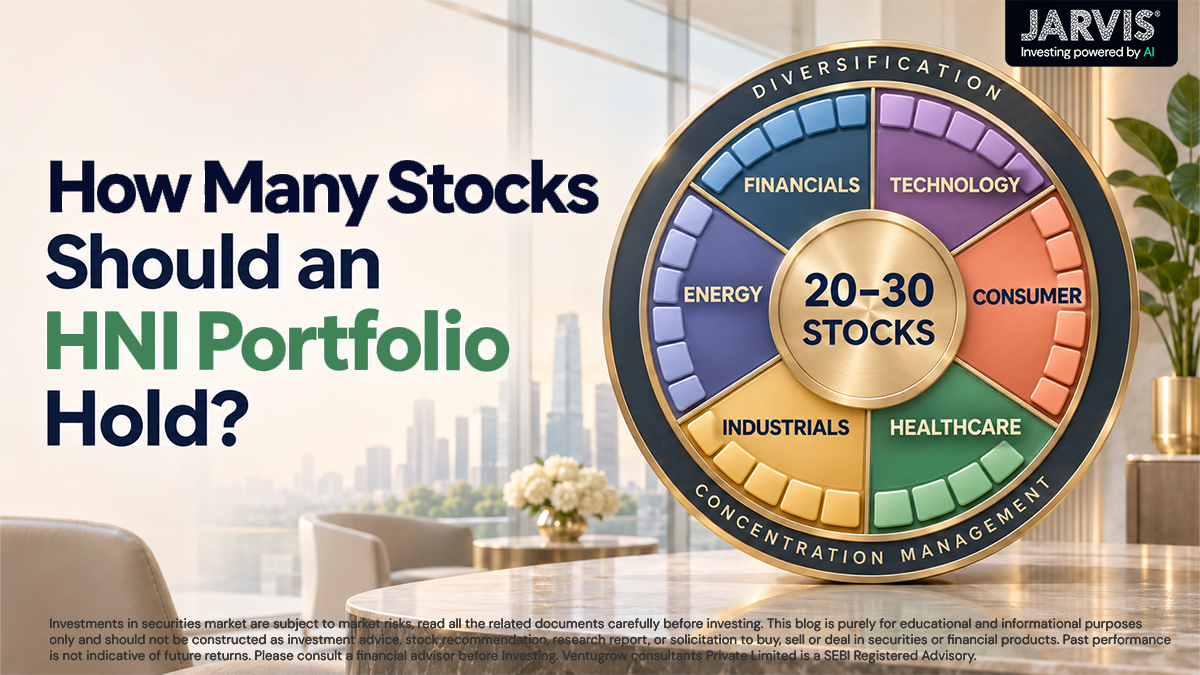
For an HNI investing primarily through direct equities, 20–30 stocks can be a practical starting point for discussion, rather than a fixed rule. A focused large-cap strategy may use fewer holdings, while portfolios with meaningful mid-cap and small-cap exposure may require broader diversification.

Consider a ₹3 crore direct-equity portfolio with 25 equally weighted stocks. The average allocation would be ₹12 lakh per company.

The important question is whether each position is large enough to matter but not so large that one company can threaten the portfolio. Investors should also consider whether their other investments, such as mutual funds and ETFs, already provide exposure to the same companies.

6. Position Sizing Matters as Much as Stock Count

The number of holdings alone does not reveal the true level of risk. An investor may own 30 stocks but have half the portfolio invested in the five largest positions. That portfolio can still be highly concentrated.

HNI investors should regularly review:

  • Single-stock exposure: Check whether any position has grown too large.
  • Sector concentration: Identify dependence on one industry or investment theme.
  • Liquidity: Consider how easily large positions can be sold.
  • Fundamentals: Review earnings, debt, valuations and management quality.
  • Rebalancing: Reassess allocations when prices, business prospects or financial goals change.

7. Why Continuous Monitoring Is Important

Portfolio risk changes over time. A stock that once represented 5% of the portfolio may become 12% after a strong rally. Another holding may become less attractive after a deterioration in earnings or governance.

Data-driven research can help investors assess fundamentals, identify concentration and monitor changes in market conditions. Platforms such as Jarvis Invest use AI-powered analysis and investment intelligence to support stock research and portfolio risk assessment. The objective is to understand how each holding contributes to overall risk and return.

The Bottom Line

There is no universal number of stocks that guarantees a well-diversified HNI portfolio. The ideal number depends on the investor’s financial goals, risk appetite, investment horizon, available capital and ability to monitor individual companies. While holding too few stocks can increase concentration risk, owning too many can make portfolio management complicated and reduce the impact of high-conviction investments.

For HNIs, the focus should be on building a portfolio where every investment has a clear purpose. Stock selection, position sizing, sector diversification and regular rebalancing are just as important as the total number of holdings. Investors should also consider their exposure through mutual funds, ETFs and other assets before adding more stocks.

Ultimately, wealth creation is not about owning the maximum number of companies or chasing the highest possible returns. It is about allocating capital intelligently, protecting wealth against unnecessary risks and maintaining a portfolio that can perform across different market conditions.

If you’re an HNI or UHNI with ₹25 lakh or more to invest, get personalised equity portfolio management from the investment experts at Jarvis Invest, a SEBI-registered investment adviser. Build an equity portfolio tailored to your financial goals, risk profile and investment horizon.

Disclaimer: The information, data, charts and company references presented in this article are compiled from publicly available sources believed to be reliable. While reasonable efforts have been made to ensure accuracy, Jarvis Invest does not guarantee the completeness, accuracy or timeliness of the information. This content is intended solely for educational and informational purposes and should not be construed as investment, financial or trading advice. Investments in securities are subject to market risks. Please conduct your own research or consult a SEBI Registered Investment Advisor before making any investment decision. Jarvis Invest is a SEBI Registered Investment Adviser (Registration No. INA000013235). Past performance is not indicative of future results.
Tags: AI based stock trading IndiaAI portfolio management for HNIsBest investment advisor for HNIsbest stock market advisor in indiaBest stocks to invest in for HNIs Indiaequity portfolio management for hnihni portfolioHNI portfolio management MumbaiHNI portfolio management service Indiahni portfolio management services indiajarvis aijarvis artificial intelligenceportfolio managementportfolio management servicesportfolio management services in Indiaportfolio managemt for HNIsSEBI Registered Investment Advisorstock market ai
Sumit Chanda

Sumit Chanda

Sumit has 18 years of experience in BFSI industry, into devising strategy for various functions, Investments and Managing Asset Portfolios. Specializes in Strategy & implementation in sales & operations, Team management, IT implementation, Affiliations.

Leave a Reply Cancel reply

Your email address will not be published. Required fields are marked *

Get access to AI-picked stock ideas, market insights and research updates daily tailored to your investing style.

Popular Posts

  • How many stocks should an hni portfolio hold
    How Many Stocks Should an HNI Portfolio Hold?November 18, 2026
  • Top 8 stock market news you need to know banner with finance graphics a gold bull statue and stock charts in blue and white
    Stock Market News Updates – 18th November, 2026November 18, 2026
  • Va tech wabag down 10   what should investors do now
    VA Tech Wabag Down 10% – What Should Investors Do Now?November 17, 2026
  • Ashok leyland share price   will it hold after the 20 fall
    Ashok Leyland Share Price – Will It Hold After the 20% Fall?November 17, 2026
  • Q2 fy27 results   is earnings growth catching up with stock valuations
    Q2 FY27 Results – Is Earnings Growth Catching Up With Stock Valuations?November 17, 2026

Recent Posts

  • How Many Stocks Should an HNI Portfolio Hold? November 18, 2026
  • Stock Market News Updates – 18th November, 2026 November 18, 2026
  • VA Tech Wabag Down 10% – What Should Investors Do Now? November 17, 2026
  • Ashok Leyland Share Price – Will It Hold After the 20% Fall? November 17, 2026
  • Q2 FY27 Results – Is Earnings Growth Catching Up With Stock Valuations? November 17, 2026

Browse by Category

Jarvis Invest

India's AI-powered, SEBI-registered investment advisory — research, portfolios and global market intelligence for every investor.

Company

  • About Us
  • FAQs
  • Contact Us
  • Become a Partner

Products

  • Jarvis Portfolio
  • Jarvis Protect
  • Jarvis OneStock
  • Jarvis Prime
  • Sentiment Tracker (F&O)
  • US Multi-Asset Portfolio

Explore Topics

  • Equity Markets
  • Investing Basics
  • AI for investing
  • Trending Stock Market News: Quick Reads
  • Financial Planning
  • Portfolio Management
  • Stock Market News Updates
  • Global Stock Market

Get in touch

Customer support customersupport@jarvisinvest.com

Jarvis Invest — SEBI Registered Investment Adviser (Reg. No. INA000013235) & SEBI Registered Research Analyst (Reg. No. INH000018762). Investments in the securities market are subject to market risks. Read all the related documents carefully before investing. Registration granted by SEBI and certification from NISM in no way guarantee performance of the intermediary or provide any assurance of returns to investors.

© 2026 Jarvis Invest. All rights reserved.

  • Privacy Policy
  • Terms & Conditions
  • Disclaimer
Categories
Equity MarketsGet latest insights on the Indian equity market including stock trends, market analysis, sector…Investing BasicsLearn stock market basics including investing fundamentals, equity concepts, and beginner-friendly guides to start…AI for investingStay ahead with AI-powered stock insights, trend analysis, and intelligent investing strategies for ai…Trending Stock Market News: Quick ReadsDiscover the latest trends in the stock market with insightful blogs from Jarvis Invest…Portfolio ManagementExpert insights on portfolio management, asset allocation, risk management, and strategies to optimise best…Stock Market News UpdatesGet daily stock market news updates, key market movements, and insights that matter to…Global Stock MarketGet latest global stock market news, trends, and AI-driven stock insights on US, Europe…Stock AdvisoryLearn how AI-powered stock advisory and expert market research can help you build wealth.
I Am A
BeginnerBeginner-friendly stock market guides covering investing basics, common mistakes, and simple strategies to build…IntermediateIntermediate-level stock market insights covering investment strategies, portfolio analysis, and market concepts for informed…
Products
Jarvis PortfolioModel portfolio matched to your risk profile for long-term wealth creation.Jarvis ProtectContinuous portfolio monitoring for your existing portfolio with timely sell alerts to help manage downside risk.Jarvis OneStockHigh-conviction stock recommendations designed for short-term investing.Jarvis Prime - For HNIs & UHNIsPremium portfolio management services for investors with ₹25 lakh+ investment corpus.Jarvis Sentiment Tracker - AI Tool for F&OReal-time market sentiment analysis and trading signals for options traders.Jarvis US Multi-Asset PortfolioDiversified US portfolio investing across stocks and ETFs with automated portfolio management.Jarvis AtlasInvestment opportunities across Indian equities, global markets, and commodities in 10+ global markets.
No Result
View All Result
  • CATEGORIES
    • Equity Markets
    • Investing Basics
    • AI for investing
    • Trending Stock Market News: Quick Reads
    • Portfolio Management
    • Stock Market News Updates
    • Global Stock Market
    • Stock Advisory
  • I AM A
    • Beginner
    • Intermediate
  • Home
  • Products
    • Jarvis Portfolio
    • Jarvis Protect
    • Jarvis OneStock
    • Jarvis Prime – For HNIs & UHNIs
    • Jarvis Sentiment Tracker – AI Tool for F&O
    • Jarvis US Multi-Asset Portfolio
    • Jarvis Atlas
  • FAQs
  • About Us
  • Contact Us
  • Become a Partner

© 2023 Jarvis Invest

Go to mobile version