Jarvis
  • CATEGORIES
    • Equity Markets
    • Investing Basics
    • AI for investing
    • Trending Stock Market News: Quick Reads
    • Portfolio Management
    • Stock Market News Updates
    • Global Stock Market
    • Stock Advisory
  • I AM A
    • Beginner
    • Intermediate
  • Home
  • Products
    • Jarvis Portfolio
    • Jarvis Protect
    • Jarvis OneStock
    • Jarvis Prime – For HNIs & UHNIs
    • Jarvis Sentiment Tracker – AI Tool for F&O
    • Jarvis US Multi-Asset Portfolio
    • Jarvis Atlas
  • FAQs
  • About Us
  • Contact Us
  • Become a Partner
No Result
View All Result
Jarvis
  • CATEGORIES
    • Equity Markets
    • Investing Basics
    • AI for investing
    • Trending Stock Market News: Quick Reads
    • Portfolio Management
    • Stock Market News Updates
    • Global Stock Market
    • Stock Advisory
  • I AM A
    • Beginner
    • Intermediate
  • Home
  • Products
    • Jarvis Portfolio
    • Jarvis Protect
    • Jarvis OneStock
    • Jarvis Prime – For HNIs & UHNIs
    • Jarvis Sentiment Tracker – AI Tool for F&O
    • Jarvis US Multi-Asset Portfolio
    • Jarvis Atlas
  • FAQs
  • About Us
  • Contact Us
  • Become a Partner
No Result
View All Result
Jarvis
No Result
View All Result
Home Portfolio Management

What to Do in a Market Crash-Score Your Portfolio

by Sumit Chanda
October 1, 2026
in Portfolio Management
Reading Time: 18 mins read
A A
0
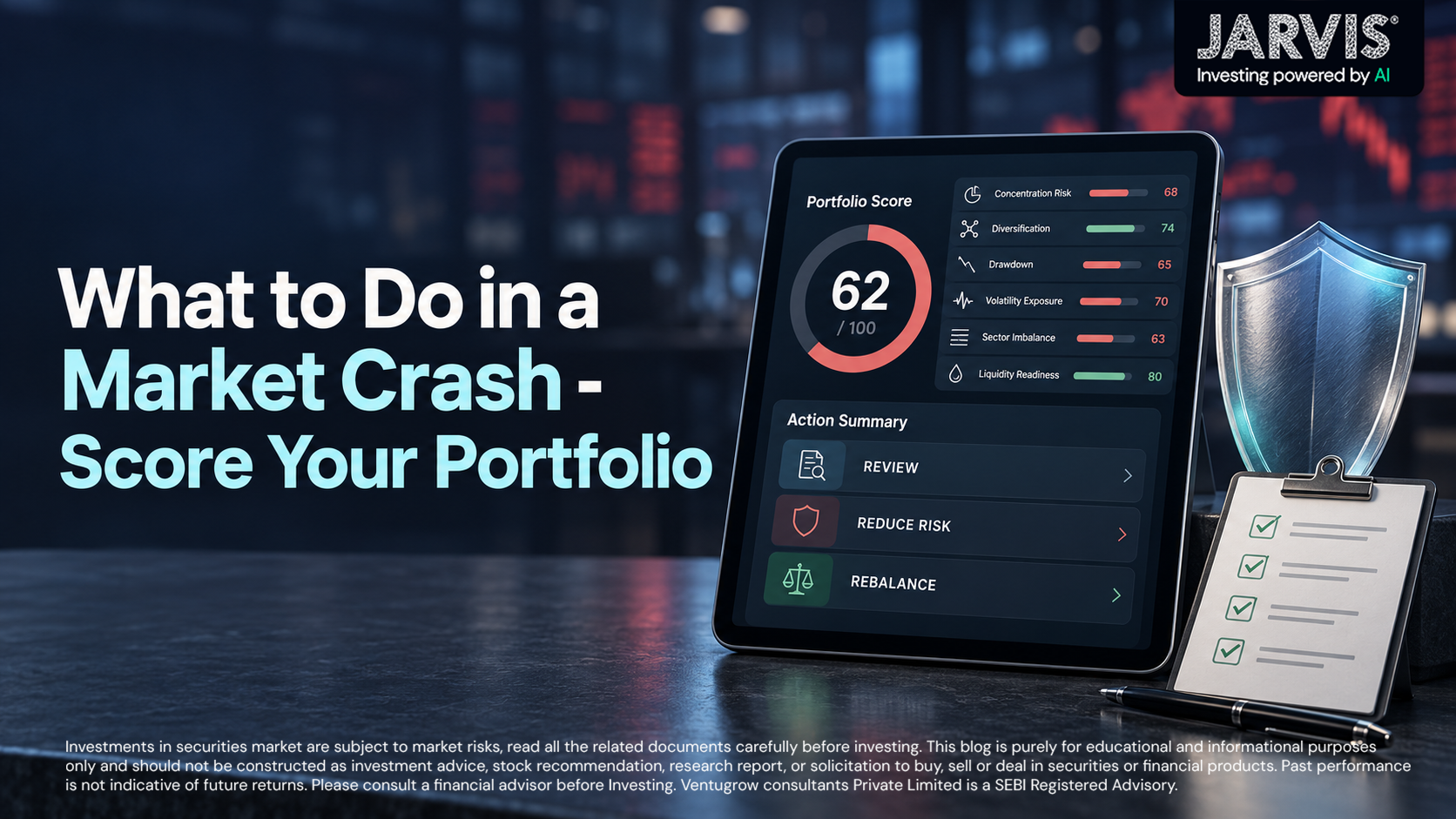
What to do in a market crash   score your portfolio

What to Do in a Market Crash - Score Your Portfolio

Share on FacebookShare on Twitter

Everything looks good in a rising market. Prices go up, returns look good, and your confidence is in the seventh sky. The real test comes when markets fall – 10 – 20 – 30 percent fall. That is when fear replaces logic, losses appear faster than gains ever did, and weak portfolios get exposed. So what should you actually do when the stock market crash?

Not react in haste,The more sensible step is to pause and look inward, to understand whether your portfolio is built to withstand such phases. A simple portfolio health check can often reveal risks that stay hidden in good times, but matter the most when markets turns.

In this article, we have fully explained a point-by-point framework to help investors genuinely assess how strong your portfolio is when stock markets crash.

Drawdown Tolerance in Market Crash: Can You Actually Handle Losses?

Drawdown is the temporary fall in your portfolio value from its peak. Most investors think they can tolerate a 20% fall. Very few actually can.

When your portfolio falls:

  • Daily losses look larger than daily gains ever felt.
  • Confidence drops faster than prices
  • Decision-making becomes emotional, not logical

If a 15% fall makes you check your portfolio every hour, your portfolio risk is already too high for you, even if the assets are “good.” A strong portfolio is aligned not just with market risk, but with your personal emotional capacity. If the structure forces you into panic, it is, by definition, weak.

Asset Allocation Strategy for a Market Crash: The Core Strength Test

Asset allocation is the single biggest factor in how your portfolio behaves in a market downturn. Portfolios fail not because stocks fall, but because everything falls together.

A weak allocation usually means too much equity exposure, no balance between growth and stability & no predefined structure. On the other hand, a strong allocation means equity for growth, debt for stability, and cash for flexibility.

When markets fall, debt and cash do not exist to give returns. They exist to prevent bad decisions. They slow down losses, give mental comfort, and allow rebalancing. If your portfolio only works when markets rise, it is not a portfolio. It is a bet.

Market Capitalization Exposure: Where the Pain Hits First

Not all stocks fall equally. Historical data suggest that:

  • Large-cap stocks usually fall less and recover earlier
  • Mid-cap stocks fall more and recover slower
  • Small-cap stocks fall the hardest and test patience the most

In bull markets, small and mid-caps make portfolios look smart. In bear markets, they expose overconfidence. A strong portfolio knows why each market cap exposure exists:

  • Large caps for stability
  • Mid-caps for measured growth
  • Small caps only for long-term capital that can tolerate deep volatility

If your portfolio is dominated by whatever performed best recently, it is structurally weak.

What to do in a market crash   score your portfolio today with portfolio health check
what to do in A market Crash

Role of Debt as Protection in a Market Crash: The Shock Absorber

Debt assets are often ignored because they feel unexciting. In market falls, they become critical. Debt does three important things:

  1. Reduces overall volatility
  2. Protects capital during sharp corrections
  3. Gives you money to rebalance into equity at lower levels

Without debt, every fall forces you into a corner: either tolerate extreme volatility or sell equity at the wrong time. Strong portfolios use debt intentionally, not accidentally. Debt is not about returns. It is about control.

Liquidity: Can You Survive Without Selling?

Liquidity decides whether you are an investor or a forced seller. During market falls:

  • Job risk increases
  • Emergency expenses feel heavier
  • Fear of running out of cash increases

If you do not have enough liquid money:

  • You sell investments to raise cash
  • You sell when prices are low
  • You lock in permanent losses

A strong portfolio always separates:

  • Emergency money
  • Short-term needs
  • Long-term investments

Markets recover. Portfolios recover. Only if you are not forced to exit.

Sector and Theme Concentration: One Story Risk

Concentration feels comfortable when the story is working. The problem appears when the story breaks. If your portfolio depends heavily on one sector, theme, or macro-narrative, then a single negative event can damage the entire portfolio at once.

Strong portfolios spread risk across:

  • Different business cycles
  • Different economic drivers
  • Different types of companies

It does not eliminate losses. It prevents irreversible damage.

Leverage Risks Amplified in a Market Crash

Leverage turns normal market volatility into a personal crisis. This includes:

  • Investing with borrowed money
  • High EMIs are dependent on market income
  • Margin trading or leveraged products

When markets fall, leverage creates pressure from both sides: Asset values fall & obligations stay fixed. Even a good portfolio can fail under bad cash flow pressure. Strong portfolios are built to survive bad markets without financial stress.

Rebalancing Strategy in a Market Crash: Turning Pain Into Advantage

Portfolio Rebalancing is what separates long-term investors from emotional traders. Without rebalancing:

  • Equity weight rises in bull markets
  • Risk silently increases
  • Falls hurt more than expected

With rebalancing:

  • You automatically sell what has held up
  • You buy what has fallen
  • Risk stays controlled

Rebalancing forces you to do the hardest thing in investing, calmly and systematically. Portfolios that rebalance regularly fall less and recover faster.

Time Horizon Alignment: Are You Using the Right Assets?

Many investors panic not because markets fall, but because they need money at the wrong time.

Problems arise when:

  • Short-term goals are invested in equity
  • Long-term money is used casually
  • Goals are not clearly defined

Strong portfolios assign every rupee a job:

  • Short-term needs stay safe
  • Long-term goals get equity exposure
  • No confusion during volatility

Time does not eliminate risk. Misalignment magnifies it.

Final Portfolio Strength Assessment

When you score your portfolio honestly on these points, the result is usually eye-opening.

  • A high score means you can stay invested
  • A medium score means fine-tuning is needed
  • A low score means your most significant risk is not the market, but your structure
Protect your portfolio real time before sudden market crash from sebi registered investment advisor jarvis invest
protect your portfolio today before sudden market Crash from Sebi registered investment Advisor

Before You Go

Market falls are not accidents. They are part of the system. Strong portfolios are not built to avoid falls. They are built to survive them without panic, without forced selling, and without permanent damage. If your portfolio allows you to stay calm when prices are falling, you are already ahead of most investors.

Know your portfolio score using our Portfolio Health Check with Jarvis Invest – https://jarvisinvest.com/jarvis-health-check

Disclaimer: The information, data, charts and company references presented in this article are compiled from publicly available sources believed to be reliable. While reasonable efforts have been made to ensure accuracy, Jarvis Invest does not guarantee the completeness, accuracy or timeliness of the information. This content is intended solely for educational and informational purposes and should not be construed as investment, financial or trading advice. Investments in securities are subject to market risks. Please conduct your own research or consult a SEBI Registered Investment Advisor before making any investment decision. Jarvis Invest is a SEBI Registered Investment Adviser (Registration No. INA000013235). Past performance is not indicative of future results.

Frequently Asked Questions

1. What should I do with my portfolio during a market crash?

Start by reviewing your asset allocation, liquidity, diversification and investment horizon rather than reacting only to falling prices. A market crash can expose risks that were less visible during a rising market, including excessive equity exposure, sector concentration and insufficient liquidity. Recent investor guidance has similarly emphasized maintaining allocation discipline and avoiding emotional portfolio changes during corrections.

2. How do I know if my portfolio can survive a market crash?

A portfolio’s resilience can be assessed through factors such as drawdown tolerance, equity-debt allocation, large-cap, mid-cap and small-cap stocks exposure, liquidity, sector concentration, leverage and rebalancing discipline. A portfolio that forces you to sell investments to meet short-term expenses may be more vulnerable during a sharp fall.

3. How much can a portfolio fall during a market crash?

There is no fixed percentage because the drawdown depends on asset allocation, stock selection, market-cap exposure, diversification and the severity of the decline. Equity-heavy portfolios can experience significantly larger fluctuations than portfolios diversified across different asset classes.

4. Should I sell my stocks when the market crashes?

A falling market alone does not determine whether an investment should be sold. Investors should review whether their original investment thesis, financial goals, risk tolerance or asset allocation has changed. Selling simply because prices have fallen can turn temporary declines into permanent losses, particularly when the decision is driven by short-term fear rather than portfolio fundamentals.

5. Why is diversification important during a market crash?

Diversification reduces dependence on a single sector, theme, company type or economic driver. It cannot prevent losses during a broad decline, but it can reduce the damage caused when one concentrated part of a portfolio performs particularly poorly.

6. Should I rebalance my portfolio after a market crash?

Rebalancing may be appropriate when market movements have pushed your asset allocation materially away from its intended structure. Rather than trying to predict the market bottom, rebalancing restores the portfolio toward its planned risk level. Recent Moneycontrol coverage similarly emphasizes reviewing asset allocation before making reactive changes to funds.

7. How can I check my portfolio risk before the next market crash?

Review how much your portfolio could potentially fall, how concentrated it is across stocks and sectors, whether your asset allocation matches your risk tolerance, how much liquidity you have and whether you follow a defined rebalancing process. A portfolio health check can help identify these weaknesses before volatility makes them more visible.

Tags: ai for stock tradingai tool for stock market indiaAIbasedstockmarketbest ai for stock market analysis indiafree portfolio health checkhow to protect portfolio in bear marketjarvis aijarvis artificial intelligencemarket crashmarket crash todayportfolio health checkprotect portfolioStock Market Crashtop sebi registered investment advisor
Sumit Chanda

Sumit Chanda

Sumit has 18 years of experience in BFSI industry, into devising strategy for various functions, Investments and Managing Asset Portfolios. Specializes in Strategy & implementation in sales & operations, Team management, IT implementation, Affiliations.

Leave a Reply Cancel reply

Your email address will not be published. Required fields are marked *

Get access to AI-picked stock ideas, market insights and research updates daily tailored to your investing style.

Popular Posts

  • 5 stocks from a sector with upside potential of 33 in these volatile markets to watch now
    5 stocks from a sector, with upside potential of 33% in these volatile markets To Watch NowOctober 3, 2026
  • Varun beverages share price rebound after 20 fall time to buy now in 2026
    Varun Beverages Share Price Rebound after 20% fall, Time to Buy Now in 2026?October 2, 2026
  • Why volatility hurts portfolio health more than bad stocks
    <strong>Why Volatility Hurts Portfolio Health More Than Bad Stocks</strong>October 2, 2026
  • What to do in a market crash   score your portfolio
    What to Do in a Market Crash-Score Your PortfolioOctober 1, 2026
  • Global portfolio rebalancing   when should investors exit or add
    Global Portfolio Rebalancing – When Should Investors Exit or Add?October 1, 2026

Recent Posts

  • 5 stocks from a sector, with upside potential of 33% in these volatile markets To Watch Now October 3, 2026
  • Varun Beverages Share Price Rebound after 20% fall, Time to Buy Now in 2026? October 2, 2026
  • Why Volatility Hurts Portfolio Health More Than Bad Stocks October 2, 2026
  • What to Do in a Market Crash-Score Your Portfolio October 1, 2026
  • Global Portfolio Rebalancing – When Should Investors Exit or Add? October 1, 2026

Browse by Category

Jarvis Invest

India's AI-powered, SEBI-registered investment advisory — research, portfolios and global market intelligence for every investor.

Company

  • About Us
  • FAQs
  • Contact Us
  • Become a Partner

Products

  • Jarvis Portfolio
  • Jarvis Protect
  • Jarvis OneStock
  • Jarvis Prime
  • Sentiment Tracker (F&O)
  • US Multi-Asset Portfolio

Explore Topics

  • Equity Markets
  • Investing Basics
  • AI for investing
  • Trending Stock Market News: Quick Reads
  • Financial Planning
  • Portfolio Management
  • Stock Market News Updates
  • Global Stock Market

Get in touch

Customer support customersupport@jarvisinvest.com

Jarvis Invest — SEBI Registered Investment Adviser (Reg. No. INA000013235) & SEBI Registered Research Analyst (Reg. No. INH000018762). Investments in the securities market are subject to market risks. Read all the related documents carefully before investing. Registration granted by SEBI and certification from NISM in no way guarantee performance of the intermediary or provide any assurance of returns to investors.

© 2026 Jarvis Invest. All rights reserved.

  • Privacy Policy
  • Terms & Conditions
  • Disclaimer
Categories
Equity MarketsGet latest insights on the Indian equity market including stock trends, market analysis, sector…Investing BasicsLearn stock market basics including investing fundamentals, equity concepts, and beginner-friendly guides to start…AI for investingStay ahead with AI-powered stock insights, trend analysis, and intelligent investing strategies for ai…Trending Stock Market News: Quick ReadsDiscover the latest trends in the stock market with insightful blogs from Jarvis Invest…Portfolio ManagementExpert insights on portfolio management, asset allocation, risk management, and strategies to optimise best…Stock Market News UpdatesGet daily stock market news updates, key market movements, and insights that matter to…Global Stock MarketGet latest global stock market news, trends, and AI-driven stock insights on US, Europe…Stock AdvisoryLearn how AI-powered stock advisory and expert market research can help you build wealth.
I Am A
BeginnerBeginner-friendly stock market guides covering investing basics, common mistakes, and simple strategies to build…IntermediateIntermediate-level stock market insights covering investment strategies, portfolio analysis, and market concepts for informed…
Products
Jarvis PortfolioModel portfolio matched to your risk profile for long-term wealth creation.Jarvis ProtectContinuous portfolio monitoring for your existing portfolio with timely sell alerts to help manage downside risk.Jarvis OneStockHigh-conviction stock recommendations designed for short-term investing.Jarvis Prime - For HNIs & UHNIsPremium portfolio management services for investors with ₹25 lakh+ investment corpus.Jarvis Sentiment Tracker - AI Tool for F&OReal-time market sentiment analysis and trading signals for options traders.Jarvis US Multi-Asset PortfolioDiversified US portfolio investing across stocks and ETFs with automated portfolio management.Jarvis AtlasInvestment opportunities across Indian equities, global markets, and commodities in 10+ global markets.
No Result
View All Result
  • CATEGORIES
    • Equity Markets
    • Investing Basics
    • AI for investing
    • Trending Stock Market News: Quick Reads
    • Portfolio Management
    • Stock Market News Updates
    • Global Stock Market
    • Stock Advisory
  • I AM A
    • Beginner
    • Intermediate
  • Home
  • Products
    • Jarvis Portfolio
    • Jarvis Protect
    • Jarvis OneStock
    • Jarvis Prime – For HNIs & UHNIs
    • Jarvis Sentiment Tracker – AI Tool for F&O
    • Jarvis US Multi-Asset Portfolio
    • Jarvis Atlas
  • FAQs
  • About Us
  • Contact Us
  • Become a Partner

© 2023 Jarvis Invest

Go to mobile version