
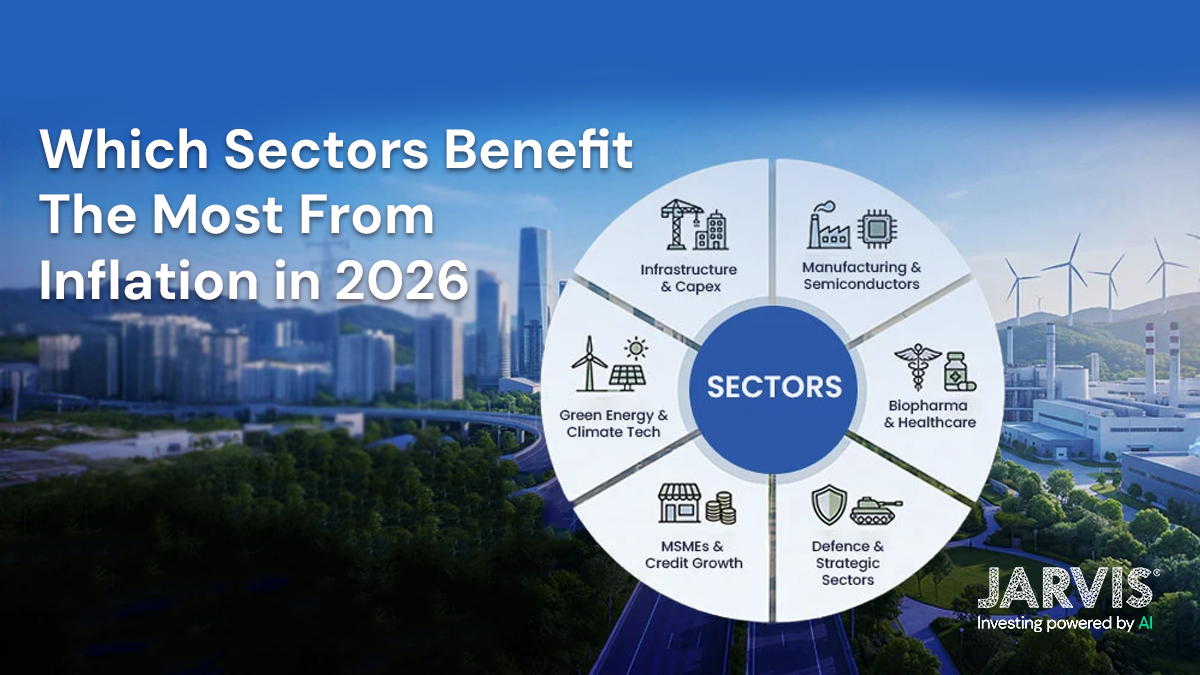
Energy, Banking, Commodities, Infrastructure, Defense and select FMCG companies are among the sectors expected to benefit most from inflation in 2026.
These sectors often possess pricing power, enabling them to pass higher costs to customers, maintain margins, and potentially deliver stronger earnings during inflationary periods. Investors should assess valuations, sector fundamentals, growth prospects, and risks before investing.
The economies of most countries around the world will be more stable in 2026 than they were during the years of high inflation, creating new opportunities across key sectors. As compared to 2021 to 2023, inflation isn’t going up as fast now. Most predictions say that global inflation will drop to between 3.0% and 3.2% in 2026. This level of inflation is less than what it has been in the past. The world’s GDP growth is expected to stay the same at 3.2% to 3.3%, though. This trend means that the recovery is stable and not slowing down.
Inflation affects what people spend and borrow, as well as how much businesses make and invest. This change is important for this reason. When inflation goes down, the economy as a whole gets better, which makes some industries do better because demand goes up and costs go down.
Understanding the 2026 Disinflation Trend
The world economy is not going through deflation as of 2026. Rather, it is going through controlled deflation. This means that prices are still rising, but not as quickly as they were. This is a slow but steady move toward the 2% goal set by central banks for advanced economies like the US and some parts of Europe. Rising markets, on the other hand, are still getting stable after years of being more unstable.
Monetary policy changes when inflation goes down. This is one of the most important effects. After raising interest rates very quickly to fight inflation, central banks are either taking a break or getting ready to slowly lower rates again. With this change, it is now easier to borrow money, invest, and spend. But there are still risks, such as sudden drops in the price of energy and unrest in the government. This data means that the trend toward deflation is steady but not certain.
Consumer Discretionary: The Primary Beneficiary
It is clear that consumer discretionary is the sector that benefits the most when inflation goes down. When prices drop due to inflation, people can buy more with their money because it goes further. People are more likely to spend money on things apart from necessities because of this change. This shift makes more and more people want to purchase cars, electronics, and other lifestyle items.
In 2026, this can be widely seen in growth markets like India and Southeast Asia. Here people are buying more because their middle-class incomes are going up. Because of high inflation, people have been focusing on buying things they need for years. However, they are now purchasing unnecessary items, particularly those that align with their desired experiences and lifestyles. This makes the sector one of the best performers in a world where inflation is going down.
Real Estate and Housing Sectors: Driven by Rate Sensitivity
The Real Estate market is supposed to boom as the interest rates change. This is because of inflation. When inflation goes down, it’s easier for central banks to raise or lower interest rates. This process makes it less expensive for people to borrow money to buy homes and build new ones.
As of 2026, this trend has slowly made people want to buy homes again in many places. Mortgage rates are still higher than they were before the recession, but they are leveling off, which is good because it makes homes more affordable and brings in new buyers. Furthermore, it’s still hard to find a place to rent in some economies, which makes people want to buy their own homes.
Real estate is one of the main industries that is benefiting from the current macro shift. It has stable demand and better ways to get loans.
Real Estate & Housing Stocks Poised to Benefit from Easing Inflation in 2026
| Company | Sector | Market Cap (₹ Cr) | Why It Benefits From Inflation |
|---|---|---|---|
| DLF Ltd | Real Estate | 1,29,781 | Strong presence in premium residential and commercial properties allows DLF to benefit from rising property prices and rental yields during inflationary periods. |
| Lodha Developers | Real Estate | 69,809 | Growing demand for residential housing and premium developments can support revenue growth as real estate prices appreciate. |
| Godrej Properties | Real Estate | 45,320 | Strong project pipeline, trusted brand, and expansion into high-growth cities position the company to benefit from long-term property demand. |
| Phoenix Mills | Retail & Commercial Real Estate | 53,735 | Owns premium malls and commercial assets that can generate higher rental income as inflation and consumer spending increase. |
| Oberoi Realty | Real Estate | 53,057 | Focus on luxury residential and commercial projects enables the company to capture value from rising real estate prices. |
| Prestige Estates Projects | Real Estate | 50,512 | Diversified portfolio across residential, commercial, retail, and hospitality segments provides multiple growth opportunities during inflationary cycles. |
Technology and Growth Sectors Stock: Valuation Expansion Returns
When inflation is low, several tech companies perform well. This is especially true for the ones that want to grow fast. A big portion of how much they are worth is all their future earnings. And all of this capital is worth more when the interest rates go down.
Inflation and rising rates have made tech prices drop a lot in the last few years. This is different now, in 2026, when prices are lower and getting money is easier. Money is flowing back into growth areas. This is especially clear in fields like AI, cloud computing, and designing new semiconductors.
Venture capital funding and interest in the stock market are both going up, which makes this trend stronger. Tech is again growing and becoming a big market around the world.
Technology and Growth Stocks Poised to Benefit from Easing Inflation in 2026
| Company | Sector | Market Cap (₹ Cr) | Why It Benefits From Inflation |
|---|---|---|---|
| Tata Consultancy Services (TCS) | Information Technology | 8,64,669 | Lower inflation can support global IT spending, improving demand for digital transformation and outsourcing services. |
| Infosys Ltd | Information Technology | 5,15,060 | Easing inflation may encourage businesses to increase technology investments, supporting revenue growth. |
| HCL Technologies | Information Technology | 3,70,063 | Strong enterprise technology demand and long-term digital adoption trends can benefit earnings during a stable inflation environment. |
| Wipro Ltd | Information Technology | 2,00,801 | Lower inflation can improve corporate spending confidence, supporting IT services demand globally. |
| LTIMindtree | Information Technology | 1,24,584 | Increased digital transformation budgets and AI adoption can drive growth as inflation pressures ease. |
| Tech Mahindra | Information Technology | 1,36,296 | Recovery in telecom and enterprise technology spending may improve business performance during disinflationary cycles. |
| Persistent Systems | Information Technology | 77,245 | Strong exposure to cloud, AI, and digital engineering positions the company to benefit from rising technology investments. |
| Coforge Ltd | Information Technology | 38,435 | Growth in travel, BFSI, and digital services spending may accelerate as inflation stabilizes. |
| Mphasis Ltd | Information Technology | 40,307 | Strong focus on cloud and banking technology solutions can benefit from improving business confidence. |
| Tata Elxsi | Engineering & Technology Services | 25,919 | Growth in automotive technology, EVs, embedded systems, and digital engineering can drive earnings during economic expansion. |
Financial Services Sectors: Benefiting from Stability
The best way for the economy to work is for inflation to be stable, not very high. It can be hard for people to borrow money when inflation is high, and the risk of default goes up. When inflation is very low, it can make it harder to make money. Now, there is a perfect balance that supports healthy growth, as inflation is relatively low.
More people and businesses want to borrow money now that inflation is going down in 2026. Loans for homes, people and small businesses are moving fast once again. The asset quality is improving as the economy is changing, which is reducing the risk of loan defaults as well.
It’s possible that interest margins will get a little smaller as rates level off, but the rise in lending and financial transactions will still help the sector do well.
Financial Services Stocks Poised to Benefit from Easing Inflation in 2026
| Company | Sector | Market Cap (₹ Cr) | Why It Benefits From Easing Inflation |
|---|---|---|---|
| HDFC Bank Ltd | Private Banking | 11,64,123 | Lower inflation can support credit growth, improve loan demand, and strengthen retail banking activity, benefiting earnings growth. |
| ICICI Bank Ltd | Private Banking | 8,83,701 | Strong retail and corporate lending franchise may benefit from improving economic activity and increased borrowing demand. |
| State Bank of India (SBI) | Public Sector Banking | 9,41,569 | India’s largest bank can benefit from rising credit demand, infrastructure financing, and economic growth during stable inflation periods. |
| Kotak Mahindra Bank | Private Banking | 3,63,991 | Strong balance sheet and focus on high-quality lending may support profitability as business confidence improves. |
| Axis Bank Ltd | Private Banking | 3,74,566 | Expansion in retail and corporate banking segments could benefit from increased borrowing and consumption trends. |
| Bajaj Finance Ltd | NBFC (Consumer Lending) | 5,25,395 | Lower inflation may improve consumer spending and financing demand, supporting loan book growth and profitability. |
| Bajaj Finserv Ltd | Financial Services Conglomerate | 2,71,213 | Diversified exposure to lending, insurance, and wealth management provides multiple growth avenues during economic expansion. |
| SBI Life Insurance | Life Insurance | 1,84,324 | Rising disposable income and financial awareness may support insurance penetration and premium growth. |
| HDFC Life Insurance | Life Insurance | 1,31,584 | Strong distribution network and growing protection product demand can drive long-term growth. |
| ICICI Lombard General Insurance | General Insurance | 87,030 | Economic growth often leads to higher demand for motor, health, and commercial insurance products. |
Manufacturing and Industrials Sectors: Margin Recovery
When you discuss costs, things such as logistics, energy, and raw materials are essential to both the industrial and manufacturing sectors. It is difficult to make money when prices go up. This problem is because of high inflation.
As inflation falls in 2026, these stresses are slowly going away. After being very unstable for a few years, supply chains have mostly become stable again. Businesses are now able to run more smoothly thanks to this. At the same time, this helps margins grow and production go up.
Building up their infrastructure is still a big deal in many economies, which means more demand for capital goods and businesses that work with construction. This has led to a steady rise in industrial activity, which has been helped by demand in the US and other countries.
Manufacturing Stocks Poised to Benefit from Easing Inflation in 2026
| Company | Sector | Market Cap (₹ Cr) | Why It Benefits From Easing Inflation |
|---|---|---|---|
| Larsen & Toubro (L&T) | Engineering & Infrastructure | 4,90,544 | Lower inflation can support infrastructure spending, project execution, and capital expenditure cycles, benefiting order inflows and profitability. |
| Siemens India | Industrial Automation & Engineering | 93,631 | Increasing industrial automation, smart manufacturing, and infrastructure investments can drive long-term growth. |
| ABB India | Industrial Technology & Electrification | 1,29,406 | Strong demand for factory automation, electrification solutions, and energy-efficient technologies supports growth opportunities. |
| Bharat Electronics (BEL) | Defense Electronics | 2,95,863 | Rising defense spending and indigenous manufacturing initiatives can support a strong order pipeline and revenue visibility. |
| Hindustan Aeronautics (HAL) | Aerospace & Defense Manufacturing | 2,39,923 | India’s focus on defense self-reliance and military modernization may drive sustained growth in defense production. |
| Cummins India | Industrial Engines & Power Solutions | 1,28,543 | Growing industrial activity, infrastructure expansion, and power generation demand can support earnings growth. |
| Thermax Ltd | Energy & Industrial Solutions | 38,039 | Demand for industrial energy efficiency, clean energy, and environmental solutions may increase as businesses expand operations. |
| Bharat Forge | Industrial & Auto Components | 82,446 | Benefits from growth in automotive, defense, aerospace, and industrial manufacturing sectors both domestically and globally. |
| Dixon Technologies | Electronics Manufacturing Services (EMS) | 60,925 | Rising electronics production, smartphone manufacturing, and PLI-led growth can support long-term revenue expansion. |
| Polycab India | Electrical Equipment & Cables | 1,06,336 | Infrastructure development, housing growth, and increasing electrification projects may drive demand for cables and electrical products. |
E-commerce and Digital Retail Sectors: Volume-Led Growth
E-commerce platforms make money when customers spend more money and when it costs less to run the business. When inflation goes down, it’s easier to plan for logistics costs, especially those that have to do with fuel and transportation. This helps businesses handle their costs better.
This field is growing quickly in 2026, especially in developing nations where more and more people are going digital. People who have more money to spend are more likely to buy things online because it makes them feel better.
This change isn’t just for your convenience; it’s also to save you money, since deals and discounts can last longer when inflation is low.
Travel, Hospitality, and Aviation Sector: A Demand Revival
Some of the most affected industries that show how much people have are the travel and hospital industries. Inflation causes the prices to shoot up. This effect makes people plan their trips a lot less. People do travel faster when prices drop, though.
As of 2026, the industry is growing quickly because people are saving money and wanting to spend it on experiences. Traveling the world is gradually improving as long as prices remain stable and people feel more optimistic about the state of the economy.
It’s still possible for fuel prices to go up or down, but the long-term trend in this sector is still toward growth and recovery.
Indian Travel, Hospitality & Aviation Stocks poised to benefit from easing inflation in 2026
| Company | Sector | Market Cap (₹ Cr) | Why It Benefits From Easing Inflation |
|---|---|---|---|
| InterGlobe Aviation (IndiGo) | Aviation | ~1,50,000–1,70,000 | Lower fuel costs and increasing passenger traffic can improve profitability and support earnings growth. |
| GMR Airports Infrastructure | Airport Infrastructure | ~80,000–90,000 | Rising air travel demand and higher passenger volumes can boost airport revenues and commercial income. |
| IRCTC Ltd | Railways & Travel Services | ~70,000–80,000 | Growing domestic tourism, railway travel demand, and digital booking adoption can support long-term growth. |
| Indian Hotels Company (Taj Hotels) | Hospitality | ~75,000–85,000 | Higher hotel occupancy, premium room pricing, and increasing business and leisure travel can drive earnings growth. |
| EIH Ltd (Oberoi Hotels) | Luxury Hospitality | ~20,000–25,000 | Strong demand for luxury travel and premium hospitality experiences may support revenue expansion. |
| Lemon Tree Hotels | Mid-Scale Hospitality | ~10,000–12,000 | Growing domestic tourism and increasing occupancy rates can enhance profitability across its hotel portfolio. |
| Chalet Hotels | Hospitality & Commercial Real Estate | ~18,000–22,000 | Benefits from improving hotel demand, premium assets, and rising corporate travel activity. |
| SpiceJet Ltd | Aviation | ~6,000–8,000 | Potential beneficiary of lower aviation fuel costs and recovery in domestic passenger demand, though risk remains elevated. |
| Thomas Cook India | Travel & Tourism Services | ~8,000–10,000 | Increased outbound and domestic travel demand can drive growth in travel bookings and foreign exchange services. |
| Easy Trip Planners (EaseMyTrip) | Online Travel Platform | ~6,000–8,000 | Rising travel activity and digital bookings can support transaction volumes and revenue growth. |
Sector Comparison Table
| Sector | Growth Potential | Inflation Protection | Risk Level | Suitable For |
|---|---|---|---|---|
| Energy | High | Very High | High | Aggressive Investors |
| Banking | Moderate to High | High | Medium | Long-Term Investors |
| Infrastructure | High | Moderate | Medium | Growth Investors |
| Commodities | High | Very High | High | Experienced Investors |
| FMCG | Moderate | High | Low | Conservative Investors |
| Real Estate | Moderate to High | High | Medium | Long-Term Investors |
Small-Cap and Emerging Market Equities: Liquidity Boost
Small businesses and emerging markets usually do better when there is more cash on hand. They use “accommodative” policies more often when inflation goes down. These policies make it easier for people to borrow money and encourage them to take risks.
As of 2026, emerging markets are getting more attention because demand is higher at home, currencies are more stable, and population growth is positive. When inflation was high, small-cap stocks were under a lot of stress. But now that growth prospects are better, they are getting more attention again.
This change happened because more money moved to places where growth was higher in a more stable macro environment.
Sectors That May Face Pressure
Lower inflation will be good for many places, but it may slow growth in some places.
Businesses dealing with commodities and energy are doing well when prices are up.
Things may not be able to charge as much as they can, though, once inflation stops rising. For the same reason, normally safe areas like utilities and basic goods for people may do worse as investors look for places with faster growth.

Key Risks to Monitor
Even though things look good, there are certain things that could look wrong and stop the falls in prices. Energy prices remain a critical factor, with oil prices reaching the 90- to 100 dollar per barrel range because of geopolitical tensions.
Also, food and housing prices are still rising slowly in some areas, which could make the central bank take longer to ease.
That’s why it’s even more important to keep an eye on changes in the economy as a whole, even though the overall trend is still good.

Conclusion
Because prices are going down in 2026, the economy is getting stronger and better. The main areas that will benefit from this change are those that have a lot to do with interest rates, consumer demand, and investment flows.
As inflation eases in 2026, markets are not just stabilizing, they are reshaping. Sectors like consumer discretionary, real estate, technology, and financial services are entering a phase where growth is driven by stronger demand, improving margins, and better access to capital.
But here’s what most investors miss –
Identifying which sectors will benefit is only the first step. The real challenge is selecting the right stocks at the right time, managing risk across cycles, and staying aligned with long-term wealth creation.
This is where a structured, research-driven portfolio becomes critical.
Instead of reacting to market noise or chasing short-term trends, investors who build well-diversified, data-backed AI Stock Portfolios are better positioned to capture opportunities that emerge from macro shifts like easing inflation.
A disciplined portfolio approach helps you:
- Stay invested in high-growth sectors early
- Avoid overexposure to underperforming industries
- Adapt to changing market cycles with confidence
- Focus on long-term wealth creation, not short-term speculation
As markets evolve, the difference between average and successful investors will come down to how intelligently their portfolio is built and managed.


