
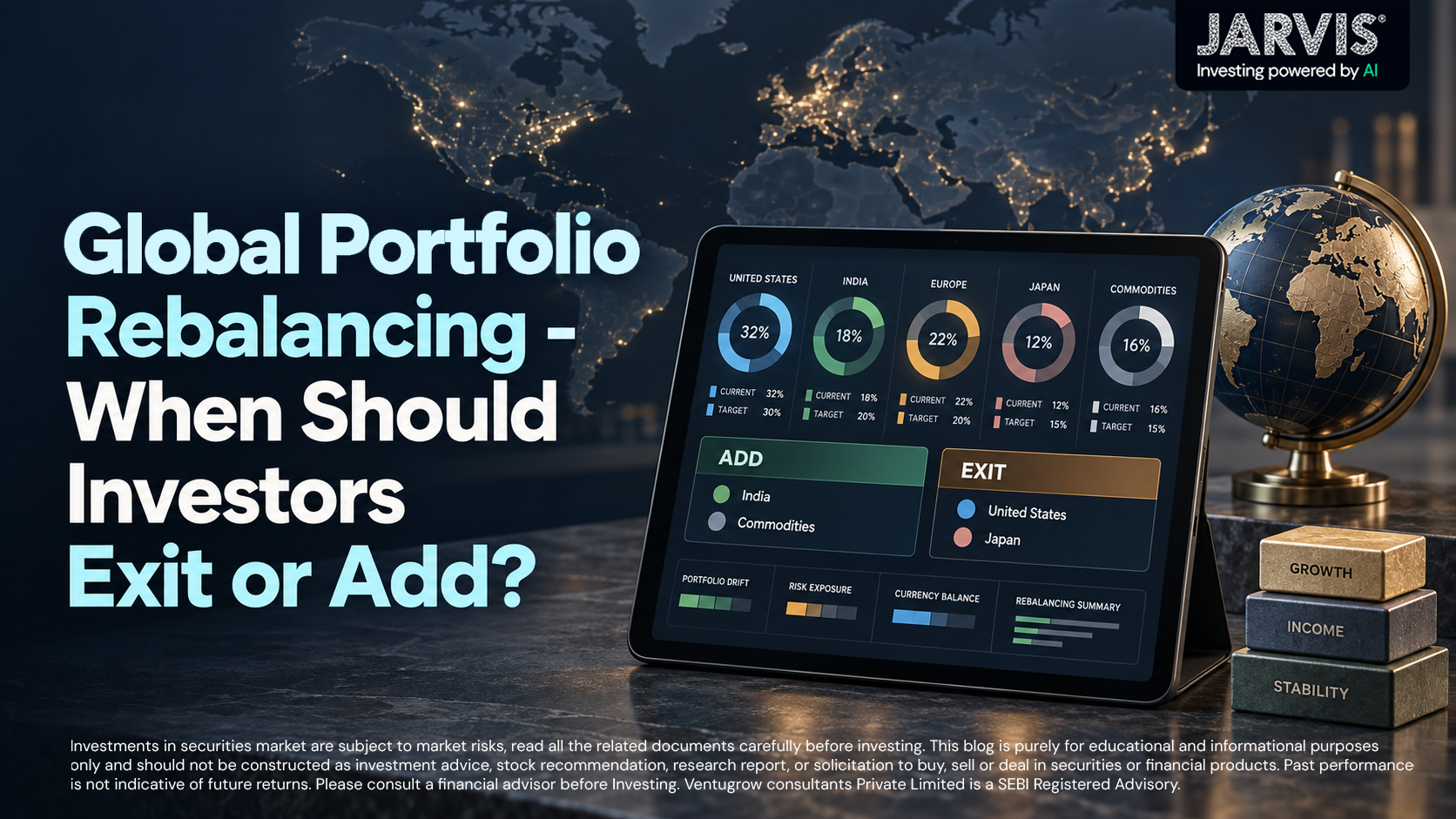
A global portfolio can change its risk profile without the investor making a single trade. A strong rally in US equities can push an investor’s international allocation from 30% to 40%.
A correction in emerging markets can cut another allocation by 20%. Currency movements can further change returns for an Indian investor. That is why global portfolio rebalancing is less about predicting markets and more about knowing when your portfolio has moved too far away from its intended structure.
Rebalancing Is About Risk, Not Timing the Market
Suppose an investor has ₹1 crore, with ₹30 lakh allocated to global equities. If global markets rally 25% while the rest of the portfolio remains unchanged, that ₹30 lakh becomes ₹37.5 lakh. The global allocation has now increased materially without the investor consciously taking additional exposure. This is portfolio drift.
Vanguard describes portfolio rebalancing as restoring a portfolio when its asset allocation moves away from the investor’s intended mix. Its research also notes that many investors use a threshold of around 5 – 10 percentage points to trigger a review.
The important point – rebalancing does not necessarily mean selling everything that has performed well. It means bringing risk back toward the level the investor originally intended.
When Should Investors Add?
A falling market is not automatically a buying opportunity. Before adding to global equities, investors should examine three things: valuation, fundamentals and portfolio allocation. Imagine a global equity allocation falls from ₹30 lakh to ₹24 lakh after a 20% decline.
If the original investment thesis remains intact, valuations have become more reasonable and the allocation is now materially below its target, adding capital may be worth evaluating.
But if the decline reflects deteriorating earnings, structural problems or excessive leverage, simply buying because prices are lower can increase portfolio risk.
This distinction is particularly important when using AI for investment or AI based portfolio management India. Technology can process large amounts of fundamental, market, macroeconomic and sentiment data, but the objective should be better decision-making, not blindly buying every correction.
When Should Investors Reduce or Exit?
The harder question is often knowing when to sell. A profitable position should not automatically be exited simply because it has generated a strong return.
Consider an investor who buys ₹10 lakh of global equities and the position grows to ₹16 lakh. A 60% gain sounds attractive, but if that position now represents 45% of the entire portfolio instead of the intended 30%, the investor’s risk profile has changed.
Reducing part of the position can therefore be a risk-management decision, rather than a prediction that markets will fall. Investors should consider reducing exposure when:
- An allocation becomes significantly overweight.
- The original investment thesis has weakened.
- Valuations become difficult to justify against expected earnings.
- Geographic or sector concentration becomes excessive.
- Currency exposure becomes disproportionate.
- A more attractive risk-adjusted opportunity emerges elsewhere.
Don’t Sell Every Time Markets Get Volatile
Global markets can react sharply to interest-rate decisions, geopolitical developments, inflation data and changes in liquidity. That does not mean every correction requires an exit.
For example, a 10% fall in an international equity allocation caused by temporary market sentiment is very different from a 10% fall accompanied by a structural deterioration in earnings. Investors need to separate price volatility from fundamental change.
This is particularly relevant for long term portfolios. International diversification can reduce dependence on a single domestic market because different markets do not always move together. However, international investing also introduces currency and geopolitical risks.
A 5% Rule Can Create Discipline
One practical approach is threshold-based rebalancing. Suppose an investor targets 30% global equities and sets a 5-percentage-point tolerance band. The portfolio can be reviewed when global equities move above 35% or below 25%.
Another approach is calendar-based rebalancing reviewing the portfolio every six or twelve months. Vanguard notes that annual rebalancing can be an effective approach for many investors, while also highlighting threshold-based and combined calendar-and-threshold approaches.
Rebalancing Should Consider Currency Too
For Indian investors, global portfolio returns are not determined only by the foreign asset. They are also affected by exchange rates. If a US investment rises 12% but the rupee strengthens against the dollar, the return measured in INR will be lower than 12%. If the rupee weakens, currency movement can work in the opposite direction.
Therefore, an investor with ₹20 lakh in overseas assets should monitor both the investment exposure and the currency exposure. This becomes increasingly important as international allocation grows.
AI Can Make Rebalancing More Adaptive
Traditional portfolio reviews may happen once or twice a year. Markets, however, change every day. Modern stock market analysis AI and portfolio intelligence systems can continuously monitor factors such as volatility, momentum, sector concentration, macroeconomic developments and portfolio-level risk.
Jarvis Invest Intelligence describes analysing company fundamentals, market data, economic indicators, news, sentiment and global market trends, while continuously evaluating how signals perform under changing market conditions.
Jarvis Atlas also combines global equities, Indian equities and commodities, with its research engine tracking global markets, macro trends, sector rotations, sentiment and technical structures. The advantage is not necessarily more trading. It is having a more systematic way to identify when the portfolio’s risk-reward structure is changing.

Final Thoughts
Global portfolio rebalancing should not be treated as a prediction game. Add when an asset class has fallen below its intended allocation and the underlying fundamentals still support the investment case. Reduce when concentration, valuation or fundamental deterioration changes the risk-reward equation.
The best rebalancing framework is one that replaces emotional reactions with predefined thresholds, continuous monitoring and disciplined portfolio management. Because in global investing, the biggest risk is not always choosing the wrong asset. Sometimes, it is simply allowing one asset to become too important.


