
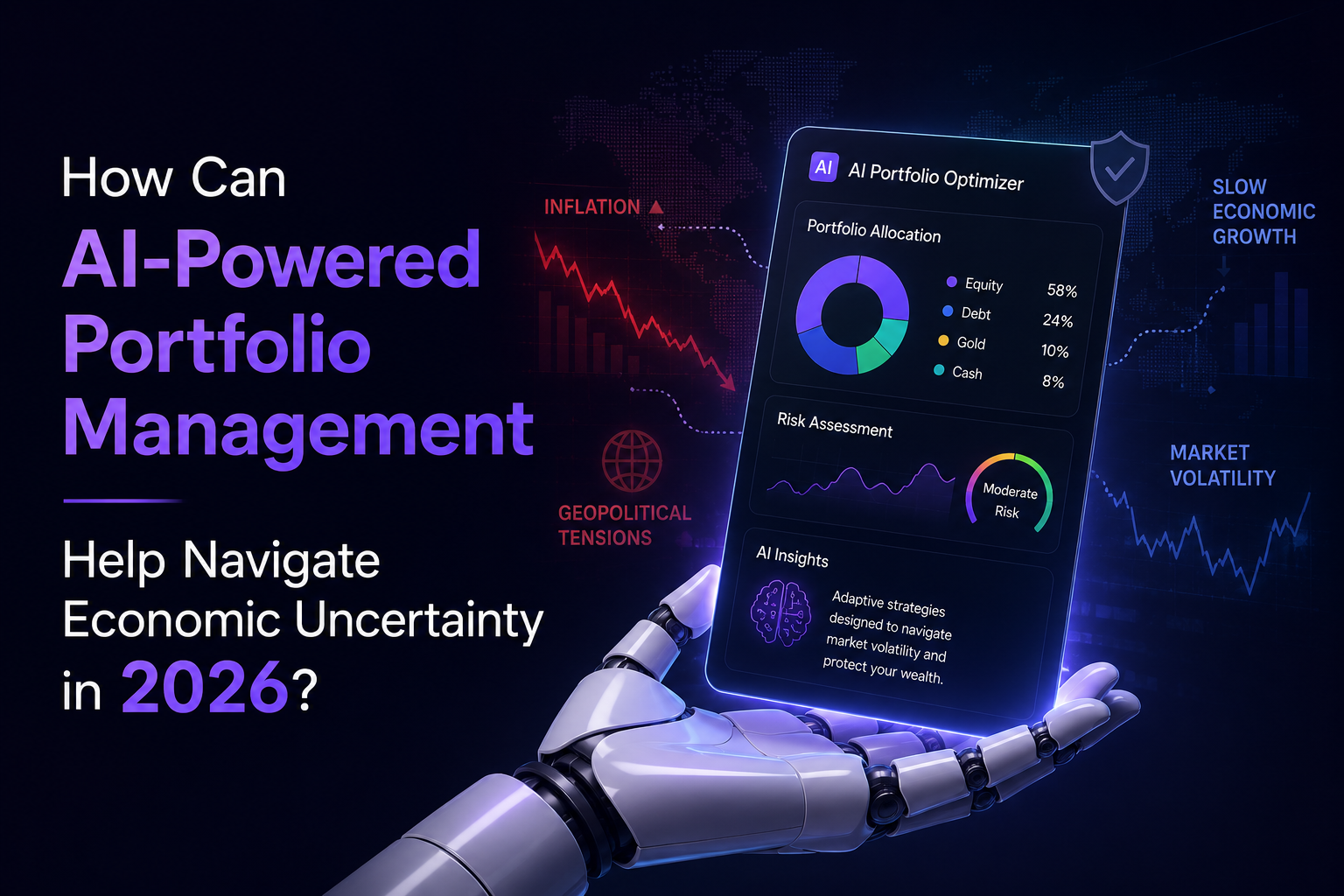
The global economy in mid-2026 is navigating one of the most complex macro environments in recent memory. The Middle East dispute has introduced a fresh energy supply volatility into an already highly inflationary world,while slowing global growth, shifting interest rate expectations, and geopolitical uncertainty continue to reshape financial markets. In such an environment, effective portfolio management has become more important than ever for investors seeking to protect capital and achieve long term financial goals.
The IMF’s April 2026 World Economic Outlook predicts global growth slowing down to 3.1% in 2026. In short, it is a meaningful decline from earlier projections.
OECD data points out that global growth is being slowed down significantly. Plus, with inflation pressures, it is expected to stay the same well beyond initial projections. The US faces low inflation pressure. While India is structurally durable, it is not resistant to global infection.
Against this background, the average investor is caught in a contradiction:
- Markets enforce a lack of action,
- Yet impulsive decisions during volatility are portfolio-destroying factors.
This is exactly where AI-powered portfolio management enters. So, you just need to understand this blog. Here, we will elaborate on what it actually means and how it can help to navigate uncertainty.
What Is AI-Powered Portfolio Management, and How Does It Actually Work?
AI-powered portfolio management relies on predictive analytics, machine learning algorithms, and continuous real-time data. It processes all this information to structure, analyze, update, and protect an investment portfolio. Moreover, it adapts to your risk profile, financial goals, and time horizon.
The difference between this and a traditional human advisor is architectural.
A human fund manager is skilled, analyzes data sequentially, operates within logical biases, and applies broad group-level thinking. On the other hand, an AI system runs continuously 24/7 across millions of data points concurrently and adapts in real time when market signals fluctuate.
Let’s see how this AI-powered portfolio management actually works.
- Risk profiling. A well-built AI system looks at your actual financial situation, such as your liquidity needs, income stability, tax position, investment horizon, and behavioral patterns, so that it can construct a risk profile that is genuinely unique to you.
- Multi-factor stock selection and portfolio construction. AI collects fundamental data, global macro indicators, sector rotation signals, corporate governance metrics, and earnings trajectory across the entire investable universe. It then selects a set of stocks that collectively align with your risk-return objective to behave rationally under different market conditions.
- Continuous monitoring and real-time alerts. AI monitors all signals continuously, 24/7, and alerts you when a holding crosses a safety threshold. This is the single most powerful risk management capability AI brings to the individual investor.
- Emotion-free, rules-based exit discipline. When a stock breaches its fundamental or technical exit criteria, the system signals a sell because the data says it is time to exit.
- Automated rebalancing for portfolio integrity. AI rebalances the portfolio dynamically to maintain the intended allocation, ensuring your portfolio continues to match your goals.
- Tax-optimized decision-making. AI can optimize the timing of exits to minimize tax drag on your compounding.
Why AI-Powered Portfolio Management Offers an Edge During Economic Uncertainty?
The features above are valuable in any environment. But mid-2026 specifically amplifies the advantages of AI-driven investing for three structural reasons.
- Speed of information processing. AI systems tracking actual macro data, commodity price indicators, and industry-wide flows can modify a portfolio before the retail investor has even read the news headline.
- Behavioral protection. Volatile markets generate panic selling at the bottom and happy buying at the top. The NASSCOM analysis of AI-driven portfolio management notes that by eliminating emotional noise, AI creates a system where investment decisions are governed by logic and pre-defined rules.
- Ability to handle complexity at scale. Inflation, interest rates, geopolitical risk, AI investment cycles, currency movements, sectoral policy shifts, and corporate earnings are all moving simultaneously and are interrelated in irregular ways. The Vanguard 2026 economic outlook notes that AI adoption is accelerating, and today’s AI leaders may look very different from tomorrow’s winners. In short, it means the universe of investment opportunities is genuinely dynamic.
- Democratization of institutional-grade analysis. As the NASSCOM analysis of AI-driven investing highlights, AI is narrowing the gap between institutional and individual wealth strategies, making tools once accessible only to the very wealthy available to any serious investor.
How Should an Investor Actually Use AI Portfolio Management in This Environment?
Understanding the technology is one thing. Using it correctly is another. Here is a practical framework.
Step 1: Define your goal before the algorithm does anything
AI is a powerful tool, but it optimizes toward an objective. If your objective is unclear, the output will reflect that confusion. You need to be very specific, such as:
- Wealth creation for retirement in 15 years,
- Capital protection for a child’s education in 7 years,
- Generating a secondary income stream in 5 years.
The more precise your goal, the more targeted the AI’s output.
Step 2: Trust the risk profile process
When an AI system asks about expenses, income, investment horizon, liabilities, and behavioral preferences, answer honestly. The quality of your risk profile directly determines the quality of your portfolio. An aggressive portfolio built on an inaccurate profile does not just underperform. However, it can cause genuine financial harm when markets correct.
Step 3: Resist the desire to bypass during volatility
This is where most investors lose the benefit of AI management. When markets fall sharply, the human instinct is to step in to “take control.” In a well-designed AI system, that action typically destroys value. The rules have already accounted for volatility. Overriding them reintroduces the emotional bias the system was designed to eliminate.
Step 4: Use the alerts as signals
When your AI system sends you a buy, hold, or sell alert, treat it with the same seriousness as someone who has been watching your portfolio every second and has processed every relevant data point. Read the context, understand the signal, and act accordingly.
Step 5: Review periodically, not constantly
AI portfolio management is designed to handle daily monitoring so you do not have to. Checking your portfolio hourly during a volatile market is the best rule for anxiety-driven decision-making. Trust the system’s continuous monitoring and reserve your active attention for scheduled quarterly reviews, where you assess whether your goals or financial situation have changed.
Why This Matters More for Indian Investors Right Now
India occupies a unique position in mid-2026. On one hand, trade deal progress with the US and UK, expanding digital infrastructure, a growing equity culture (with over 160 million registered investors as of 2024), and AI-driven efficiency gains across industries are all tailwinds. Meanwhile, global volatility hit emerging markets first and hardest through currency depreciation, capital movements, and imported inflation.
Deloitte’s 2026 global economic outlook notes that while India is still one of the few exceptions in global growth, risks from geopolitical tensions, energy shocks, and supply chain disruptions remain real. For Indian retail investors, this means the stakes of poor portfolio management are higher than in more developed, liquid markets.
An AI-powered system can monitor global macro signals and respond to currency risk. In addition, it adjusts sector allocations in response to energy price shocks and maintains discipline around exit rules, which are not just a performance tool for Indian investors but also a risk management necessity.
Concluding Words!
The economic conditions of mid-2026 are not a short-term problem that will fix itself in a quarter. Geopolitical dispersion, rising inflation, AI-driven market concentration, and the increasing pace of information flow are structural realities that are reshaping investing permanently.
The question is not whether AI will play a role in portfolio management; it already does, at the institutional level, at scale. The question is whether individual investors will access this capability before the next market shock or after it.
For investors, starting investments of ₹25 lakhs and above, professionally managed investment solutions can help bring greater structure, diversification, and long-term discipline to wealth creation. Some investors may prefer dedicated exposure to Indian equities through portfolio management strategies, while others may seek global opportunities investing across Indian markets, global equities, and commodities to build a more diversified portfolio.
In a market where AI expectations can fluctuate market sentiment in a news cycle and where emotional investing quietly compounds losses, Jarvis Invest is the best solution. Whether through Jarvis Prime for investors focused on Indian markets or Jarvis Atlas for investors seeking opportunities across 10+ global markets, including India and commodities, the objective remains the same: delivering disciplined, data-driven investing that never panics, never holds on out of hope, and never loses sight of your financial goals.
Start your AI-powered portfolio journey with Jarvis Invest today.


